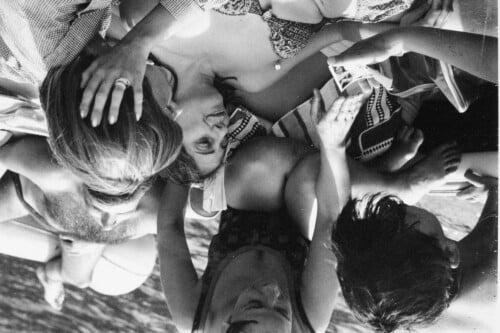
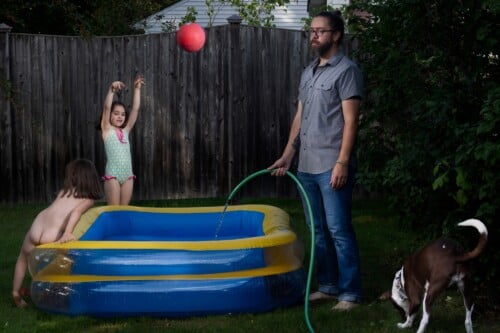
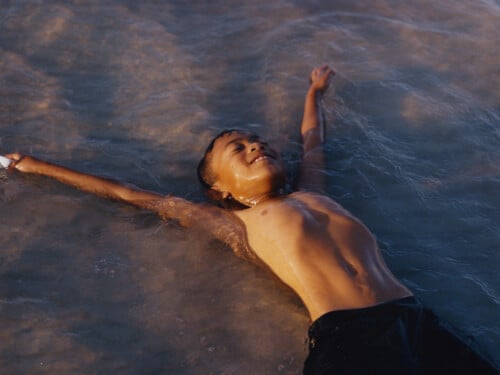
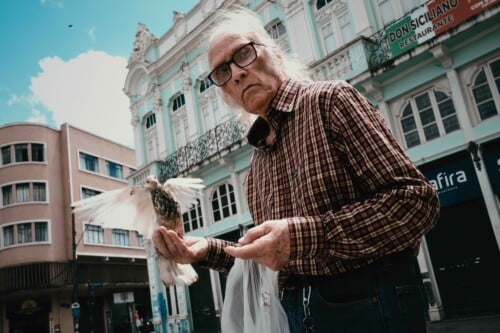
Raised between two worlds, Sonja Stich’s children become the conduit for a gaze that reflects more than it observes. In her latest photographic project, the German photographer recounts two summers spent in Morocco with her family, focusing on how her two teenage sons move through a space that is at once familiar and distant to her.


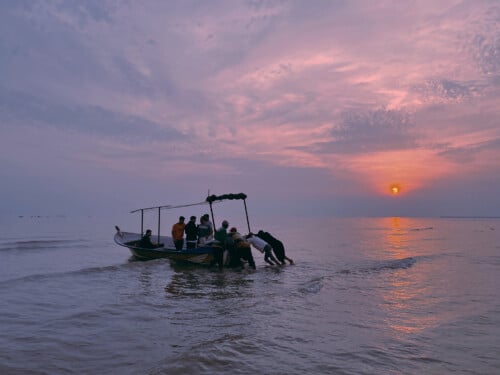
The experience of being the mother of two boys becomes, for Stich, a lens through which to explore differences in gender, culture, and ways of being in the world. Where she, as a child, tried to contain herself, her sons expand, occupying public space with ease; they blend with Moroccan peers in a physicality made of strength, play, and complicity. “I’m fascinated by how confidently they move, how they take their place in the world,” she tells us. Through the camera, Stich observes the spontaneity with which the boys weave themselves into the living fabric of Moroccan streets, between barefoot basketball games and banter in the markets.

But her attention is not only on the vitality of bodies. In her images there is a continual dialogue between strength and delicacy, between the masculine gesture and a care for beauty. Stich notices in her sons — and in Moroccan men — a sensitivity that reveals itself in the way food is prepared, craft objects are made, and things are presented.

It is this tension between care and carelessness, between aesthetics and disorder, that becomes the visual heart of the project: a plastic bag gleaming in the evening light, a bricked-up window that looks like an abstract painting, a broken sink conversing with the sun’s reflection on the wall.

Beauty, Stich seems to show us with these shots, arises precisely from that lightness, from a precarious balance between chance and intention. Her way of photographing proves it as well. Using analog film, without autofocus and sometimes with already-exposed rolls, Stich progressively lets go of control, relinquishing the precision of lines and colors to make room for atmosphere — for the memory of an emotion rather than its exact representation.

In this process, photography becomes a practice of trust — in the medium, in chance, and in what slips beyond our grasp. Like her sons and the men on those streets, Stich too learns to “let go,” to reckon with imperfection.

The result is an intimate, suspended body of work that speaks to the relationship between family and landscape, between identity and belonging. Living between Germany and Spain, Stich continues to move along this fine border between observing and participating, building a photographic language that, rather than documenting, reflects the complexity of living together.