From “Rear Window” to “The Platform”, here are the 10 best movies according to Collater.al set in just one place.
The Exterminating Angel, Louis Buñuel
Let’s start with a film set entirely in a room for the simple reason that the director decided so. In this film, we enter the surreal world of Louis Buñuel with all our bodies. At the center of the film is criticism of the bourgeoisie accompanied by a psychological analysis of man and society.
A bourgeois family invites friends over for dinner, we’re in the living room and everything points to a normal evening, until strange things start to happen, from the servants who left earlier to the sheep that go unnoticed inside the building. Nevertheless, people do not leave the room, even ending up spending the night together in the living room.
No one barricades the exits, the 3 doors of the room always remain open and yet people can’t get out, they are stuck. Soon you will understand that in addition to being physically trapped in the room they are also trapped in their social positions, in their roles as bourgeois. Unable to move, the characters simply follow the flow of events.
Rear Window, Alfred Hitchcock
We continue with a timeless film and a director, Alfred Hitchcock, who has made the maniacal care of sets, spaces and places his signature.
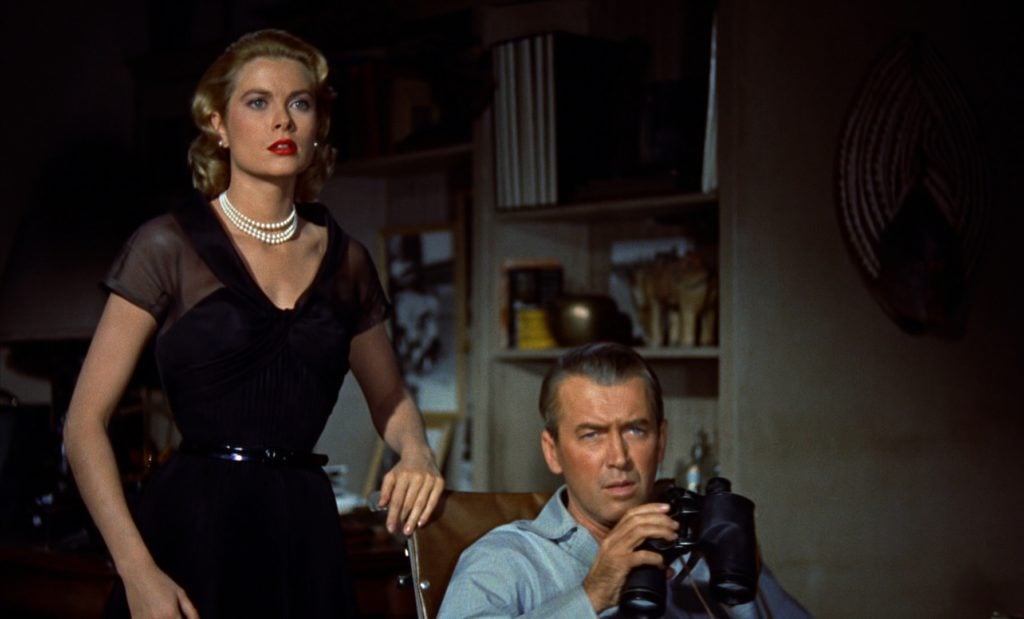
Jeff (James Stewart), a photojournalist, is forced home in a wheelchair after breaking his leg. Looking for a way to spend his time, he stands in front of the window and starts looking at what people in the neighborhood are doing, until one evening, after hearing screams, he is convinced that a crime has occurred in the house across the street.
Jeff’s house turns into his whole world, he can see everything that goes on outside but can’t go outside, and with him, us. Following his theories and looking with his eyes through wise use of subjective, we too are locked in his apartment and we too can only wait for his beautiful girlfriend (Grace Kelly), the nurse, the police inspector and to heal.
Breakfast Club, John Hughes
Let’s move on to a cult of the 1980s that marked the history of an entire film genre, that of adolescent films set in a school context. The film written and directed by John Hughes is entirely set in a high school library where 5 boys are forced to spend an afternoon in detention. The task entrusted to him is one, to write an essay entitled “Who am I?”.
The library, at the beginning a place from which the boys can’t wait to get out, becomes the space where their true identities, their thoughts and fears, those typical of adolescents, are revealed. In Breakfast Club, the library becomes a place of transition from which the 5 kids come out with greater awareness, just as the school should be in everyone’s life.
Shining, Stanley Kubrick
A timeless cinematographic masterpiece, although it has been watched and watched dozens of times it is still difficult to say who is the absolute protagonist of Kubrick’s film, Jack Nicholson or the Overlook Hotel. Never before, as in this film, based on Stephen King’s book of the same name, is the place functional to the plot.
From the exact moment that Jack Torrance accepts the job of guardian of the hotel and moves in with his family, we too begin to live in the spacious rooms and long corridors of the Overlook and, together with the Torrence family, we discover it.
Every room hides something and has a story to tell, and it is precise because of this narrative function that the one for The Shining was the largest set ever built inside the EMI Elstree Studios, both because Kubrick wanted to have all the stages of all the rooms at his disposal at the same time and because the imposing facade of the hotel was rebuilt life-size. Like the plot, the interiors of the Overlook hotel welcome and intrigue us from the very beginning, and then end up scaring us just like the iconic blood-red hall bathroom.
The Hateful Eight, Quentin Tarantino
Perhaps The Hateful Eight is not the best film of Tarantino’s career, but we don’t think it’s even to be condemned. For the first time, the American director takes a leap back in history and exactly a few years after the American Civil War we find ourselves following 8 persons that due to a storm are forced to spend time in a store that can not fail to remind us of the inns of western movies.
To underline the condition of forced cohabitation of these characters who, like many many in Tarantino’s filmography, are on the edge of the absurd and at the same time creating a place functional to the plot, the set was built with only one blind spot, represented by the big pole in the middle of the scene. In this way, it was possible to show all the protagonists together, but also to create an element behind which they could hide that did not seem totally out of context.
Room, Lenny Abrahamson
Technically, this film is not entirely set in one place but is the perfect example of a contemporary production that turns a place into a real protagonist of the scene. Joy and her son Jack live locked in a room, Joy knows the world out there very well and wants at all costs to free herself and her son, while Jack, who was born in that room, knows no other place.
In this case, we have only one place that has a very different meaning for two characters: for the young mother it’s a prison, it’s a tomb, while for the child it’s her whole world.
But the more time passes, the more Jack senses that there is an outsider.
The escape will be cumbersome and will reveal that freedom also has a very different value: for Joy, it’s a return to the real world, for Jack, it’s an unprecedented shock.
During the shooting, the fact that more than half of the film was set in a place of about 10 square meters led the technicians to assemble a modular set: the ceiling, walls and floor were made of removable blocks through which the camera could pass. Thanks to this technique we were able to have a view of the room in its entirety, seen from above, below and from any side.
Carnage, Roman Polanski
A cinematic adaptation of the theatrical drama Le Dieu du Carnage by Yasmina Reza, Roman Polanski‘s film manages in just under 80 minutes to show human nature in all its wickedness and meanness. The film begins in a park, where two children fight until one throws a thrashing at the other. The rest of the film sees the children’s parents trying to resolve the situation, first in a civilized way and then without any ethical or moral limits. The house of one of the two couples becomes from a place chosen for peace to a battlefield, a battle fought with words that, as time passes, become sharper and sharper.
The four characters are fought and so are we, they want to resolve the situation, but also to get the better of the others, we sometimes want to escape, but we remain inexplicably hypnotized, curious to get to the end.
Perfetti sconosciuti, Paolo Genovese
Critical and box office success, this film by Paolo Genovese is one of the best Italian productions of recent years. Seven friends, played by seven exceptional actors (Kasia Smutniak, Marco Giallini, Edoardo Leo, Alba Rochwacher, Valerio Mastrandrea, Anna Foglietta and Giuseppe Battiston), organize a dinner at home when, between one thing and another, one of them proposes to put all the mobile phones on the table and share with all the calls and messages that will arrive during the evening.
The idea that at first seems innocent and even quite ridiculous will end up revealing all the secrets of friends. Seven people convinced that they really know each other, convinced that they are bound by deep trust, find themselves to be perfect strangers. No one can criticise anyone else, because everyone has hidden something, but no one has the courage to leave. During quarrels and screams, the house looks like a prison, but in quiet moments the house becomes again the perfect place to spend an evening with friends, with laughter and good food.
The Place, Paolo Genovese
Italian film always written and directed by Paolo Genovese and entirely set in a bar called The Place. The undisputed protagonist of this film is Valerio Mastrandrea who plays an ambiguous figure, about whom we know very little. It seems that he has transformed the bar into his private studio, where he receives several people, all different but who all have something in common: they all have a request to make that only he can “fulfill”. In order to get what they want these people have to carry out tasks, difficult but never impossible, it will be up to them to choose whether or not to do it.
We discover what happens to these people, to his customers, only through their stories, which always take place at the same table in the bar, a place that becomes a sort of purgatory. The Place talks about good and evil, it talks about how cruel and evil life can be, but also about how in everything there is a pinch of hope and the place where it is set becomes unbearable, like those moments in life when we are in trouble when we think we will be stuck forever.
The Platform, Galder Gaztelu-Urrutia
A Spanish film which, after having been presented at several international festivals and having been quite successful with critics, has been bought by Netflix and made available on the platform since last March. The story follows the events of Goreng and is set totally inside a very particular prison that, from floor zero, develops underground, going down to meters and meters of depth. The prison is divided into numbered floors that house two inmates and have an opening in the ceiling and floor through which a platform filled with prisoners’ favorite foods passes once a day. The platform always starts from floor zero and as it descends it is looted by prisoners. This system allows inmates on the first floor to have all the food available and almost all the rest never get anything. Then, every month, the inmates changed the floor following a purely random system. However, if you find yourself in the close-up after a month of hunger, you never think of leaving anything to eat in the lower cells. The Platform lends itself to various readings and interpretations that lead to reflection on the systems on which society is based and the inequalities created by capitalism and a disproportionate division of wealth.