A former church on the island of Giudecca, an exhibition about the ocean, one of the most important artistic showcases in the world. As Above, So Below is the collateral event at the 61st Venice Biennale that until June 8th transforms a sacred space into a place of ecological reflection. The exhibition was made possible through the collaboration between One Ocean Foundation and ZEITGEIST19, with a curatorial team formed by Elizabeth Zhivkova and Farah Piriye Coene.
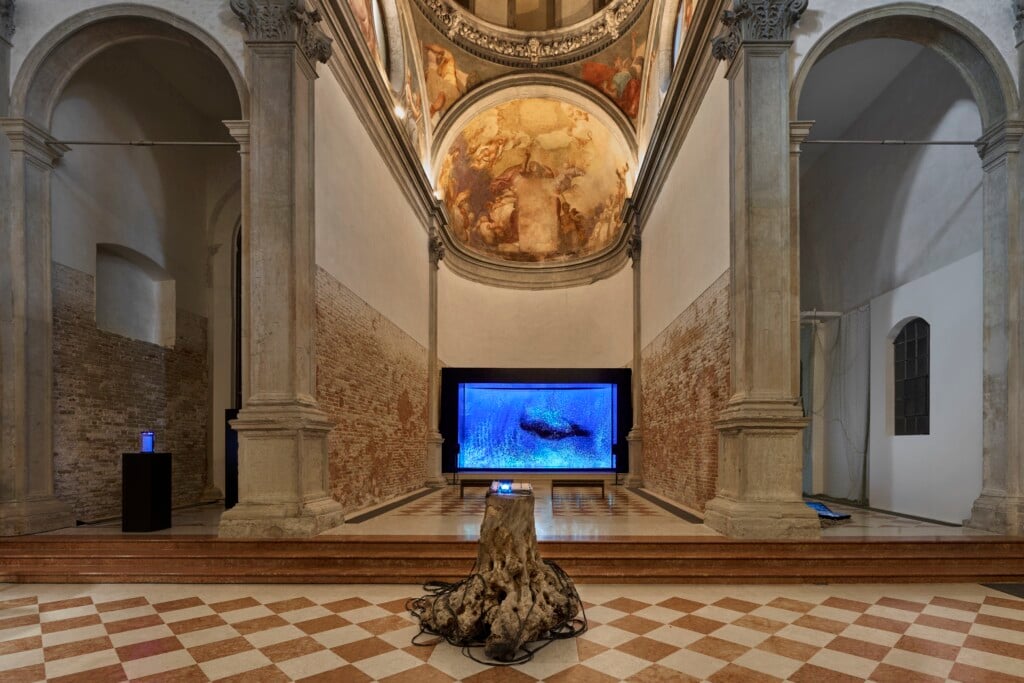
The title draws on the hermetic principle of correspondence – as above, so below – to explore the interdependence between atmosphere and abyss, human and non-human. The ocean is not presented as a distant backdrop, but as a living system capable of holding the planet’s deep memory and reflecting its imbalances. The sacred architecture of the former church, now home to Fabbrica H3, becomes an immersive environment where sound, light and computational systems dialogue with centuries of history.
Marshmallow Laser Feast: listening to whales
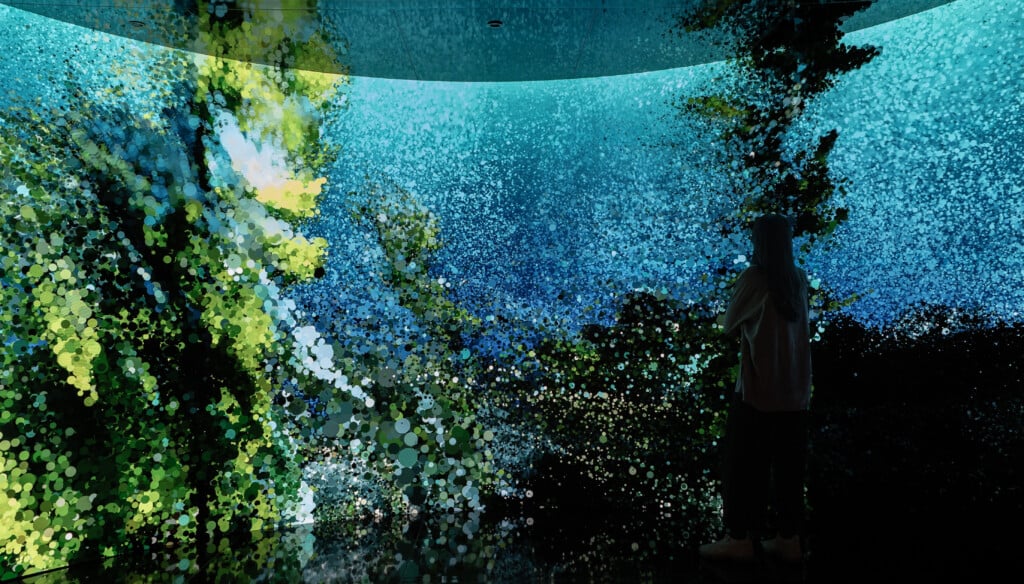
Among the works on show, Seeing Echoes in the Mind of the Whale by the collective Marshmallow Laser Feast is perhaps the one that best embodies the spirit of the exhibition. It is a 17-minute immersive audiovisual installation developed from cetacean vocalizations and bioacoustic research. The audience is guided into the sensory world of three species — the bottlenose dolphin, the humpback whale and the sperm whale — discovering how these animals perceive their environment through sound, travel immense distances and communicate in ways that exceed human sensory limits.
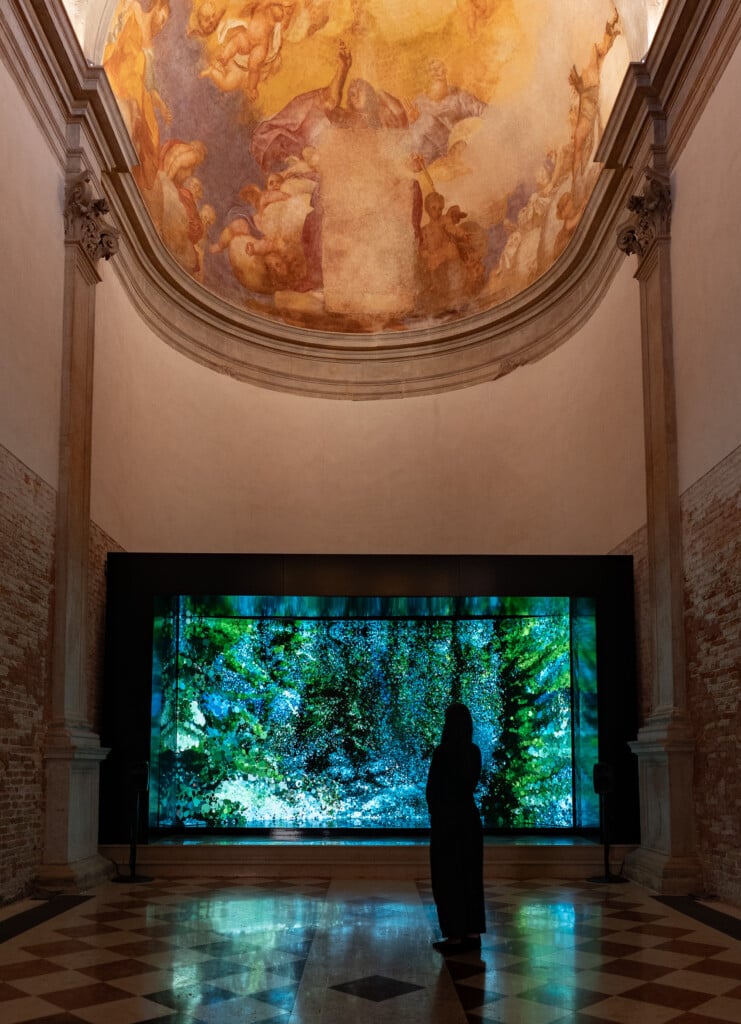
The work is installed directly beneath the fresco The Assumption of the Virgin (1672) by Girolamo Pellegrini — a deliberate choice that transforms the altarpiece into a tribute to whales, and the church space into a place of ecological contemplation. Commissioned by Disseny Hub Barcelona and Fundación Telefónica, the installation finds in Venice an ideal context to amplify its meaning.
A requiem for the Caspian Sea
Requiem for the Caspian by Suad Gara is a documentary short film, co-produced by ZEITGEIST19, that observes a retreating coastline and the lives suspended around its disappearance. On the remote island of Pirallahi, off the coast of Baku, the inhabitants of an ancient fishing village wait for the return of a sea that is drying up, while factories and oil platforms advance on what was once a vibrant ecosystem.
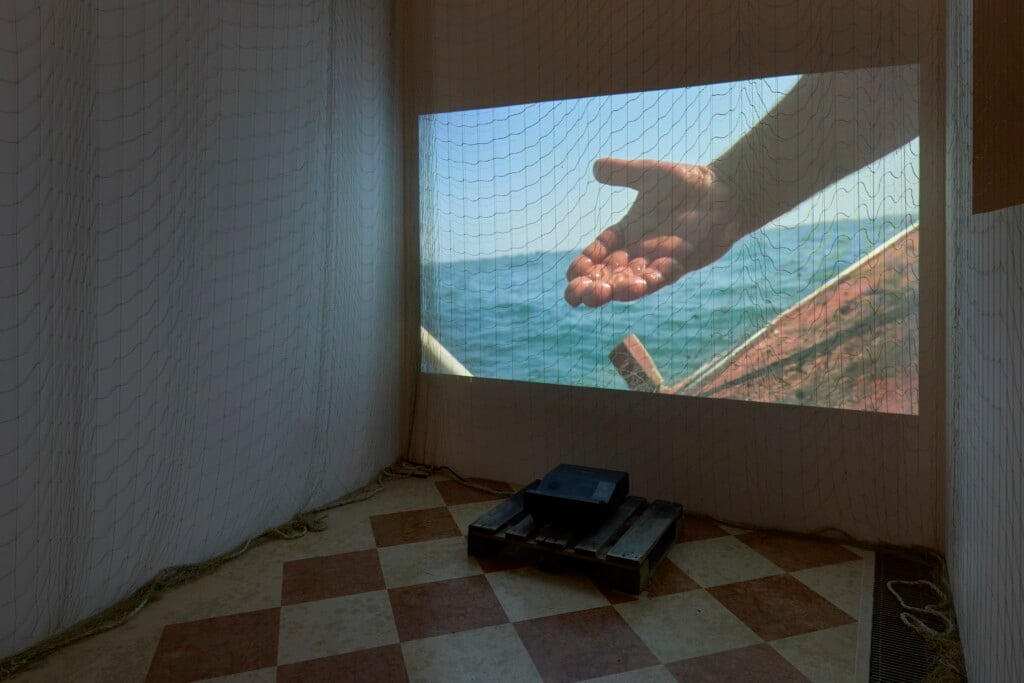
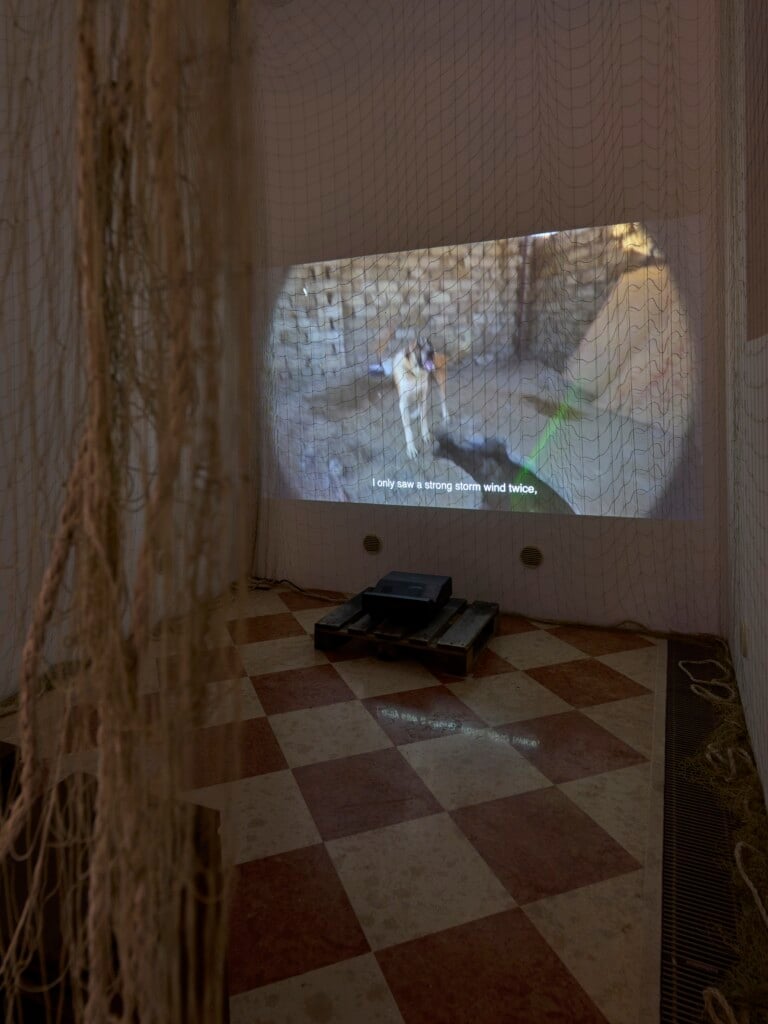
The film reads this disappearance not only as environmental collapse, but as a form of cultural colonization: a territory transformed by extractive economies, where landscape, narrative and memory are occupied and drained of meaning. Screened in dialogue with Almagul Menlibayeva‘s multimedia installation Water Older Than the Sun (Caspian) — a work that weaves cybertextile, AI video and real fishing nets collected along the Caspian coast — the documentary forms the foundation of a two-voiced narrative: one direct, the other reinterpreted through artificial intelligence.
Andrea Crespi and the myth in the hologram
With Thetis, Andrea Crespi brings to the exhibition a reflection on the boundary between nature and the imaginary. The work, created specifically for As Above, So Below, evokes the sea nymph of Greek mythology inside a primordial jellyfish suspended in a small holographic case. The abyss becomes here a symbolic as well as biological space: an archive of origins, apparitions and latent futures.
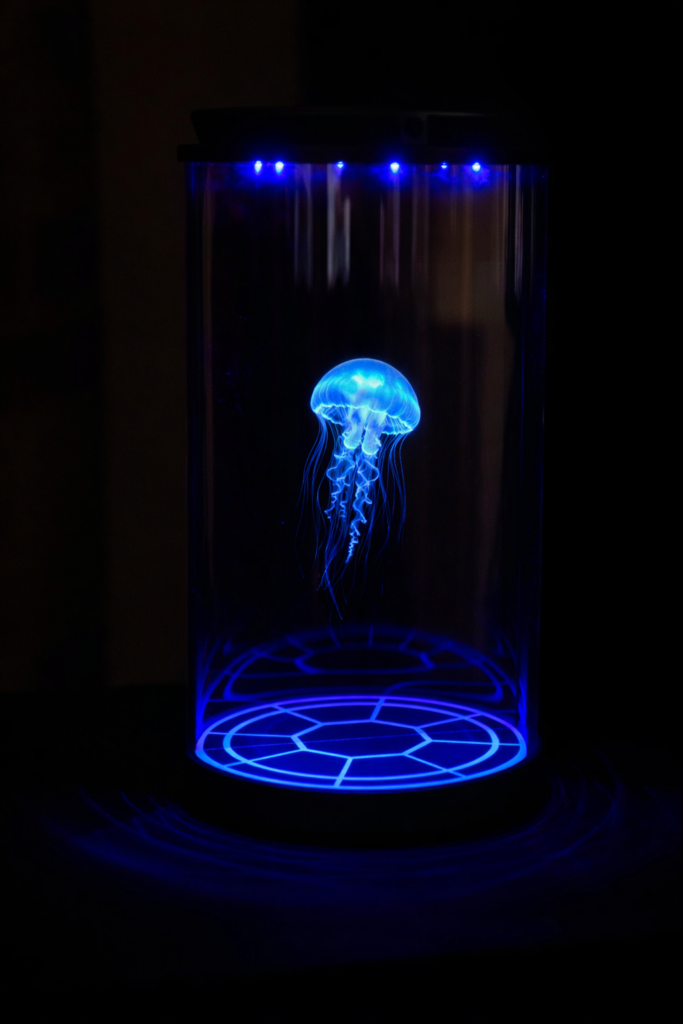
Holographic technology does not demystify the myth, but reincarnates it in a contemporary form, questioning the boundary between human and non-human, presence and projection. Placed against the frescoed interior of the former church, Thetis resonates with the classical pictorial language of the space, extending a centuries-long dialogue between art, myth and perception.
The other artists on show
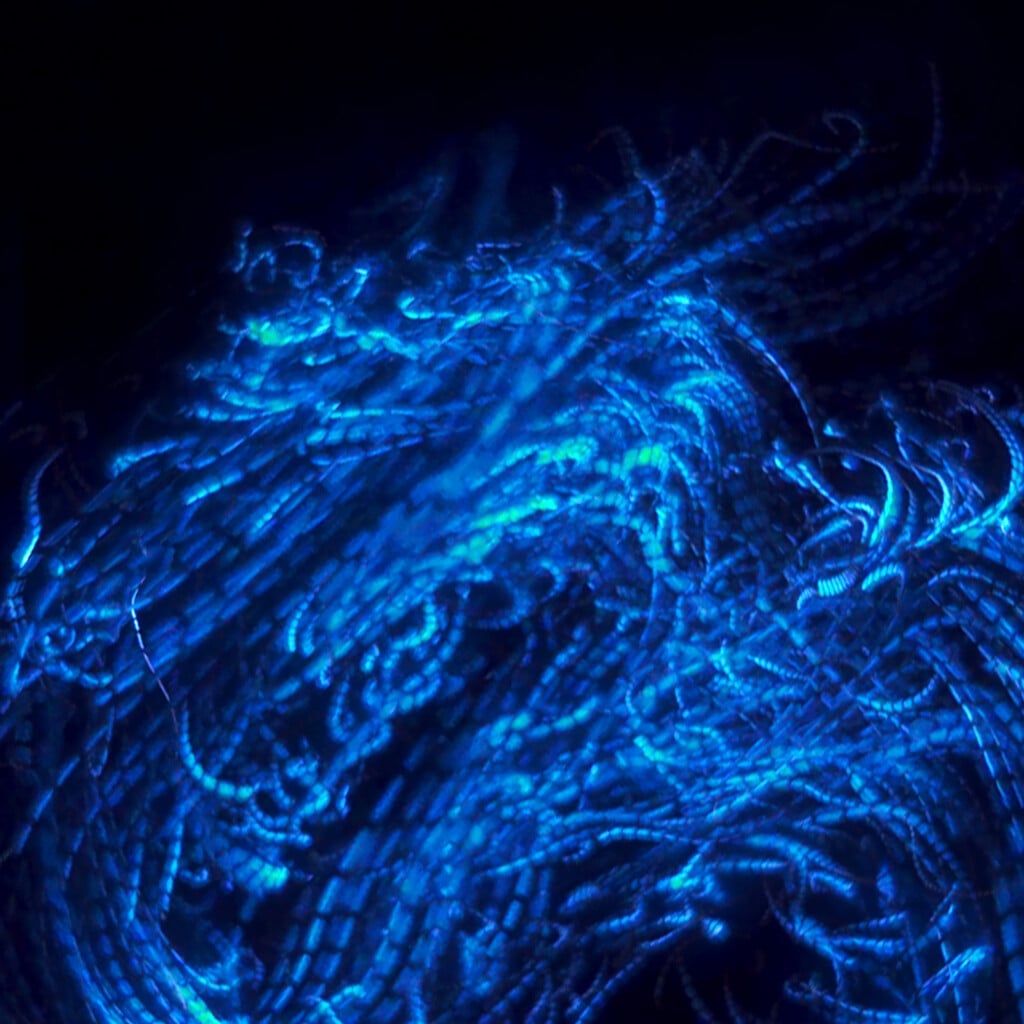
The exhibition also features four other works that expand and enrich its ecological dialogue. Yoko Shimizu presents Tides of Light: Meadows of the Abyss, a video installation born from an artist residency aboard One Ocean Foundation‘s catamaran: the delicate flashes of bioluminescent plankton become visual messages from the ocean depths, fragile indicators of the health of marine ecosystems.
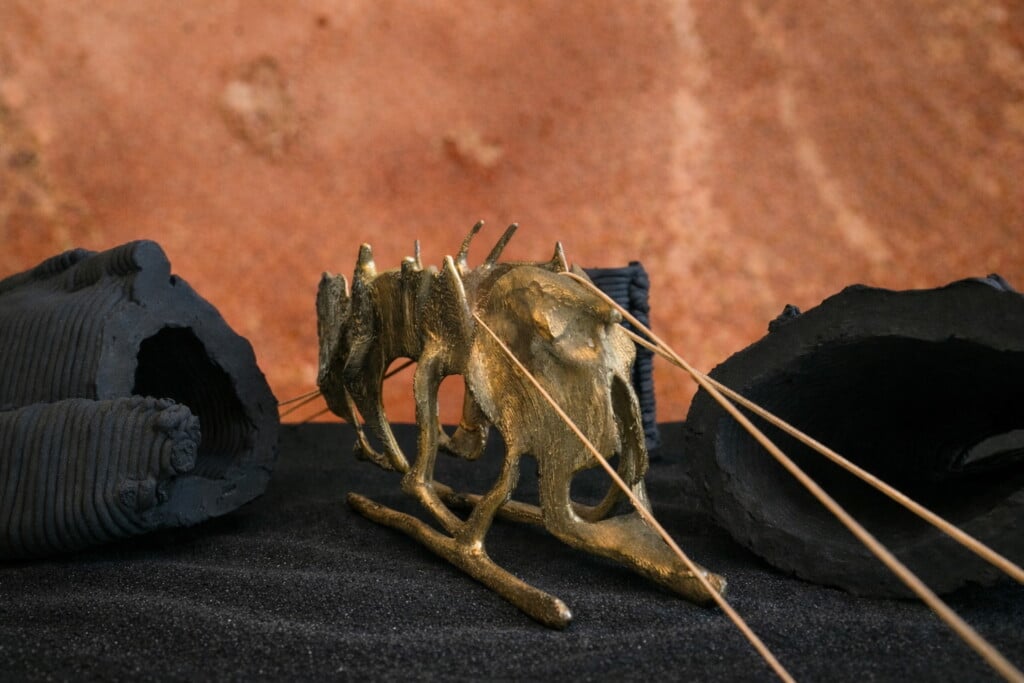
Antoine Bertin presents Fish String Theory, a sound installation built around the mysterious percussive sound produced by Mediterranean Scorpaena — long unexplained by fishermen and sailors — and the acoustic landscapes of the Venetian Lagoon. Sculptural fish forms with taut strings vibrate, activated not by human hands but by an automated listening system tuned to the sounds of the sea.
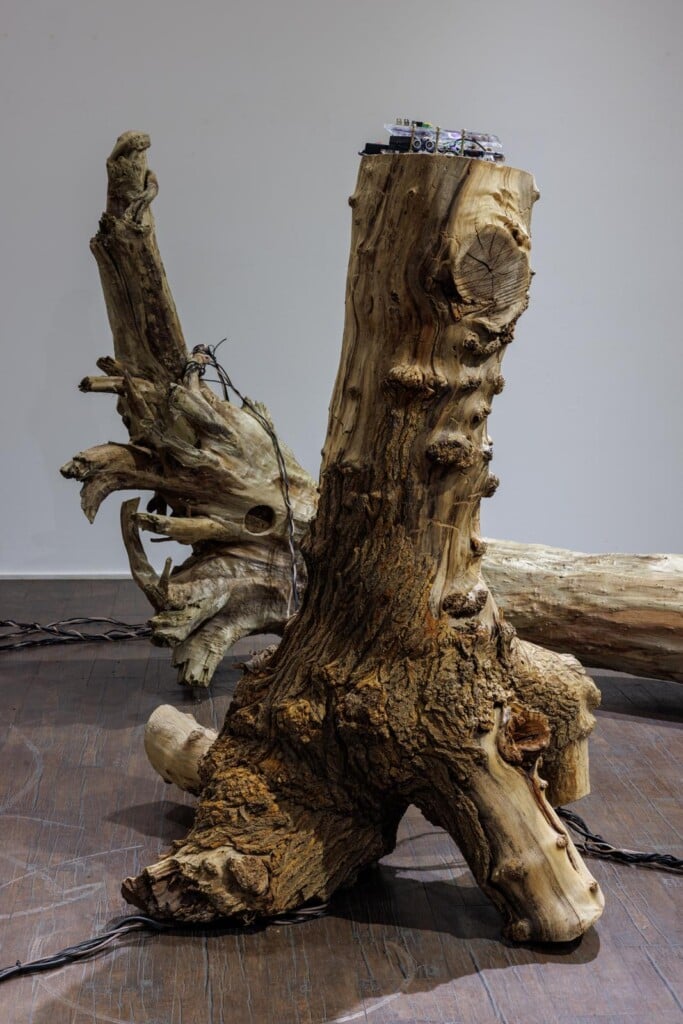
Elnara Nasirli‘s Whispering Forest transforms a recovered Italian olive tree into a sound instrument: the plant’s bioelectric signals are captured and converted into musical notes, audible only by approaching the tree in an embracing gesture. An invitation to tune into the slow rhythms of non-human life.
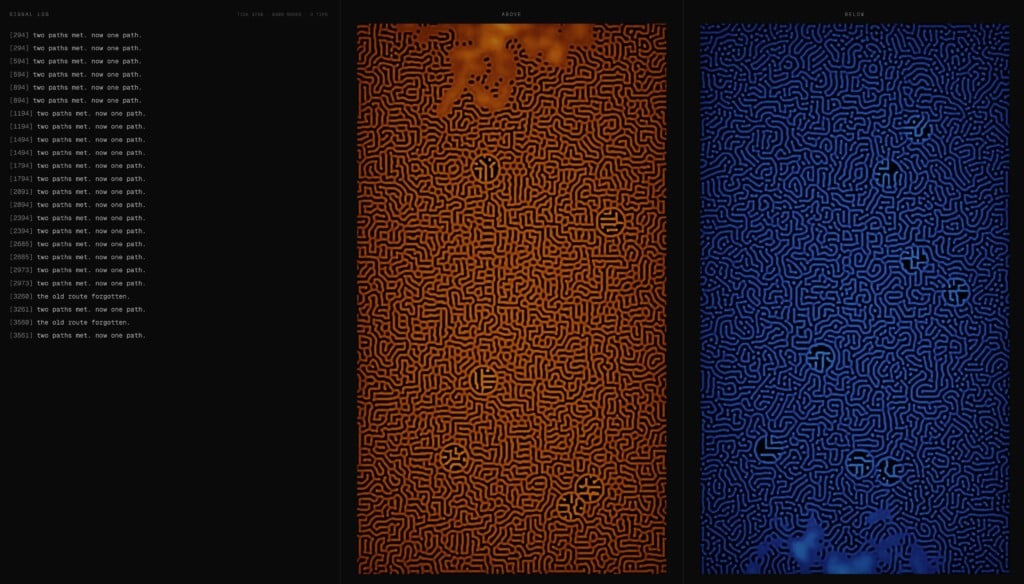
Closing the exhibition is Conversations with Nature’s Memory by Orkhan Mammadov, a generative dual-screen installation in which artificial intelligence simulates two parallel ecosystems — one above and one below the ground — guided by a mycelial growth logic, making visible the invisible underground dialogue that sustains life.
As Above, So Below extends beyond the works on display. The exhibition is conceived as a long-term research platform, accompanied by curated talks, podcasts, public programmes and artist residencies bringing together artists, filmmakers, marine scientists and researchers. Its closing date of June 8th, 2026 — World Ocean Day — is a symbolic gesture that seals the bond between curatorial vision and global environmental commitment.
One Ocean Foundation was founded in Italy in March 2018 with a clear mission: to accelerate concrete solutions for ocean protection, promoting a sustainable blue economy and spreading knowledge of marine ecosystems. Guiding its approach is the Charta Smeralda, an ethical code developed by its Scientific Committee that steers individuals and organisations towards behaviours that respect the sea. The Venice Biennale is, in this sense, a natural stage: As Above, So Below — recognised as a UN Ocean Decade Action and part of the UNESCO Blue Thread — uses art as a tool to broaden the conversation about the ocean to a global audience.
Read also: Why doesn’t objective beauty exist?