We had a chat with Lorenzo Nada aka Godblesscomputers born in Ravenna, class of ’84.
Faithful to the groove of his influences mainly related to hip hop, his sound is today a kaleidoscope of landscapes among analog synths, kalimbe, jazz guitars, scratch, samples and evanescent voices.
Today he releases his new single, “Fire In The Jungle” for La Tempesta International and distributed worldwide by AWAL.
The single develops throughout its entire duration through a continuous climax that finds its form in the second part of the song.
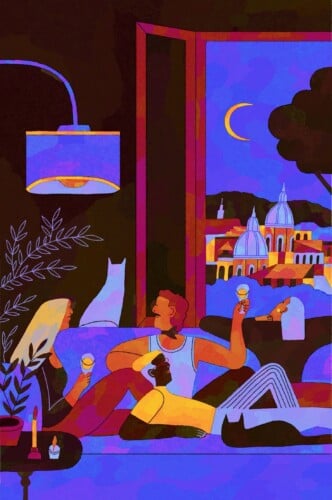
With a sound that brings together many genres, the song represents a fugue, a race through dense vegetation to an unknown destination, salvation. The guitars of Giulio Abatangelo (former collaborator and member of the band during the tour of “Solchi“) are like brushstrokes in the painting, the glue of a rhythmic and harmonic structure: sometimes they open and sometimes they darken the atmosphere, mimicking the play of light through the leaves and the bush.
Here is his new single, together with “Una playlist per sopravvivere alla noia pt.2“, created by the Italian artist exclusively for Collater.al Mag.
To begin with, since 2011 Lorenzo Nada has been “transformed” into Godblesscomputers during his Berlin residence. Why did you choose this name? And above all, how much did this experience in Germany change you?
When I left for Berlin I had just finished university and I was full of hope, eager to experience a new city. I left on my own and to keep in touch with a few friends far away I decided to start a blog. I wrote personal thoughts and stories, sometimes I shared some music and some beats I was doing in my bedroom. The name of the blog was Godblesscomputers. I think few people know that my name comes from there, from that blog that I opened a little bit for fun in 2011.
The experience in Germany, which lasted a few years, certainly changed me. But no more than other experiences I’ve had in my life. Sometimes changes happen on a daily basis, even if we are not aware of them. Every experience I think is potentially a driver for change, it depends on our individual predisposition.
Your last album was released in 2017, today the new single is out, can you do a little spoiler? What are the future projects of Godblesscomputers?
Well, I would certainly say that the new single is the prelude to a record. It’s an album that represents a further stage of my artistic and human path.
This is a question that we often ask, a little bit to “mind your own business”. Would you like to tell us at least three of the names or three records you’ve listened to that undoubtedly influenced you the most during the writing of “Fire In The Jungle”?
I’m a great listener of music before I’m a musician, so I think it’s very difficult to choose three records: there are so many things that have influenced me in recent years. Of all the records I’ve listened to the most, there are perhaps the most: Yussef Kamaal – Black Focus, Lord Echo – Harmonies, Jordan Rakei – Wallflower.

Your music is a perfect mix of hip hop dub and soul in an alternation of organic textures and impatient rhythms, silences and pathos. Over the years we’ve seen you appear silently on many albums, like Mecna, Ex-Otago and Willie Peyote. What does it mean for you to work with other artists and modify and sometimes distort their pieces? Do you feel some pressure?
I’ve collaborated with different artists over the years and each time is something different. In some cases the piece was built together, starting from my instrumental. Other times instead I found myself remixing some pieces already published and bringing them into my world. I wouldn’t say that I feel pressure to work with other artists, rather it’s the stimulus to find new languages that inspires me. Usually I prefer to collaborate with artists with whom I already have a personal relationship, so it’s easier to get to work.
Dj, beat maker, producer and artist, yours is a respectable resume, but what do you think about the Italian electronic scene today? In Italy you’re very attached to lyrics, so only instrumental electronic music will always have a smaller audience, but do you think that in the last years, thanks also to some artists, things have changed a bit?
I don’t know if it makes sense to talk about the Italian electronic scene. There are many excellent Italian artists who make electronic music, artists that I esteem a lot but with very different musical references and backgrounds. If some years ago there was interest and willingness on the part of many journalists and insiders to highlight the existence of a scene, now I would say that the differences between the various artists have increased. I certainly see this as a positive aspect: the desire not to homologate and courageously find a language of their own is what every artist should aspire to. As far as the numbers of the electronic/instrumental music audience are concerned, it’s true, but this is not only true for Italy. I’d say that it’s a rule that transversally applies a bit everywhere. The instrumental electronic music, maybe the most sophisticated and sophisticated one, will always be something that needs more effort in the audience’s listening than pop music.