In the world of advertising, Christmas has always been a crowded battleground. It’s the time when brands compete for people’s nostalgia and attention with commercials that are increasingly cinematic, emotional, and instantly recognizable. Among them all, Coca-Cola remains the undisputed queen: for nearly thirty years, its red trucks have become a symbol of the holiday season itself, a visual ritual that marks the start of Christmas every year.
Over the past two years, something has cracked. After last December’s controversy, when the company released an AI version of the iconic “Holidays Are Coming” and received criticism from all over the world, Coca-Cola is trying again. And once again, it’s doing so with artificial intelligence.

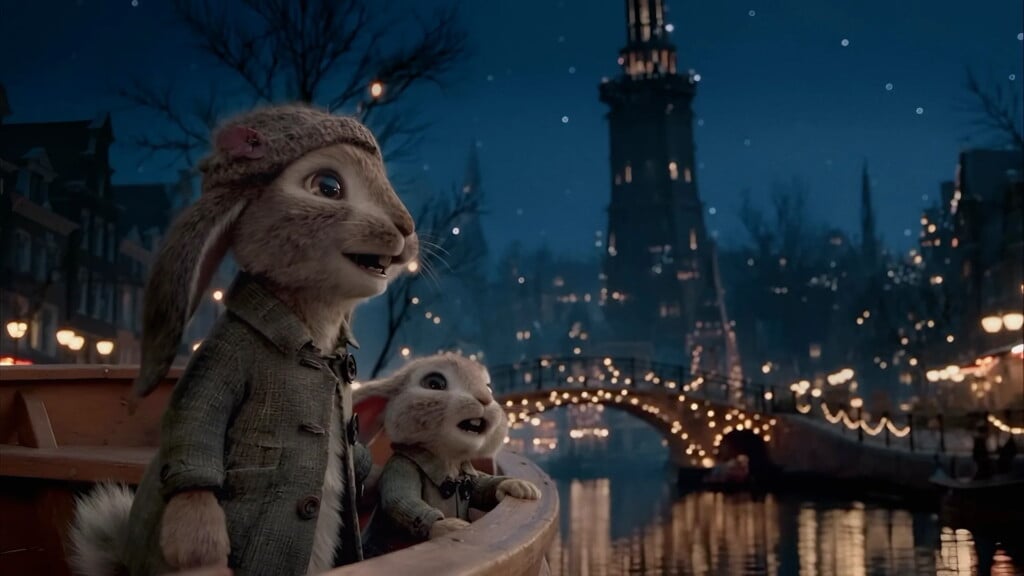
The new commercial, created in collaboration with Los Angeles studio Secret Level, follows the same visual formula: the red trucks crossing snowy landscapes, lights glowing in the night, the familiar music playing. But this time, instead of people, there are only animals — polar bears, pandas, sloths, and seals — gazing in wonder as the trucks pass by. Only at the end does Santa Claus appear, generated from the original paintings of Haddon Sundblom, the artist who in the 1930s shaped the modern image of Santa Claus.
For Coca-Cola, this marks a moment of technological maturity. “The quality is ten times better than last year,” said Pratik Thakar, Global VP and Head of AI at the brand. Yet when you watch it, doubts remain. Despite the technical improvement, the impression is that the spot works more as an experiment than a true Christmas story. The animation feels cold, the lighting too perfect, the animals’ eyes slightly empty. It’s as if something’s missing.
@nuledgermedia
Still, it’s hard to accuse Coca-Cola of inconsistency. The brand has always presented itself as a pioneer in visual communication, ready to experiment with new languages. If last year’s scandal was about using AI at all, this time the company seems intent on showing that the technology can be refined and controlled. But in the attempt to humanize the machine, we might ask — has it also automated emotion?

Because, in the end, the issue may also be symbolic. It’s true that Christmas has become a celebration of frantic consumption and “social performance,” yet beneath this commercial surface remain slower, subtler, more delicate layers, a lingering space of nostalgic memory. Entrusting it to artificial intelligence, even for a thirty-second video, risks losing the last thing that made us believe that advertising could feel “real,” even if only for a moment. We know we are dealing with linguistic and cultural oxymorons here, so let’s clarify: advertising has never been “real,” by definition. And yet, culturally, we nurtured the illusion that it could at least represent a fragment of emotional truth. Handing Christmas over to AI, even in the harmless format of a short commercial, forces us to confront a contradiction that was always already there: advertising has always been a construction, a narrative, an artifice. But we accepted the artifice because it still contained a residue of humanity, faces, imperfections, an interpretation of feeling. We believed that a human gaze behind the camera granted the illusion a minimum of authenticity. We were always complicit in that artifice.
Now, by removing the human element, the artifice reveals itself with no mask at all. Because what AI seems to remove is precisely the human gesture of interpretation, the trace of lived experience that could seep into an advertisement and make it feel, however briefly, credible.
That Coca-Cola, global emblem of marketing, should become a carrier of family warmth and sentimental values is already a paradox. It is industry attempting to occupy an intimate space that should not belong to it. And yet, for decades, that paradox worked. With AI, advertising shows what it has always been: a performance without roots.
Yet the questions raised by this commercial do not end here. Is Coca-Cola simply following a trend, or is there no longer the courage to move truly against the current?
In this new era of synthetic images and calculated emotions, perhaps the question is no longer whether AI can make a perfect commercial. It’s whether a (nearly) perfect commercial can still make us feel anything at all.