Gohar Dashti, an Iranian artist and photographer, uses the series Today’s Life and War to turn her photography into a sounding board for her generation. A way of giving voice to her people and bringing before everyone’s eyes the consequences of her country’s socio-political instability.

Gohar Dashti was born in Ahwaz, Iran, in 1980, the year in which Saddam Hussein’s Iraqi troops,
concerned by Ayatollah Khomeini’s Iranian Islamic Revolution—and seeking to claim the territories along the Shatt al-Arab River—invaded the country.

The clash, which was initially supposed to be a blitzkrieg, turned into a long and bloody trench war that lasted eight years. Nearly a decade of tension and loss for both peoples, reflected—as is now typical of every conflict in the contemporary era—on the civilian population. Even after the fighting ended, the emotional consequences continued to pour over and leave indelible marks on the artist’s generation and on those to come.

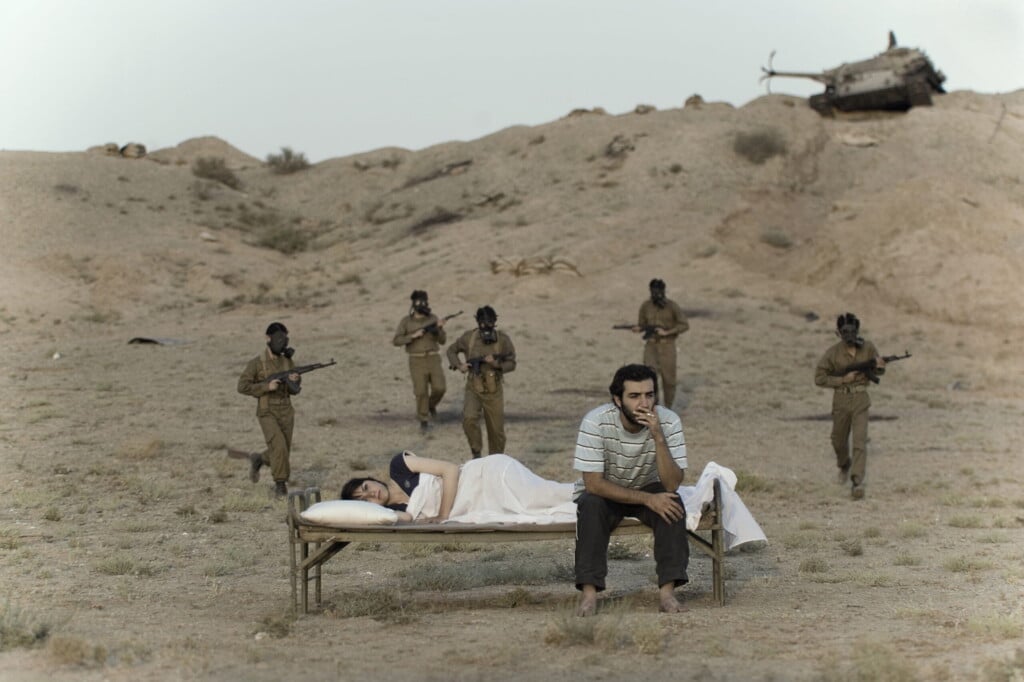
That is precisely why the photographer chose to present the series by placing at its center a couple engaged in the simplest everyday activities—watching television, having breakfast, reading the newspaper, even during their wedding—highlighting how war and danger are so deeply rooted in their lives that they follow them everywhere. Only bad news comes from the television, newspapers are filled with disasters and tragedies, and even when they should be resting, the threat of war and destruction remains an oppressive and constant presence.

This oppression is conveyed by the clean clothes that, in one of the photographs, are hung not on an ordinary clothesline but over barbed wire; it can also be seen in the deafening presence, in almost every shot, of soldiers and tanks in the background. In one of the photographs, while the woman works at the computer and her partner stares into the camera, they are both seated on sacks: perhaps trench sacks, or perhaps bags containing the little they own, always ready for an imminent and sudden move—a symbol of the constant flight and forced migration to which peoples living in war and ongoing instability are subjected.

In their lives there is no room for intimacy or for being alone, just the two of them, because the
presence of war is part of their reality, almost as if it were another life companion. Gohar Dashti’s series speaks to us with disarming delicacy about one of the most indelicate and suffocating issues, which has by now, for far too long, become part of her people’s identity.



This article was produced in collaboration with Luigi Falanga and Gaia Forlin aka @super8otto.