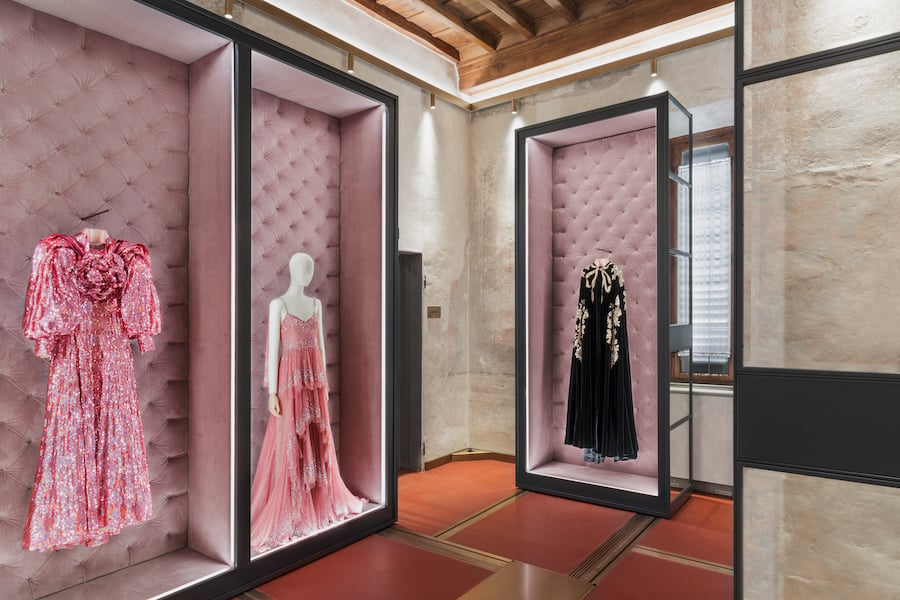
Yesterday, July 1st, the new location of the Gucci Archives was inaugurated in Via delle Caldaie in Florence, hosted by Palazzo Settimanni.
“My task was to bring back many objects, as if we had helped them return to the family. In a place where ostensibly the past is preserved, but is actually a bridge to the contemporary. An ancient building is a living thing. Like fashion”, said Alessandro Michele, Creative Director of the Italian fashion house.

Located in the Santo Spirito district in the area of the “Oltrarno”, to the left of the river, its traces date back to the 1400’s where artisan and artistic activities crowded the area. Already in the following century, following the transfer of the Medici family to Palazzo Pitti, they flanked the residences of aristocratic families who settled there to build their sumptuous homes.
The building has always proved to be a flexible structure, available for additions, splits, transfers of ownership or uses. Purchased by Gucci in 1953, it has been the Maison’s factory, workshop and showroom, and has become an integral part of it both physically and metaphorically.
Today, thanks to the restoration desired and conceived by Michele himself, its original qualities have been restored. As if it had been given the chance to tell its own story, to reveal its many identities, becoming the allegory of a dialogue between past and present, indispensable prerequisites for the future.

“Palazzo Settimanni, freed from the previous superimpositions, is transformed into a magical place to which I have returned porosity: you pass through it, air enters, you can walk through it as if it were a journey. I am porous, absorbent, permeable”, explained Alessandro Michele, who added: “I have given the palace back that fairy-tale aura that allows, for example, the small entrance hall to become an entrance to a dream dimension. I thought of it as a somewhat secret place of the company, a sanctum sanctorum from where one departs for the holy lands of Gucci”.
On the five levels, which include the first floor and the basement, the superstructures accumulated in recent times have been removed to reveal traces of nineteenth-century decorations, trompe l’oeil of the eighteenth century, frescoes of the late seventeenth century, embellishments even earlier: all elements deliberately left intact or restored to their original splendor without being moved or modified. The only relevant transformation has been the removal of the roof in the entrance hall made in the 90s, in order to diffuse light and return to the central porch the grace of the original proportions. Everything has been planned, arranged and designed with the same extreme care with which the entire operation of reusing the building as the seat of the Maison’s historical collections has been carried out, from the furniture to the details of the handles reproducing a pair of scissors, from the wunderkammer showcases to the lamps, up to the precious wooden cupboards and the large iron and glass cabinets.

It was also maintained a very strong link with the territory by entrusting local workers with all the work, including the flooring of tiles made individually in wood-fired ovens.
“The archive is a memory building”, said Valerie Steele, director and curator of the Fashion Institute of Technology museum, who collaborated on the layout of some of the spaces. “Far from resembling a dusty attic, it is, on the contrary, a dynamic system that produces knowledge and inspiration. The impulse to categorize elements of past eras is not based on nostalgia, but on the awareness that that of style is a concept in perpetual mutation. This relationship with time, for a centenarian company like Gucci, develops the theme of the archive as a point of collection of a living heritage: now and for the generations to come”.

Palazzo Settimanni is also home to Gucci Education, a unique space that offers training opportunities for the brand’s employees. A physical location that joins an innovative digital ecosystem in a marriage between the traditional learning structure and new virtual spaces where to experience personalized learning paths based on specific needs, interests, skills.
In addition to an online community, Gucci Education includes functional academic paths such as the Retail Academy, the Supply Chain Academy, the HR Academy, the Digital Academy, but also the École de l’Amour, then hosted in the ArtLab spaces and in the Gucci factories.
A multitude of constantly evolving learning opportunities to enrich and amplify personal and collective growth to the fullest, drawing inspiration from the DNA and codes of the Maison celebrated by the archives to project the company into the next 100 years.