On the doorbell of Giger’s home, in a former working-class neighborhood on the outskirts of Zurich where he lived for 40 years, there was no first or last name written but a phrase that read, “We’re always here”.
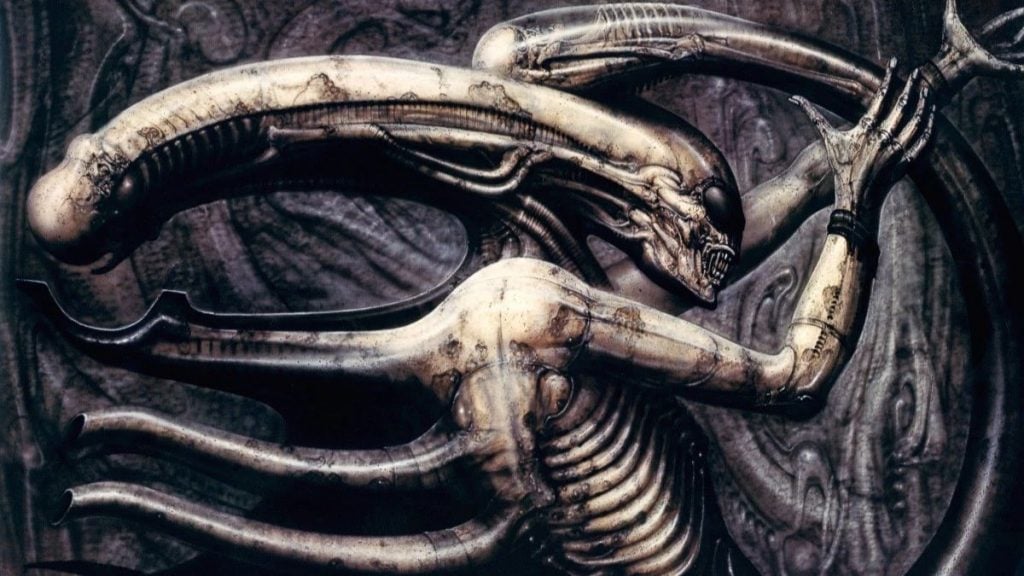
Hans Ruedi Giger, for all H. R. Giger as he used to sign his works, was one of the most innovative, avant-garde, creative, disturbing, terrifying and obscure artists and designers who ever lived. An absolute visionary who exorcised his own nightmares through his unique and unrepeatable symbolic and surrealist inspired art.

He worked in the field of illustration and design and then became a point of reference in the field of cinematic special effects. Winner of the Oscar for best special effects in 1980 for the representation of the Xenomorph, the frightening creature protagonist of Ridley Scott’s film Alien. Giger has left his inimitable, very personal and monstrous imprint on the world of contemporary art and design, giving us a pass to hell.
The son of a pharmacist, Giger spent a serene and very happy childhood in Chur, a Swiss commune in the canton of Grisons, where he was born on February 5, 1940. His father’s laboratory was a place of pastime and amusement for little Hans, who spent his days in the family pharmacy observing bottles with liquids in strange colors and leeches that were still used in medicine at the time. The child’s fascination with the “macabre” begins to be strong until it completely explodes when a pharmaceutical company sends his father a human skull. The young Giger remains fascinated. From then on the call of all that was bleak, bizarre and obscure kidnaps him completely, also influenced by the work of artists such as Salvador Dali and Jean Cocteau.

He attended the school of industrial design and applied arts in Zurich from 1962 to 1970 where he refined and perfected his technical skills and incredible precision in depicting the mechanical and robotic parts of his works. His name began to make its way in the world of independent art thanks to works that ranged from dreamlike and surreal landscapes to sculpture and graphics for music album covers. The use of acrylic with the airbrush technique will be what will make him famous worldwide and to the general public, thanks to the enormous realistic potential.
The bichromism, already disturbing in itself, will become one of the hallmarks of the dark aesthetics of Giger that will see its greatest exemplification in the invention of “biomechanoids”, creatures in which blend organic and mechanical elements.

In 1975 came a call that was completely unexpected and represented Giger’s first approach to the world of cinema. After the success of El Topo and above all of The Holy Mountain, the filmmaker and playwright Alejandro Jodorowsky had the idea of making the most important and gigantic film in the history of cinema: the cinematographic transposition of the science fiction novel written by Frank Herbert, Dune. “His” Dune, set itself the goal of becoming a revolutionary film, capable of shifting the balance of society of the time by providing new reference models. Jodorowsky had involved an unprecedented team that included, in addition to Giger, Moebius and Chris Foss, the special effects expert Dan O’Bannon as well as relevant personalities in all areas such as Pin k Floyd for the soundtrack and actors of the caliber of David Carradine, Mick Jagger, Salvador Dali and Orson Welles. Of this film never made remains only the storyboard, which we talked about in this article of a few days ago, in which Giger edited the characterization of the villains of the film.
The boom of Giger’s career in cinema will come in 1979 when Ridley Scott will ask him to create the sets and animatronics (in collaboration with the Italian artist Carlo Rambaldi) of Alien, thanks to this work will win the Oscar in 1980.

Giger’s legacy has had a huge influence on hundreds of artists across disciplines, from rock bands to tattoo artists, science fiction writers to car and interior decorators, and even video game developers.
The incredible, dreamlike, dark and alien visions of the Swiss designer have given way to thousands of ideas on the subject, and not only, pushing creatives around the world to break down barriers and limits making it an icon in the history of art and design.