Hashem Shakeri is an Iranian photographer we had the pleasure of talking about here.
We at Collater.al asked Hashem to tell us his story through an interview, which you can find below:
What does it mean for you to take pictures? How did you start?
Actually, my mother was the first person to have opened the door for me to art because she had some artistic experience. The first time I got my hands on a camera was with my mother when I was a child and this curiosity continued for many years. But the most serious encounter with photography for me happened later in my life, about 12 years ago when I was a student of architecture.
I was just walking around and I accidentally noticed that the university was hosting a photographer who had documented the Iran-Iraq war and he was presenting his work among the students. I got curious, went in to see what was happening and came across images of the war between Iran and Iraq and I was so overwhelmed I was moved to tears. When I came out of the exhibition, I saw myself as a would-be photographer. On the same day, I sold some antique pieces and an old analog camera that I had collected since childhood so I could get a better camera. It was right then that I pictured myself as a professional photographer in the future. That day, the course of my life changed completely.
Your works are very interesting, as well as beautiful, what do you want to communicate to the public?
In general, my world is timeless and placeless, a nowhere geography. The things that happen there can happen anywhere on this earth, to anyone, in any language. It is the world of human beings who are struggling with the basic issues of human life, with the human condition, regardless of nationality, ethnicity, religion and so on – issues that the humankind, in general, are faced with. This is my point of departure and my work isn’t limited to a particular person or situation; but rather, it has a universal characteristic. To me, the poetry and the narration of the image are very important and I strongly believe in poetic storytelling through my images. At the height of bitterness and pain, I like to take beautiful pictures – beautiful according to my definition of aesthetics, beautiful and poetic but bitter.
The spaces that I love to press the shutter for fall somewhere between certainty and uncertainty. They can be perfect and imperfect at the same time. The suspense is a critical element of my job. I don’t like to finish the story of the image. At the same time as it draws attention to itself and affects the viewer, the image must maintain a sense of mystery and suspense that allows the viewer to breathe and live in it.
There are moments that you don’t know why a certain frame seems good, you don’t know if it’s because of the content or the atmosphere but something from the inside tells you that you should press the shutter and capture that space. I think there’s no technical or scientific explanation, it’s just some intuition or feeling that comes from the artist’s exclusive sense of beauty or aesthetics and it’s not like anybody else’s in the world. It just happens with the artist’s intuition in that certain time and place and each artist captures his or her own atmosphere or moment.
I love to create my own world in photography and every project that I work on has a relative relevance to the coordinates of the world I am trying to create. It’s a thread that connects my projects together. So I press the shutter only for things or happenings that relate to the world I have in mind. But I’ll never try to capture a frame of whatever’s not in line with my narrative approach, my own perspective, even if it’s a significant or newsworthy event.
One of my major concerns is the psychological investigation of human relationships in the contemporary world. By capturing restlessness, perplexity and social struggle in the modern capitalist world, I record the optical unconscious of the society and provide a universal narrative with a personal insight. I capture the souls of my subjects in my images at the most decisive moment as they live most vibrantly. Photography is defined for me like these moments where people’s souls turn to poetry in images.
Is there a particular reason why you selected these photographs?
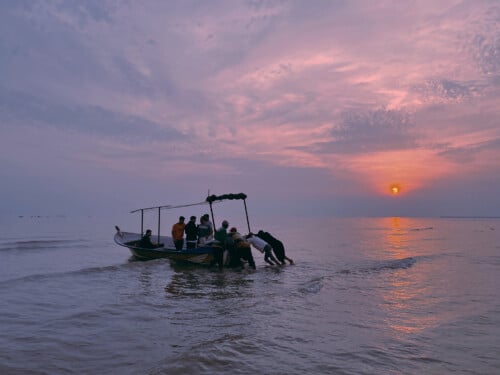
Regarding my project “An Elegy for the Death of Hamun” my first and main concern revolves around the all-out destruction of the environment, which as a global issue has affected human life and has roots in capitalism. Never before has the earth seen this much destruction. At the current moment, the ecosystem and environment are harshly treated and violated by humankind and many species have faced the danger of extinction, all of which boils down to environmental destruction by humans. Nowadays, we are facing an urgent condition for the ecology of the earth which not only endangers the various species on earth but also directly poses a threat for the lives of humans in different places around the globe. Deforestation, global warming, rising of sea levels, increasing of floods, storms and droughts and climate change, in general, have had a detrimental effect on the lives of different species on earth.
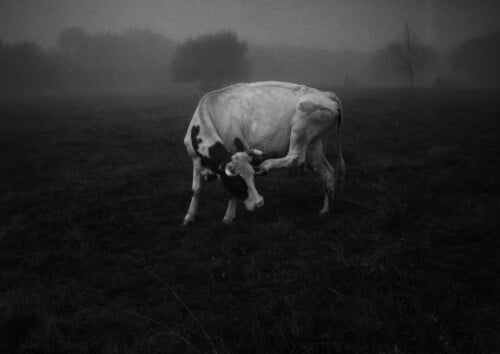
It’s really awful to see Sistan, a historical land of myths, legends and Iranian epics, which used to be called the reservoir of cereals and which was described as a land with green forests, abundant water, and fertile soil has been damaged so badly in 18 years that we see an all-out human catastrophe in its 5,000 years of history. During the past 18 years, it’s been treated so harshly that it’s become devoid of all living species. This is catastrophic both regarding the drying of Lake Hamun, which was the root of life for various plants and animal species such as the extinct Sistani cow and regarding the vast wave of migration and the gradual depletion of residents in this land who had settled there for a long time. Sistan and Balouchestan province has the highest rate of migration in the country, with young people constituting the greater portion of the migrating population. Under devastating conditions and because of unemployment, young people have to resort to migration as their last chance and of course they face so many challenges and social problems when they do. If this condition is not dealt with appropriately, soon we will face an infertile ground devoid of people called Sistan, the name of which can only be seen in the legendary history of Iran.
An important issue that is very awful is that the death of this land with all its species and residents is taking place gradually and this is an important reason that compelled me to work on this series. People’s voices in this land are not heard and although it is the broadest province in Iran, it is the most oppressed one and according to the officials, out of 13 critical areas identified in Iran, 11 areas exist here in this province. Humans have become hardened in their battle with nature and they are fighting tooth and nail to survive. Human dignity is facing a deadly threat and human life is now history there.
I think my smallest duty as a social documentary photographer is to represent the dimensions and consequences of this silent human catastrophe and I’d like to prevent the ultimate death of Hamun before Sistan’s body stops working forever and make the voices of this land’s silent, exhausted and forgotten people heard. In general, by doing the only thing that I can do (that is, the representation of reality), I have my contribution in fighting against monstrous capitalism which by robbing humans of their dignity and destroying the human status is not only violating humanity itself but also annihilating all life on earth by its illegitimate and unquenchable desire. We should do something before we have to sing an elegy at the funeral of our little earth in this vast cosmos because there might even be no mourners left then.

How has your culture influenced your art?
We may consider it a given that an artist’s work is influenced by his culture. It’s not something that you can easily prove in objective terms but I believe that the environment you live in, with all its determinations and specificities, forms your subconscious – maybe that’s why it sometimes evades us. However, the process of creating a work hinges to a great extent on the artist’s subconscious. Wittingly or unwittingly, the artist feeds on their own subconscious. Your concerns as an artist, your political viewpoints and the raw material you use for your work are all formed and informed by your cultural and social background. So I guess even if I attempt to adopt a universal outlook in my art, my personal concerns as someone who lives in Iran are – at least in part – different from those of an Italian artist based in Italy.
Which artists influenced you the most?
What’s important to me is that the picture I take is an organic, living picture. I want it to have a life independent of mine and I want it to subsist eternally, independently of me. I want it to never lose its living essence, a timeless and placeless image that lives in the eternal memory of existence. That is why I’m so much inspired by film directors whose world I can appreciate and identify with, like Béla Tarr and Michael Haneke – cinematographers who have a unique worldview and have created a world of their own from start to finish with their oeuvre.