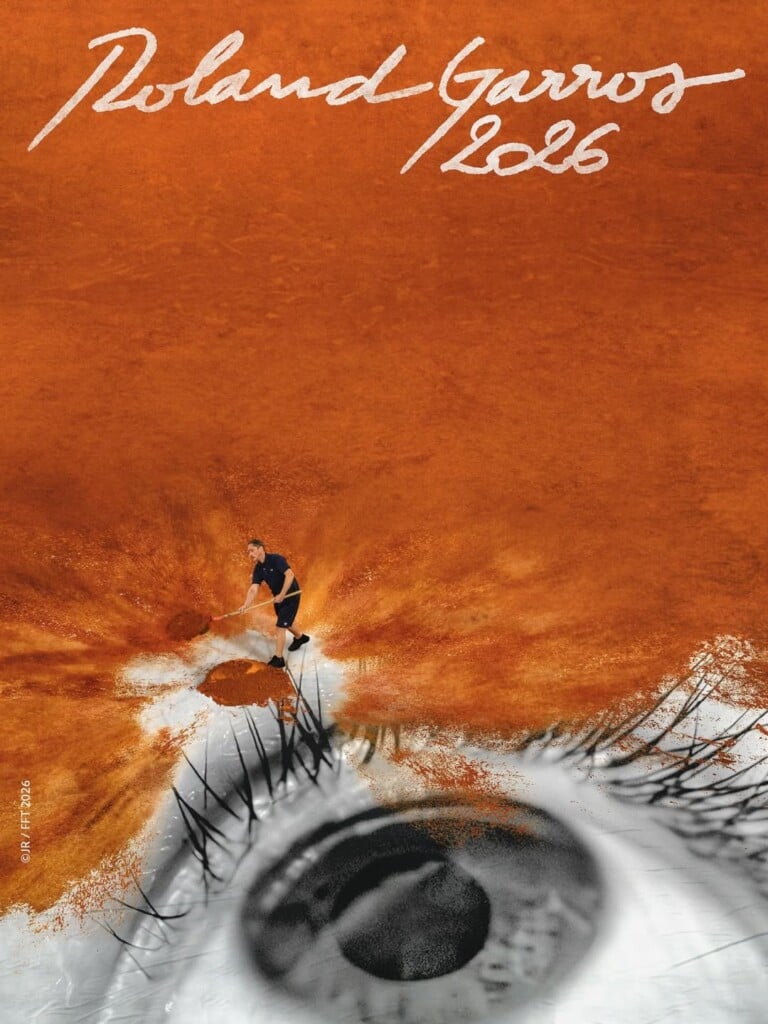
In 2026, Roland-Garros renews one of its most interesting traditions, once again entrusting its image to an artistic perspective capable of moving beyond the boundaries of sport. After more than forty years of posters created by contemporary artists, the choice has fallen on JR, a figure who has built his entire practice around the way we look and what often escapes our attention.
Rather than focusing on the athletic gesture or the iconography of victory, JR chooses to shift the point of view. At the center of the image is not the player, but the red clay, the foundational and defining element of the Parisian tournament. The poster is born from a moment that normally remains invisible: the preparation of the court. A technical, repetitive, almost silent gesture that takes place بعيد from the public eye and here suddenly becomes the protagonist. Photographed on Court Philippe-Chatrier in winter, the court loses its spectacular dimension and turns into a suspended place, closer to a ritual than to an event.

The surface of the court thus stops being a simple backdrop and becomes living matter, something that exists only through the constant work of those who build and maintain it. It is precisely in this shift that the image gains its strength: instead of showing the culminating moment, it focuses on what makes it possible.
Interrupting this apparent documentation is one of the most recognizable elements of JR’s visual language: a black-and-white eye created through photographic collage. It is not a decorative insert, but a fracture that completely changes the reading of the image. The contrast between the warm, compact texture of the clay and the monochrome graphic sign introduces an immediate tension, pushing the viewer to question what they are seeing. It is not clear who is observing whom, whether we are looking at the court or the image itself is looking back at us.
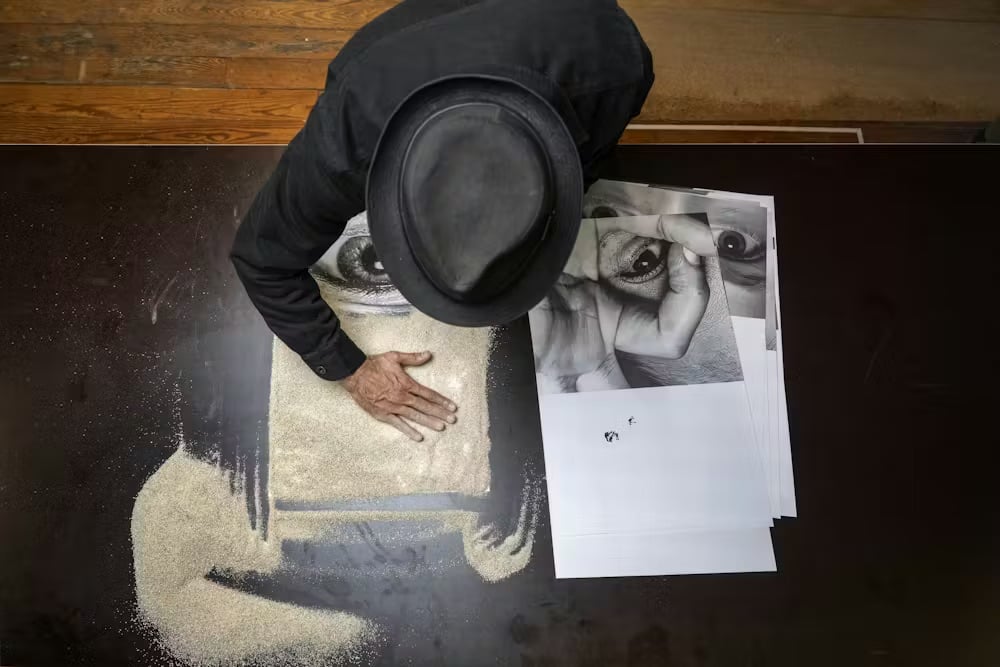
As often happens in the artist’s work, meaning is never closed off. The image remains open, available to different interpretations, built more like a question than an answer. In this sense, even a highly codified context such as that of an official poster becomes a field for experimentation.
The strength of the project also lies in what it chooses to leave out. There are no athletes, no recognizable actions, no explicit celebration of the competition. Instead, the focus shifts to what comes before the spectacle, to that dimension made of labor, repetition, and care that usually remains at the margins. It is a choice that reflects the very nature of the tournament, still deeply tied to physical presence, natural light, and the sharing of real space in an era increasingly filtered through screens.

This approach can also be found in his most recent projects. JR is in fact working on an intervention that will transform the Pont Neuf in Paris into a monumental sculpture, covering it with more than forty thousand square meters of fabric. Arches, parapets, and street lamps will disappear beneath a new skin, radically altering the perception of one of the city’s most recognizable symbols. The reference to The Pont Neuf Wrapped from 1985 by Christo and Jeanne-Claude is explicit: a declared homage that does not merely cite, but reactivates that same idea of the temporary transformation of urban space.
The poster thus fits into that line of works that plays with the relationship between the visible and the invisible, between surface and depth, leaving it up to the viewer to construct their own narrative. Once outside the studio, the image loses the artist’s control and begins to live through interpretations, readings, and projections.
More than representing Roland-Garros, this work deconstructs and slows it down, bringing it back to its most essential material. Not the final gesture, but the process. Not the event, but what makes it possible. A surface that is continuously built and rebuilt, just like the gaze of the person observing it.