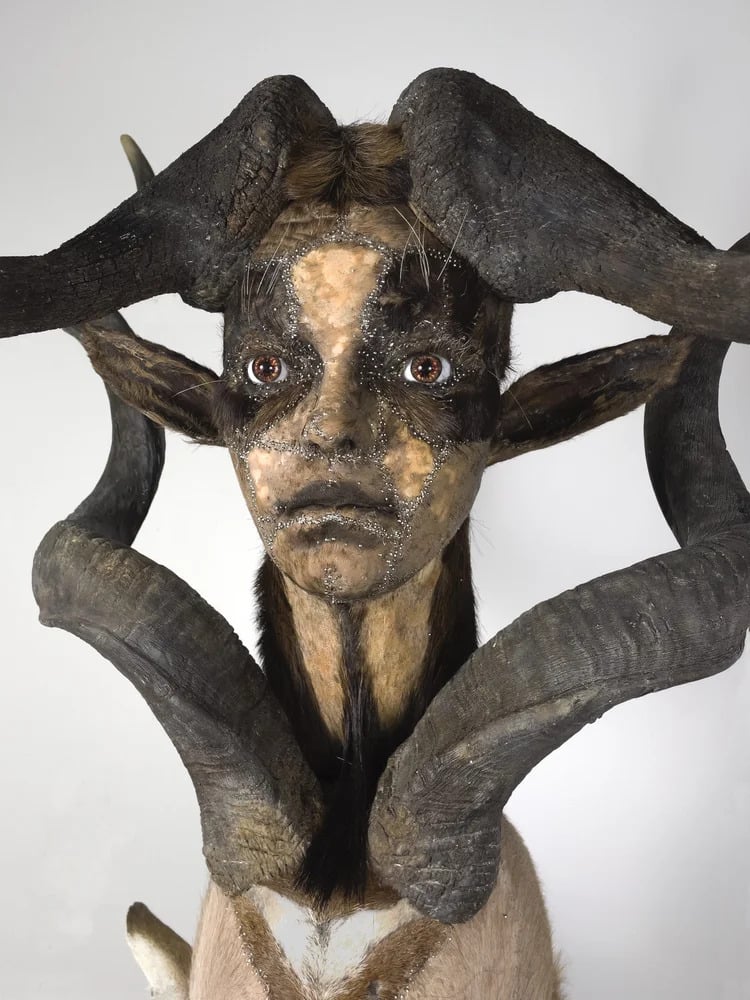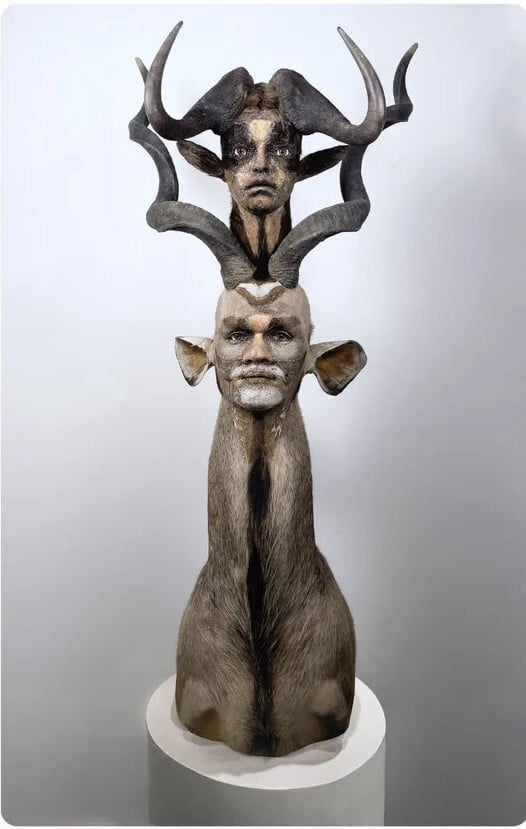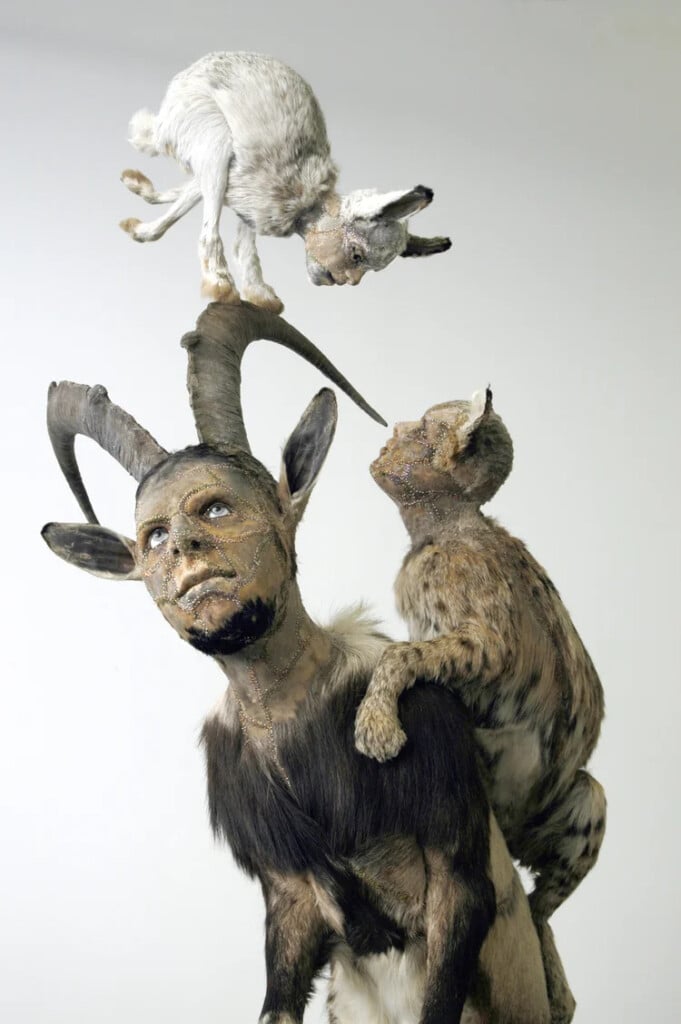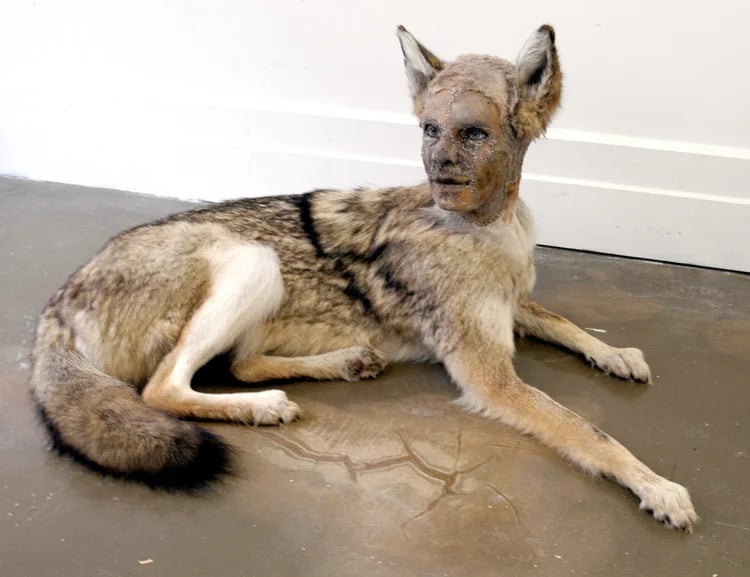
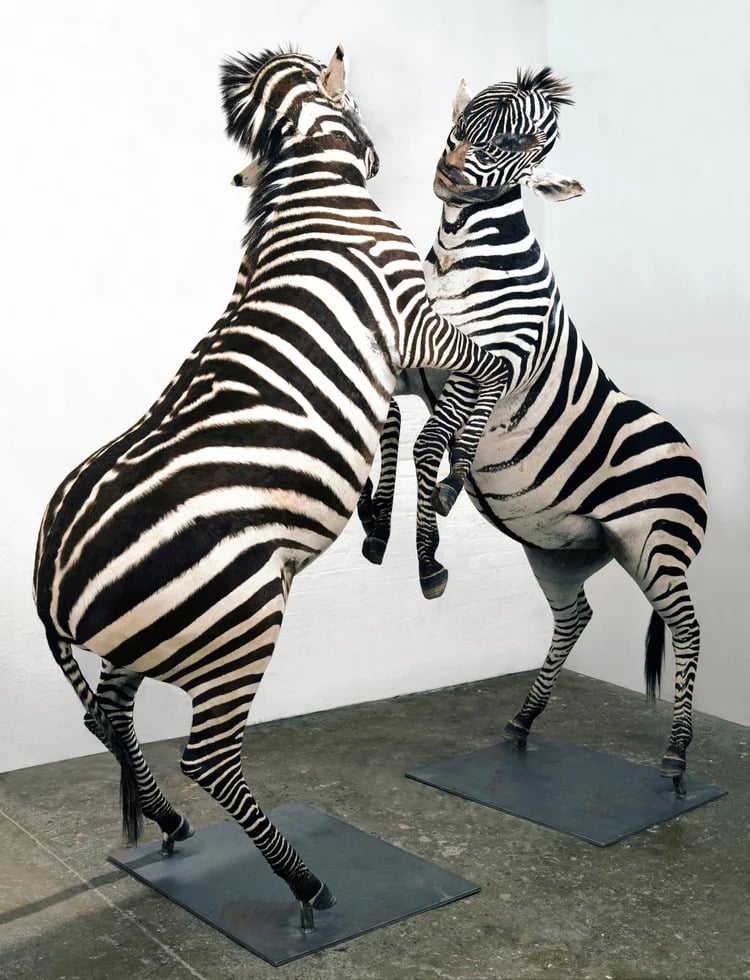
What would happen if, looking at an animal, instead of a muzzle we suddenly found ourselves facing a human face? Not a mask, nor a barely hinted resemblance, but a face capable of returning our gaze, an expression and a familiar presence. It is from this visual short circuit that the work of Kate Clark takes shape, an American artist who uses taxidermy to build sculptures halfway between the human and animal worlds.
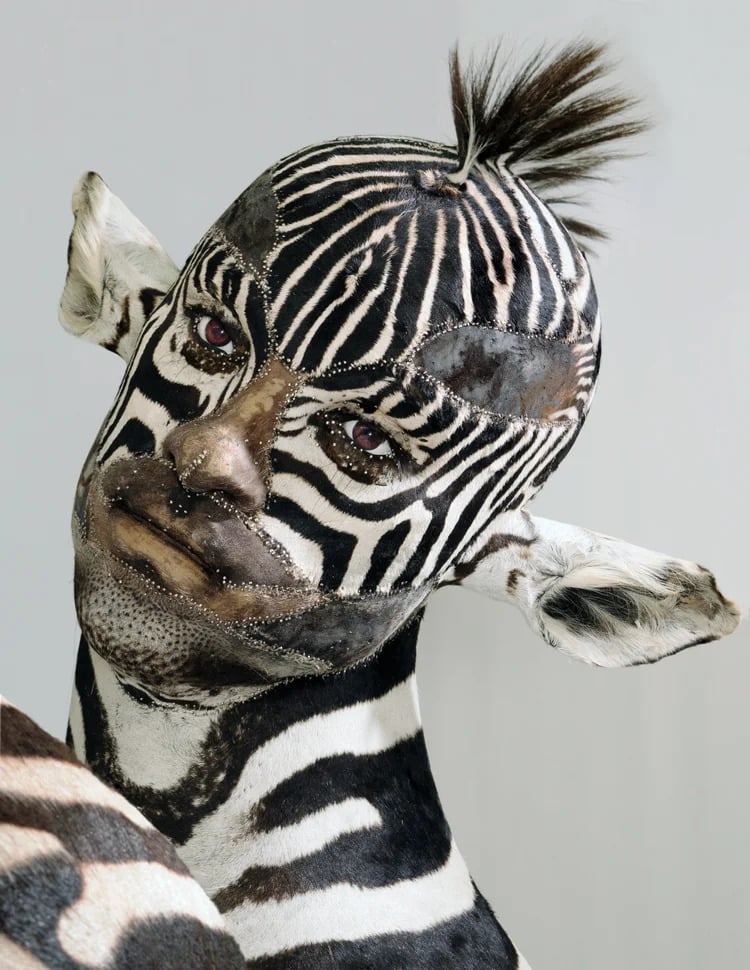
In her works, deer, antelopes, zebras and other large mammals keep their original body, fur, horns and proportions, but in place of the muzzle they have a human face. The result is a figure that is hard to classify: animal enough to seem like it came out of a natural history museum, human enough to provoke an immediate reaction of recognition. It is not simply a matter of turning an animal into a fantastical creature. Clark intervenes precisely in the way we look, forcing us to reconsider how thin the distance is that we keep establishing between ourselves and other species.
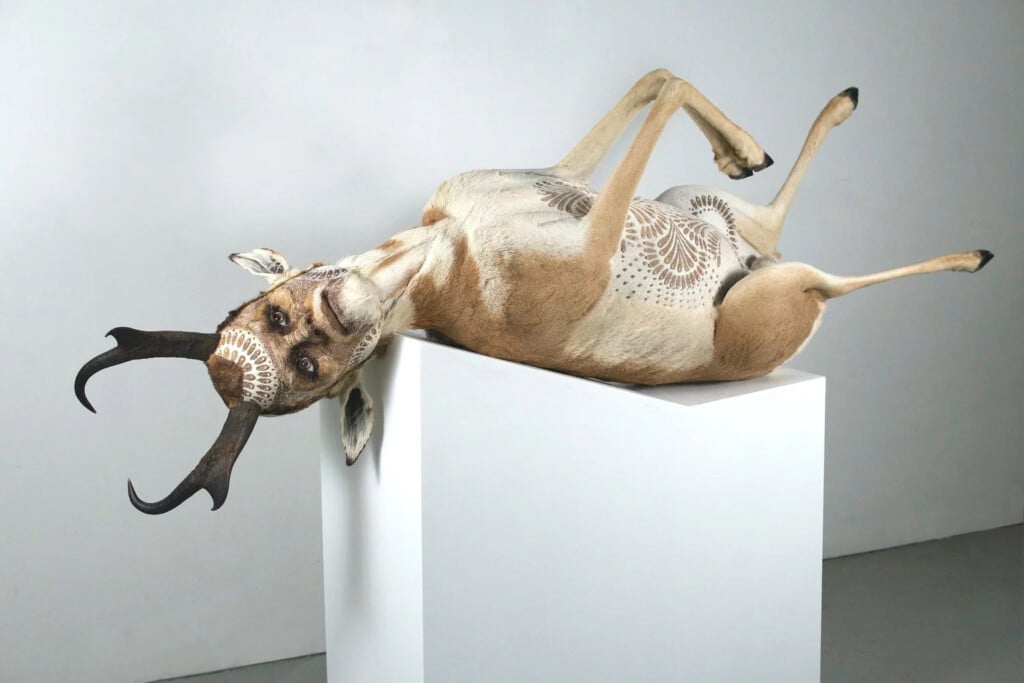
The starting point of Kate Clark’s research was not initially taxidermy, but the human face. During her studies at the Cranbrook Academy of Art, the artist became interested in the ability of facial expressions to communicate emotions and allow us to immediately recognize who is in front of us. From this reflection came the idea of transferring those features onto bodies belonging to another species. The first experiment involved a deer with a human face even larger than its own. An experiment that paved the way for a practice destined to become the hallmark of her work.
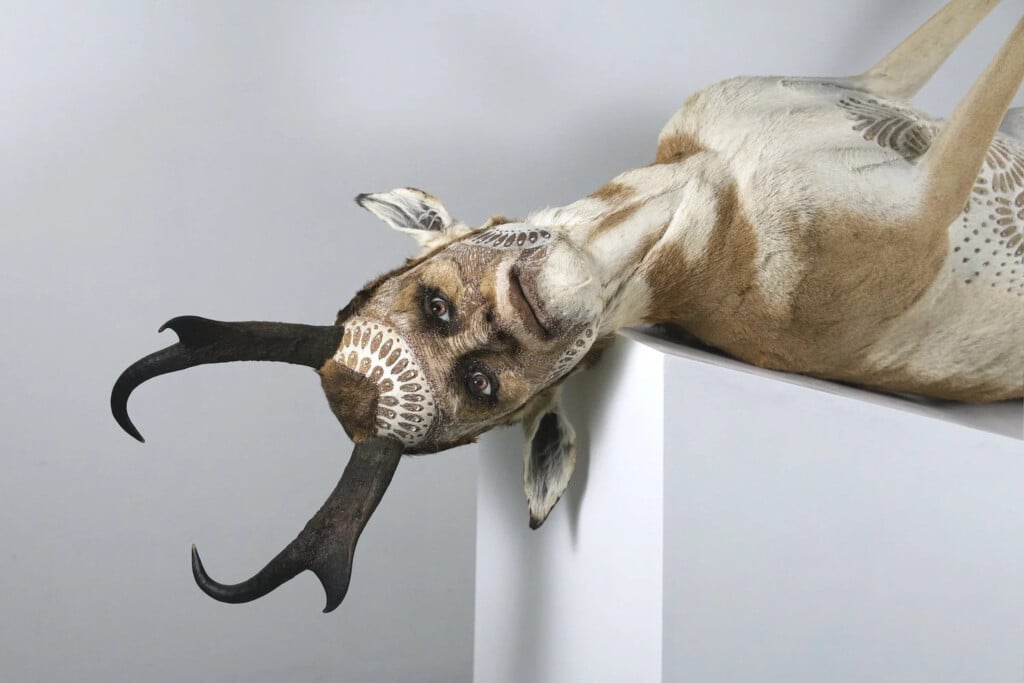
Making the sculptures requires a process that combines modeling and traditional taxidermy techniques. Clark sculpts the faces by hand, often starting from real human models, using materials such as polymer clay. She then covers them with portions of animal hide, working on the continuity between the surface of the face and that of the body. The fur, the spots, the color variations and the anatomical characteristics of the animal are not hidden, but become an integral part of the new subject’s physiognomy. Even the pins and stitches used to assemble the different parts can remain visible: rather than building a perfect illusion, the artist lets the process that gave rise to the figure show through.
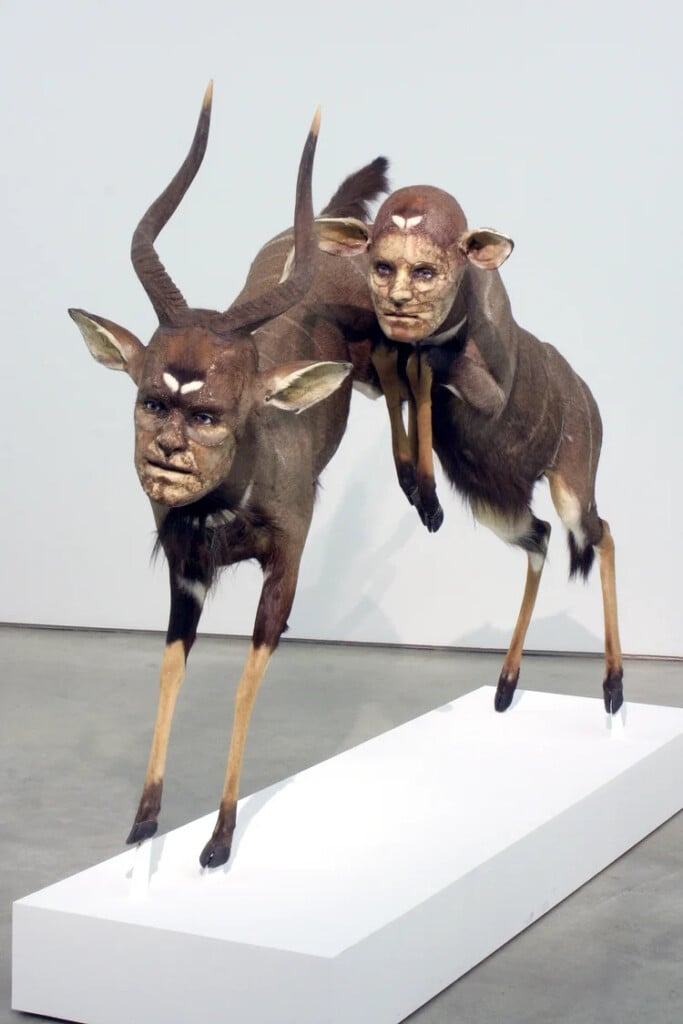
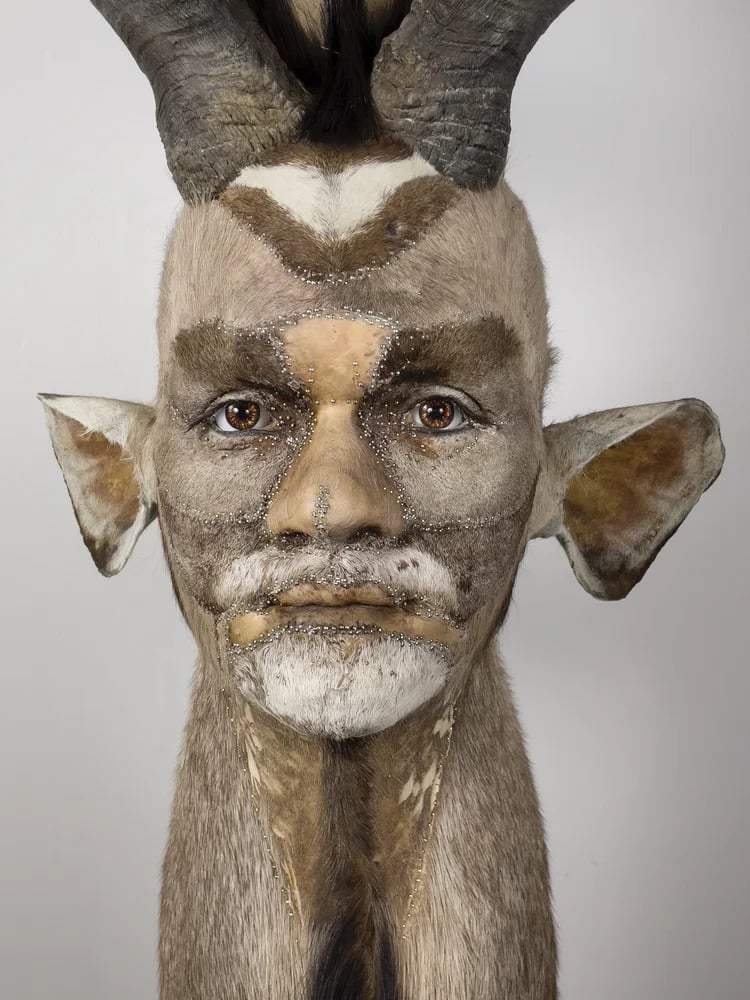
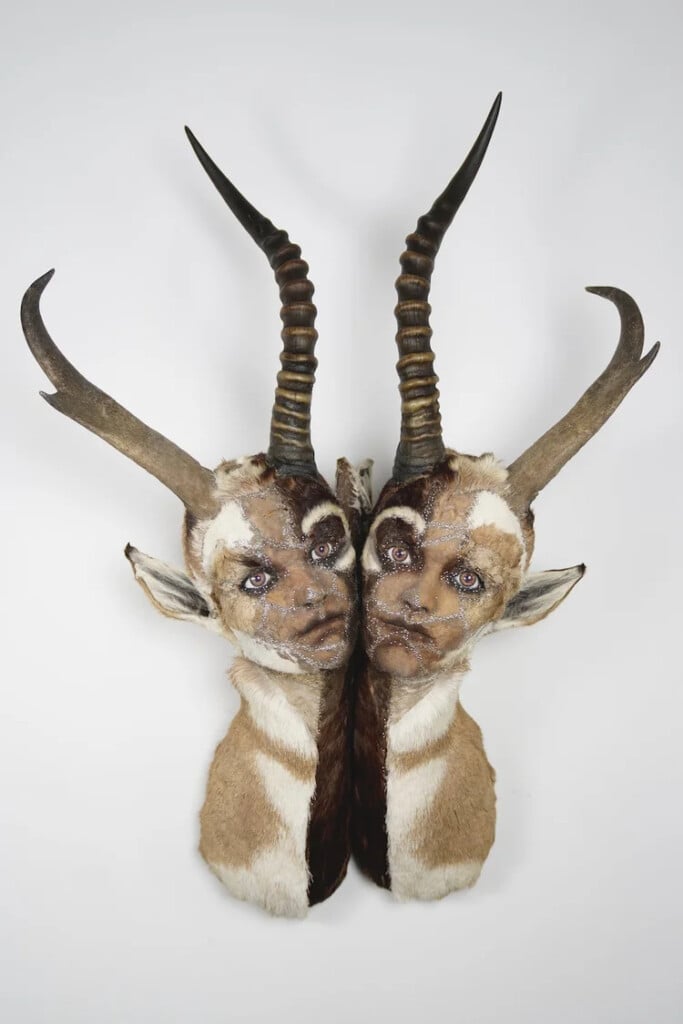
This choice is important because it keeps the sculptures from becoming mere exercises in illusionism. What we see is not an animal disguised as a human being, but a new identity built through the meeting of two bodies. The expressions are often serious, focused, sometimes melancholic. They do not try to imitate those of an animal nor to reproduce a particular human emotion. They seem rather to belong to someone who observes the world from a perspective different from ours.
It is precisely this aesthetic ambivalence that makes the sculptures interesting beyond their visual impact. Faced with these figures, the first impulse is to try to understand what we are looking at. Then, almost inevitably, we begin to dwell on the expressions, the eyes and the posture. The body belongs to one species, the face to another, but our attention ends up focusing on the person who seems to emerge from that combination. In this way Clark challenges a very common mechanism: we more easily recognize a form of individuality when we can find something human in what is in front of us.
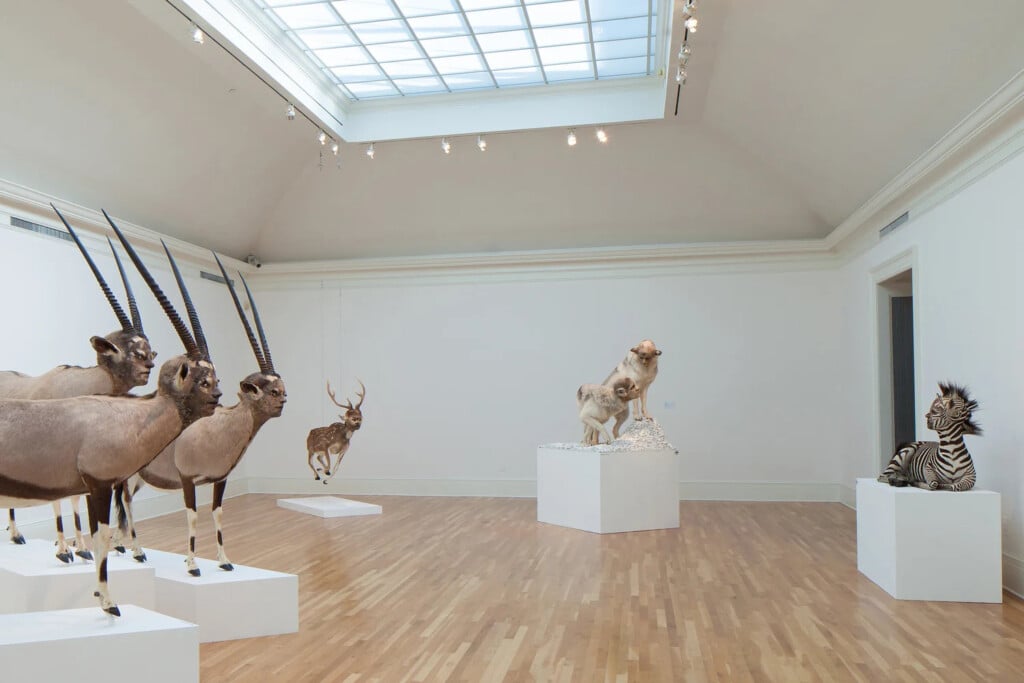
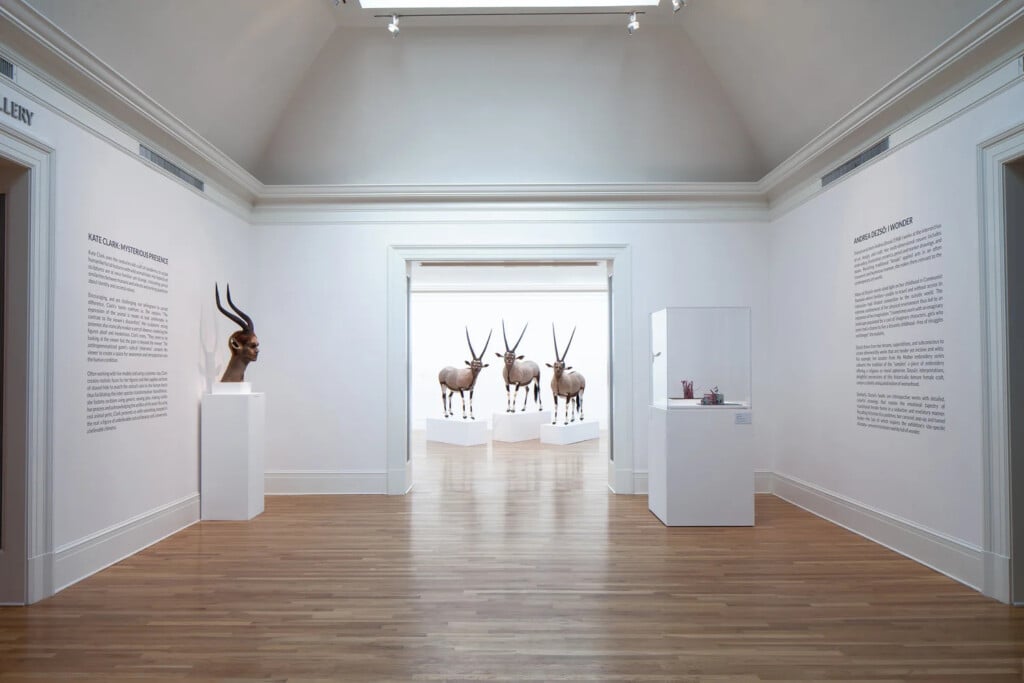
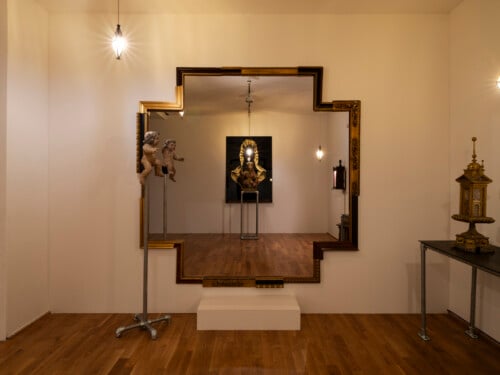
Museum installations of the artist’s works make it possible to observe how these works change meaning depending on the space that hosts them. In 2016, for example, Clark presented Mysterious Presence at the Newcomb Art Museum in New Orleans and subsequently at the Hilliard Art Museum. The rooms housed isolated figures on pedestals, sculpted heads and life-size animals, arranged so as to create close encounters between the works and the visitors.
In some images of the installation, three long-horned antelopes can be seen arranged side by side, as if standing still, waiting. In others, two figures with animal bodies and human faces seem to interact on a base covered with white fragments. The essential layout of the rooms, with light walls and white pedestals, lets the sculptures occupy the space completely. There is no need for elaborate sets: it is their proportions, surfaces and above all their gazes that build a relationship with those who walk through the exhibition.
Another significant context is that of the Getty Museum, where Clark’s work entered into dialogue with medieval bestiaries. In those manuscripts, animals, real or imaginary, were often used to convey moral teachings and symbolic meanings. The artist’s sculptures ideally take up that universe of hybrid creatures, but reverse the perspective: they do not try to attribute human meaning to animals, but rather to remind us that our own identity is inseparable from the natural world.
There is also a material question running through Clark’s work: the use of real animal hides might seem to contradict research that invites us to rethink our relationship with other species. The artist has addressed this aspect directly, explaining in an interview that she salvages hides that would not be used for other purposes, often because they are damaged, dry or imperfect. The choice to work with authentic materials is also tied to their texture: for Clark, the surface of the skin, with its irregularities and organic characteristics, creates a physical connection with human skin that would be difficult to achieve through synthetic materials.
Ultimately, Kate Clark’s sculptures do not try to establish which species is closer to the other, nor to imagine a world in which humans and animals simply swap roles. Their interest lies precisely in keeping this zone of uncertainty open. They remind us that animals are not just figures to be observed, classified or represented, but beings with their own individuality, which we often struggle to recognize because we are used to considering them separate from our experience.