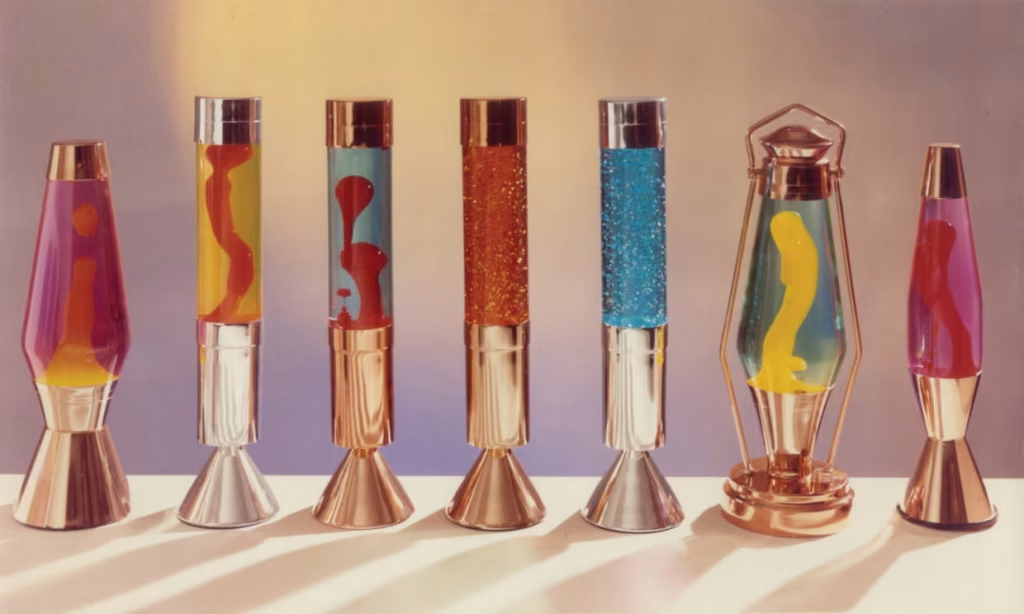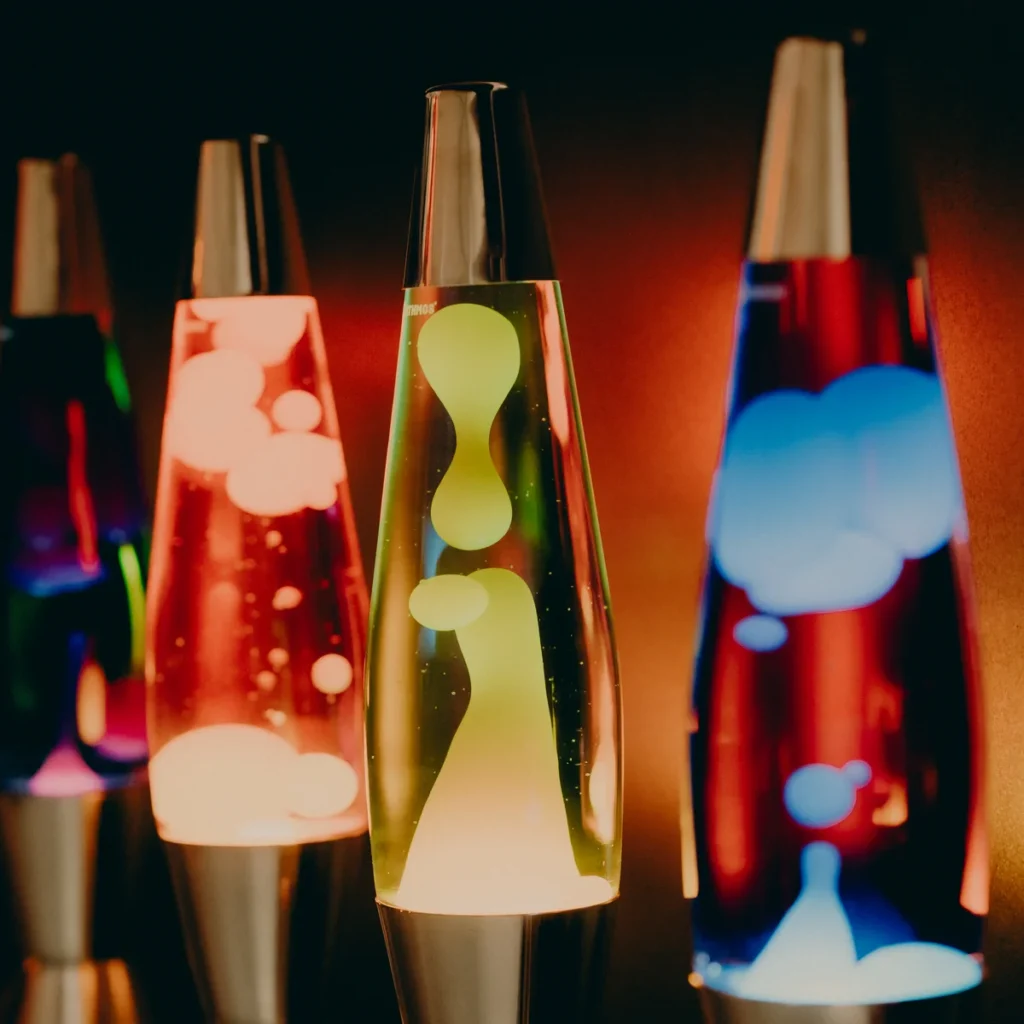
If we had to choose one design object that hypnotizes us more than any other, while also stirring up a pinch of nostalgia, it would be the Astro lamp, known around the world as the Lava Lamp. We’re talking about those lamps with the colored blobs drifting up and down. It’s one of the most recognizable design objects of all time, capable of moving from the psychedelic bedrooms of the ’70s to today’s minimalist desks without losing an ounce of its charm.
To find the origin of the Lava Lamp, we need to go back over 60 years. We’re in Dorset, England, where Edward Craven Walker — a former RAF pilot, accountant, entrepreneur, and thoroughly unconventional character — was struck by a rudimentary egg timer: a homemade contraption that, as it heated up, made shapes float inside a liquid. Craven Walker decided to refine the idea until he turned it into a decorative lamp, which he officially registered as a “display device.”

He founded Crestworth, the company based in Poole, Dorset, where Lava Lamps are still produced today, now under the name Mathmos. They’re called that precisely because they were inspired by ropy lava (the so-called pāhoehoe lava), whose sinuous shape closely resembles the movement of the wax inside the glass.
Technically speaking, the lamp works through a bulb placed at the base, which heats a mixture of wax and mineral oils suspended in a transparent liquid. The heat makes the wax expand and become lighter, causing it to rise to the surface; there, away from the heat source, it cools down, becomes denser again, and sinks back to the bottom, starting the cycle over, endlessly.


The Lava Lamp officially arrived on the international market in 1965, at the Brussels trade fair, where it caught the eye of American entrepreneur Adolph Wertheimer, who bought the rights for the United States and launched it under the name Lava Lite. Success was immediate: within a few years, over seven million units had been sold, and the object quickly became one of the most recognizable symbols of the psychedelic counterculture between the ’60s and ’70s. Even Ringo Starr bought one, helping boost its fame in the music world too.


It’s no surprise that the Lava Lamp soon found its way onto both the small and big screen, helped along by all those sci-fi productions and teen-driven films. Its first television appearance dates back to a 1968 episode of Doctor Who, followed by cameos in series, films, cartoons, and video games.
Despite its success, the Lava Lamp’s popularity has always been rather up and down, closely tied to interior design trends and fads. Even so, it has never truly gone out of style, and Mathmos continues to produce it uninterrupted in the same Poole factory since 1963, ramping up collaborations, like the one with Dutch designer Sabine Marcelis, and special editions, such as one that turns the lamp into a candle.


One thing’s for sure: the Lava Lamp has carved out a place of honor among the objects that bring personality, warmth, and a bit of healthy kitsch into our living spaces. On a desk, a nightstand, or a shelf, it remains exactly what it’s always been: a small, hypnotic reminder that design can be fun, not just minimalist.