There’s denim and denim. And there’s the Levi’s, the jeans for definition. The Californian house does not only represent an institution in the field: with its century and a half of activity at the back, it can be considered between the undiscussed icons of contemporary western culture. A real legend of our days. When you talk about them the thumb goes up, always more.
Each time your outfit represents a moment of extreme concentration, always remember that those blue jeans, that denim worn with such indifference, has a story behind worth the maximum respect. Obviously, only if you wear a pair of Levi’s: at the contrary, you could never understand all my enthusiasm.

This short introduction is needed to start telling the best moments of a brand that, on its birthday cake, now counts 145 candles. A history made of iconic successes, great products and monumental celebrities made its ambassadors.
But let’s start with order. The founder of all this is Levi Strauss; born in the cold February 26th 1829 in Buttenhein, Bavaria from Hirsch Strauss and his second wife Rebecca Haas Strauss. Theirs was a very big family, Levi had three other brothers and two older sisters. It was this tight relationship that pushed him, two years after his father’s death in 1846, to move with his sisters to NY: there, his brothers had an activity of dry goods – textiles, ready-to-wear garments and products like perfumes and soaps. The New York based family business was then called “J. Strauss Brother & Co”.
Levi soon understands what is path is: trade. In 1853, for this reason, he moved to San Francisco (in the hot years of the “California Gold Rush”), and decides to open a branch of his brothers activity on the West Coast, changing the name in Levi Strauss & Co. The real turning point, in this long, overwhelming process happens at the meeting with Jacob Davis, one of Reno’s tailors, NV. We’re in 1872, when the unknown genius of Nevada proposed Mr. Strauss to patent his idea. His intention, today given for granted, was to put classic rivets and the classic denim work pants, where they could have ripped more easily. The necessity, or at least the most immediate one, was to make them even more resistant in order to last as long as possible: all this responded to a simple, but at the same time very important, need of the American working class, the majority of the population. Only a simple and almost insignificant modification was the right ingredient that was missing in the pot. The jury’s out; the rest will be history.
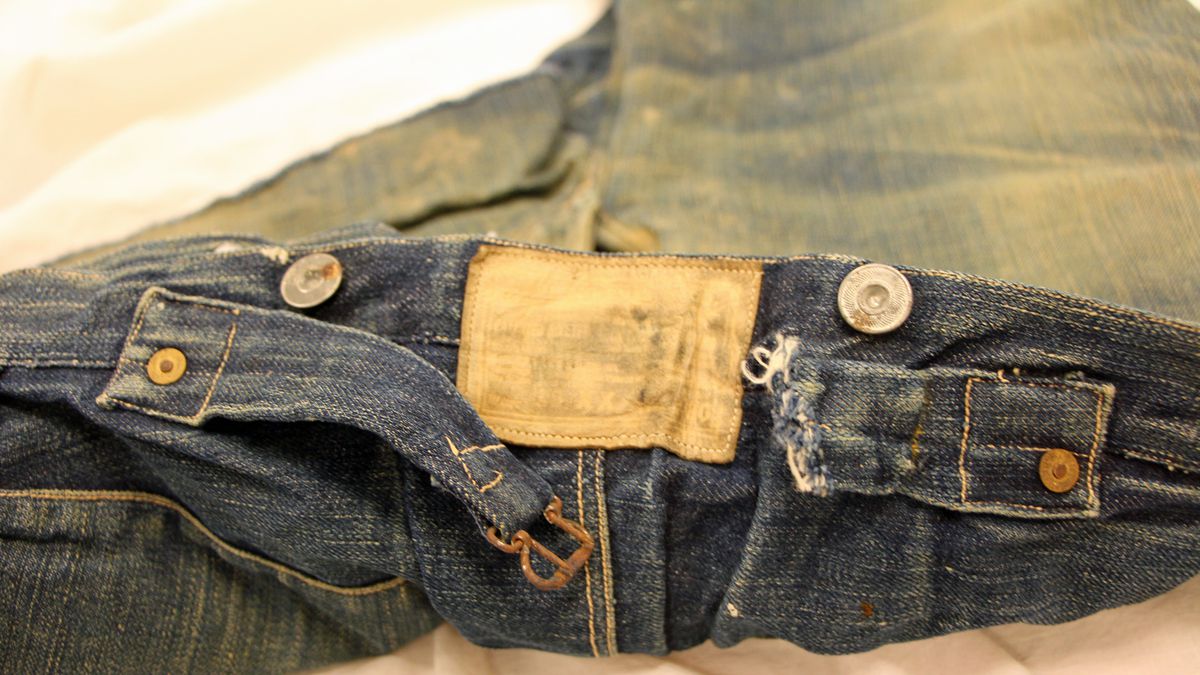
What should be kept into consideration, not being an irrelevant detail, is that no new cuts are made (nor new fits), referring to what was previously called waist overalls. It was just an upgrade.
Finally, on May 20th 1873, U.S Patent and Trademark Office sends the patent number 139,121: this will be the date of birth of the mythical blue jeans, which has now ahead a long history to write.
Let’s go back for a moment, to see how denim was actually made; it will then be easier to understand and recognize the different changes occurred later. Initially, it was presented with only one back pocket with the historical Arcuate stitching, whose meaning remains a mystery, given that an earthquake in 1906 entirely destroyed the headquarters of San Francisco Levi’s. The watch pocket and the crotch rivet, the buttons for the braces and the back buckle are the main details of this first jeans realized in Manchester, New Hampshire, with an XX blue denim of 9oz (coming from Amoskeag Mill), and ended up coming out in SF.
1886 will always remain a memorable date for the lovers of the brand: for the first time, the leather patch with the Two Horses is used, a functional idea at the basis of everything. In 1890, Levi’s is not the only brand using rivets. For this reason, it was decided to realize lot numbers, like the 501, the waist overalls with copper rivets, where number 5 indicated the better quality compared to other lots like, for example, 201.


As the years go by, fashion and consumers need change. LS&CO doesn’t stand still and watch: in 1901 another pocket is added to the back; in 1922 belt loops were added and, on the same year, the Californian firm decided to buy denim exclusively from Cone Mills in Greensboro, North California, as it was previously since 1912.
If in 1943 Levi’s satisfies all women’s needs, with the Lady Levi’s, another tassel to this creative process was added in 1936. We’re talking, obviously, about the historical red label on the back pocket, with the Levi’s logo sewn in white in capital letters: this is the only real detail to understand if you’re in front of a pair of real Levi’s vintage.
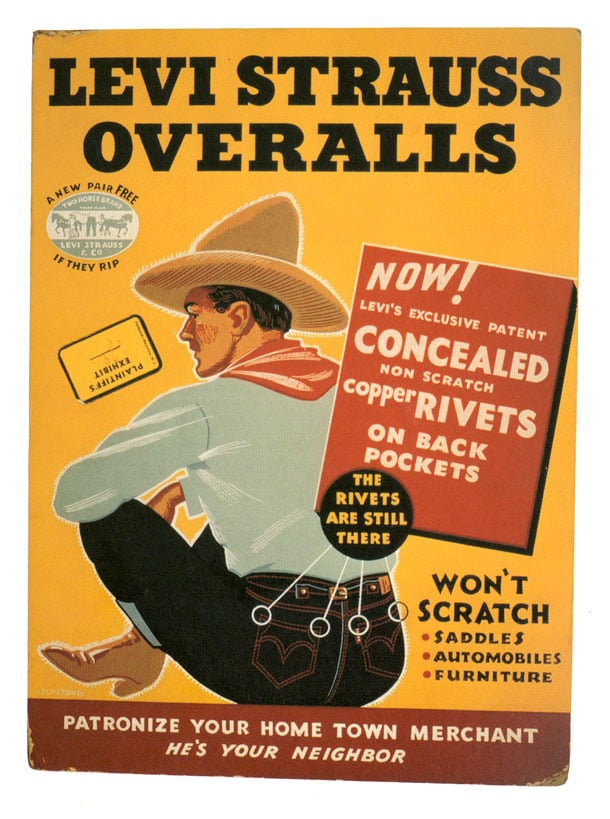
Later, even the classic rivets, the same ones that had given popularity to these trousers, start being less practical: it was decided, in 1937, to sew them under the back pockets. Numerous, in fact, were the critics at that time from who was complaining about ruining the saddles and furnitures; but for others, what was positioned at the end of the trousers crotch was the worst, so much to be definitely removed, because it would get incandescent in front of fire. The years following the second world war are determinant for the rise of the myth linked to the brand Levi’s. 1947 marks the birth of 501 as we know it, where the buckle and buttons for the braces are no longer there; on the pocket, the arcuate stitching I sewn with double thread, that crossing, creates a little diamond. Also the fit is slightly slimmed.

The years pass. Also the 50s have stories to tell, like, for example, the iconic leather patch, was substituted with a hard cardboard one, given the high costs to maintain the original one. The brand owes a lot of its fame to 1953 movie The Wild One, where Marlon Brando wear exactly these jeans. Exactly in those years, for the first time, a zipped piece is made, starting to sell also on East Coast. Later, Levi’s realizes a “tuxedo” customized for singer Bing Crosby, all in denim with a rivet on the chest to which is linked a “rose” of the brand’s red tags. Beautiful. Also the next decade represents a crossway for the American label: if on one side the Soviet Union bans the yankees from its country, and more generally blue jeans, on the other, baby boomers change the name used until then (waist overall or overall in blue jeans), giving life to the Levi’s pre-shrunk, the first piece shrinking already during the production process. All others, in fact, we shrink-to-fit, characterized by a non treated fabric, and required, in order to obtain the desired fit, an immersion in the bathtub and getting dried on.
A year we can’t forget is 1971, when the logo sewn in white on the red label gains some radical modifications: the previous Big E becomes lower case, so Little E. The reason, as we will see, was dual.

Firstly because they wanted the founder’s name, Levi’s Strauss, to resonate; secondly, because the label shifted the focus on the new logo, the batwing one. All this makes it possible for the vintage denim produced before 1971 to gain a higher value, not on only in terms of price, compare to the ones produced after this year.


I imagine you realize how far these trousers got, before becoming almost a second skin for many of us. Our journey through the history of the most famous jeans in the world now stops to the 80s, that see them as protagonists of album covers like “Boss” Bruce Springsteen’s Born in the USA, while in 1987, on the Japanese shore starts a label reproducing vintage pieces. This is a curiosity to enables us to understand that they were the ones repurposing the jeans with a Big E, xx on the patch and selvedge, anticipating what will then happen some years later, when Levi’s releases, in 1992, some pieces that, not being inspired to the previous ones, only had a capital letter E. Even lovers of a retro style will be made happy in 1996, with the introduction of the Levi’s Vintage Clothing. After loosing millions of dollars in profits, with the spread of oversize fashion in the 90s (to which the brand didn’t conform), we get to 2004, when the last local factory was closed because of the high production costs: even now, in fact, only some of the LVC are still Made in USA. As you might have understood, and I hope you didn’t get bored, on Levi’s history could be written a whole essay. However, I liked the idea of remembering the origins and the most significative moments of a brand that is part of the collective imagery. Also thanks to its collaborations, with super innovative lines, what was realized from the West Coast house is really extraordinary. How can we forget the iconic Levi’s Engineered Twisted, the Levi’s Fenom (the fabulous line realized with Fragment design, the brand of “master” Hiroshi Fujiwra), Levi’s Commuters for the “commuters” 2.0 or the line dedicated to the skate world, Levi’s Skateboarding. Among the most iconic collaborations, is definitely the one with Nike Air Jordan of 2008. Beautiful also the one with Damien Hirst and with Original Fake of artist Kaws. Interesting the works with Clot, with Medicom Toy and, obviously, Super Asia Exclusive. These are only some of them, the ones I am more affectionate to. Maybe this is due to my background as a streetwear purist, but this is another matter.


Also regarding the tv commercials, Levi’s gained popularity. Long has passed since 1966, year in which its first television ad on his jeans was broadcasted. After, the way of making advertising changed too, according to the different mood and new trends representing the will of decades of traditions, with different styles and taste. Starting from 1986, year of the landing of the first Levi’s commercials in Europe, the concept of rèclame is focused on a typically 80s idea, beauty first of all. From Nick Kamen onwards, all the beautiful protagonists Levi’s commercials with the Levi’s on and with a lot of 50s tasting music, were those period’s brand ambassadors. The 90s, in this case, reset everything. Advertising becomes synonymous of Avantgarde and modernity: there’s no more space for other time’s soundtracks or for actor’s excess of protagonist. We’re going towards a more spectacular and engaging dimension, thanks also to the use of special effects and big animations. Citing that Mr Bombastic from ’95, the one with Flat Eric, Mr Oizo’s music and the beautiful Odyssey from the Engineered line.
I hope it has been interesting to go back in time through this brief journey together; a journey within the history of a brand which is part of everyone’s life. Levi’s means jeans and jeans mean Levi’s. One of the most modern syllogisms.
The San Francisco firm, through the years, gained prestigious recognition from big personalities lined to the cinema and the show business in general.
Among the many, commendation letters from Cary Grant and Clint Eastwood; also aficionados like John Wayne, James Dean, Marylin Monroe, going from Luke Skywalker until our days, with the collab for Poggy in the line Made & Crafted and that with Justine Timberlake. What’s more to say, I leave with this: quality never goes out of style.