
Almost a year ago, a adidas jacket designed for the Chinese market began circulating well beyond its original audience. And today, we’re still talking about it. Created as a piece for Lunar New Year and initially shared on the platform Xiaohongshu, it also went viral in the West, where it was immediately labeled a Mandarin jacket. From there, the controversy began: some criticized the term, considering it inaccurate or burdened with colonial connotations, and suggested replacing it with “Tang jacket.” What initially seemed like a simple naming issue quickly turned into a broader discussion about cultural appropriation, identity, and who has the authority to define what is — or is not — “Chinese” in contemporary fashion.
@jdkicks Should they have left these as a China exclusive? #adidas #streetwear #fashion #fyp ♬ original sound – Josh Dominic
As Carolyn Marie Yim explains very clearly on Designed in China, the jacket in question is part of an adidas line labeled “New Chinese Style,” a rather vague definition that already sets certain limits from the outset. Soft volumes, boxy silhouettes, a high collar, knot closures: elements that in the West are often read as “traditional,” but that in this design are reassembled through a broader sportswear language. The three stripes running down the sleeve don’t try to blend in: they function as a visible rupture, a sign that this is not a revival but a translation. In short, something layered and difficult to pin down with a single definition.
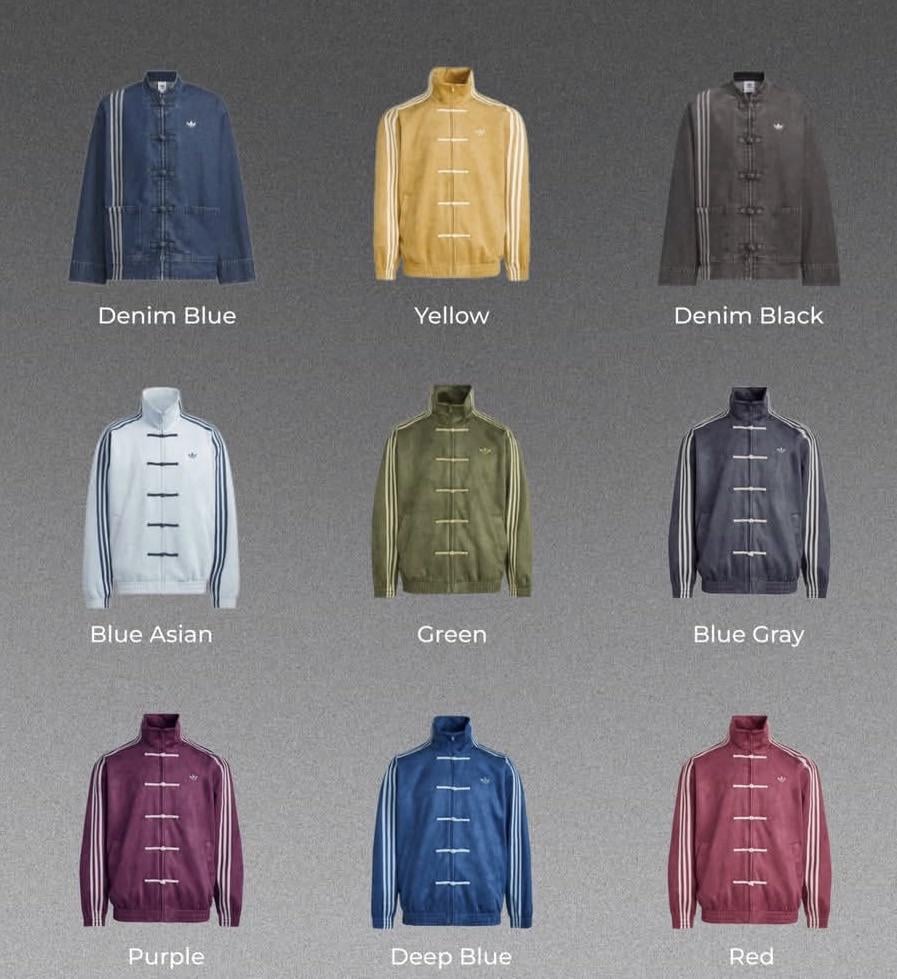
It is precisely this ambiguity that sparked the conversation. When the jacket began circulating outside its original context, a dispute over how to name this type of garment was reignited. Mandarin jacket for some, Tang jacket for others. A debate that appears linguistic, but in reality concerns control over cultural narratives: who decides what is “Chinese,” and based on which history.

The point is that even the history of the elements that make up this design has never been linear. The silhouette we now associate with these jackets derives from the Manchu magua, a functional garment designed for horseback riding and later imposed as a visual code during the Qing dynasty. Even details considered iconic, such as knot closures, did not originate as symbolic ornamentation, but as practical solutions, refined in imperial and military contexts. What we read today as tradition is often the result of adaptations, impositions, and shifts in power.
Visualizza questo post su Instagram
Even the names themselves don’t really help pin down a precise origin, as Carolyn Marie Yim also points out. Tang is a term loaded with historical prestige, but its use as a synonym for “Chinese” did not originate in China. It took shape in late nineteenth-century California, within Cantonese and Hokkien communities who had migrated to San Francisco. Rejecting the label “Qing,” the name of a dynasty perceived as oppressive, these communities looked instead to the Tang dynasty, regarded as a golden age, calling themselves Tangren, renaming Chinatowns Tangrenjie, and defining their clothing as Tangzhuang. More than an ancient legacy, then, the “Tang jacket” is the result of a diasporic strategy, born to assert dignity and cultural continuity in a hostile context.
Mandarin doesn’t come from China either. The term is the product of a long chain of translations and exchanges: from the Sanskrit mantrī (counselor), to the Malay menteri, and finally to the Portuguese mandarim, used by European merchants in the sixteenth century to refer to Chinese imperial officials. Only later did the word come to designate the language, and later still was it loaded with a broader cultural meaning. Originally, however, it referred neither to a people nor to a civilization, but to an administrative function.
The same applies to many details we now read as “traditional.” Knot closures, the so-called frog buttons, are not of Chinese origin but spread primarily during the Yuan period, tied to the practical needs of Mongol cavalry. In all these cases, we are dealing with labels and forms shaped by migrations, conquests, and adaptations, rather than origins attributable to a single place or moment in history.
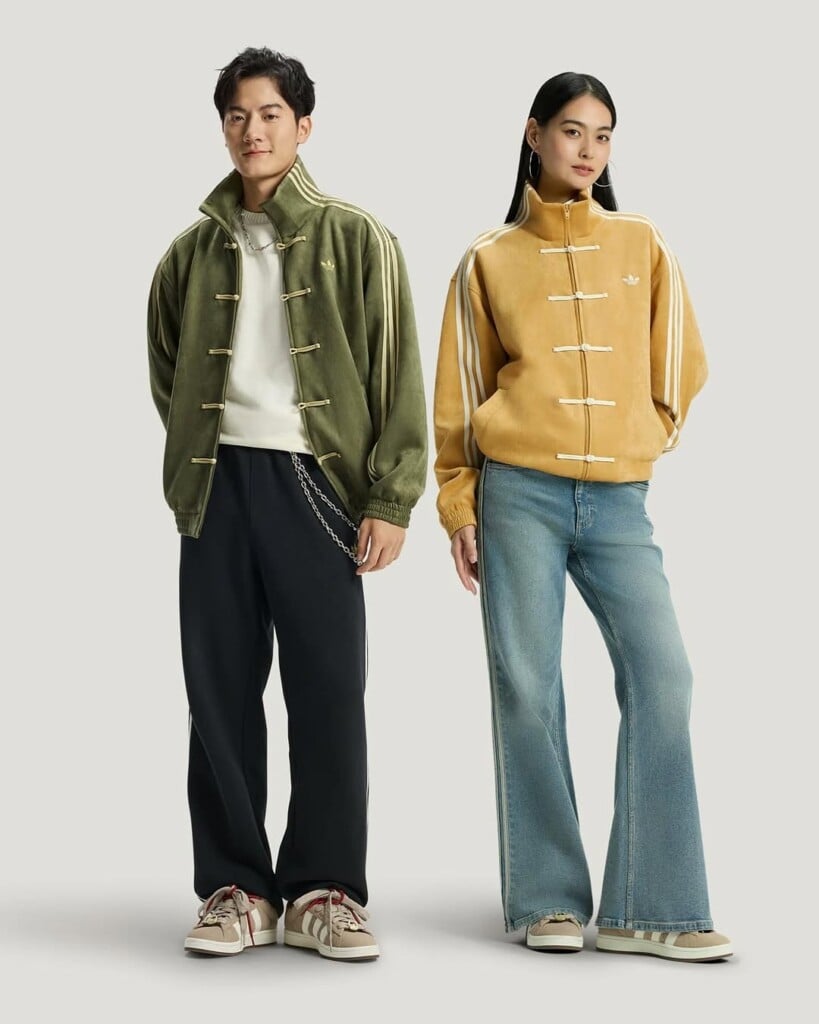
This is where the adidas jacket stops being just a product and becomes an interesting case study. It works because it embodies a contemporary condition: culture as stratification. A garment that brings together different genealogies, designed by creatives whose trajectories are not exclusively Chinese, produced by a German conglomerate, and made desirable by both Chinese and Western platforms over the course of roughly a year. Its belonging to Chinese culture does not necessarily correspond to a single truth, but to something, precisely, more layered.
And perhaps this is exactly why the jacket has worked so well online. Not as a symbol of belonging, but as a surface onto which different meanings can be projected. Rather than asking what the correct name is, it may make more sense to recognize the jacket for what it is: a garment that exists halfway between misinterpreted information and viral aesthetics. Not a heritage to be preserved, but a form in motion.