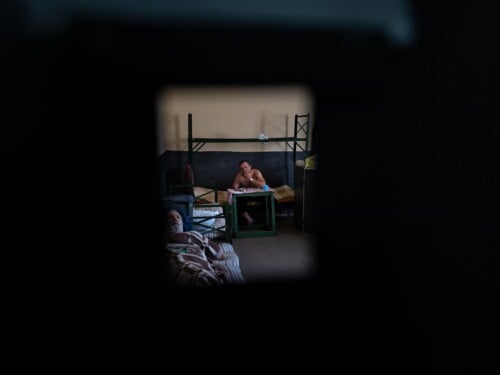
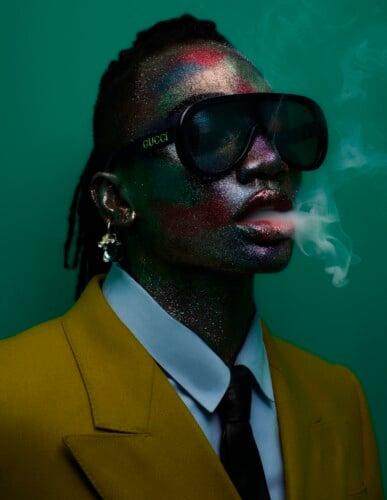
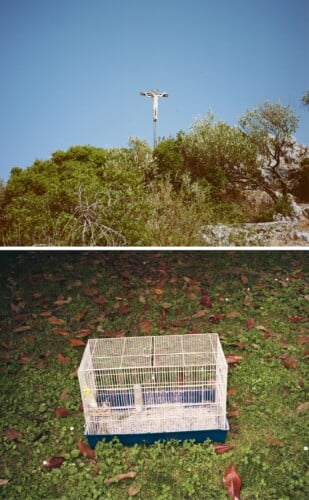
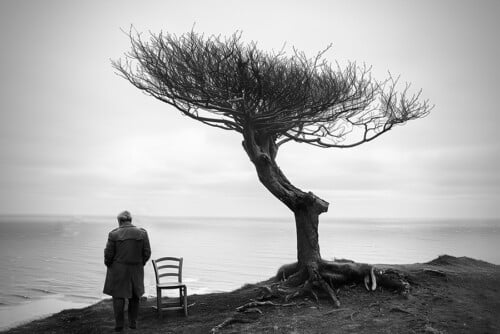
Launching “PhotoDesk,” Collater.al’s column that takes you behind the scenes of photography festivals by exploring their origins, distinctive features, and goals, is the Fotografia Calabria Festival, the first decentralized photography festival in Calabria, which made its debut in 2022. Since then, the beautiful seaside village of San Lucido has become a true open-air stage for photography. For four years now, the festival has brought exhibitions, events, inspiring talks, and workshops led by both Italian and international photographers.
The idea behind the Fotografia Calabria Festival is clear: to enrich the cultural landscape on both a national and regional level with an artistic proposal that, thanks to the communicative power of photography, can not only inform and move audiences, but also educate and encourage reflection on current and universal themes. The festival is also an important opportunity to give space to young photographers, creating meaningful collaborations with cultural institutions and artistic residencies to support them in their creative journey.
And it is precisely these opportunities that we discussed with Anna Catalano, artistic director of the Fotografia Calabria Festival.

The Fotografia Calabria Festival was born in a territory often portrayed from the outside in a stereotypical way. You, on the other hand, see it as a place from which to start new narratives, almost as a living material for dialogue, a voice with which authors must engage. Calabria thus becomes a starting point for a reflection that turns universal, one in which everyone can recognize themselves. What idea of Calabria guides your curatorial work and continues to shape the festival year after year?
The Fotografia Calabria Festival does not pursue an artificial image of Calabria—glossy, polished, too perfect to be true. On the contrary, it seeks to convey the idea of a Calabria that is not afraid to bare itself, to show and accept itself for what it is today: wild, fragile, still too little aware of its own beauty and strength, full of contradictions and distortions, a bit rough out of fear of being betrayed again, yet always welcoming and generous. If I had to choose just one word, it would be “authenticity.” This is the idea that guides, perhaps quite unconsciously, the entire curatorial line of the festival.
The open call and the residency are your main access points for authors who wish to submit their work to the festival. You don’t ask for reflections “about Calabria,” and in doing so you attract authors who are simply willing to engage with a complex and fertile context. What qualities make a project truly suitable for the Fotografia Calabria Festival? What kind of gaze are you looking for in participating authors?
Projects must be able to position themselves within contemporary photography while having a strong conceptual structure—this is fundamental for me. A work that relies solely on aesthetics for their own sake, that is self-referential, without critical thought or research, and that does not generate value for the viewer, does not interest me. When I visit a festival or an exhibition, I want to go home with butterflies in my stomach, with a sense of disturbance or with a smile. That’s what I want for our visitors as well. As for the authorial gaze, I prefer an analytical one, from which a deep respect for the subject and the theme clearly emerges.

In a landscape rich with festivals, artists are increasingly selective about where they invest their work. Why should an author want to be selected for the Fotografia Calabria Festival? What concrete opportunities can they find here that they might not find elsewhere?
The Fotografia Calabria Festival offers authors a physical and virtual space of international visibility. Participants come from Italy and abroad, share their presence on social media, and generate a strong amplification effect within the photography sector. Authors are directly involved during the opening weekend, which becomes an opportunity for exchange and professional growth. We pay great attention to the festival’s communication, ensuring strong media visibility for every project. In addition, photographers receive a participation fee and have their travel and accommodation expenses covered. Exhibitions are curated by a highly experienced exhibition manager, and each edition is accompanied by a dedicated catalogue.
Many talk about “territory,” but few manage to make it a living part of the creative process. What makes your festival impossible to replicate elsewhere? The relationship with local communities? On-site production? The curatorial approach?
The dialogue that is gradually being established between the event, its language, its desire to sow beauty, and the place that hosts it—San Lucido. It’s a fundamental pairing. I can’t say whether it is replicable elsewhere or not, but I can say how beautiful and moving it is to see a photographer like Marie Tomanova arrive from New York, present her project in the Church of Pietà where it was exhibited, and then thank Mrs. Mena, 86 years old, for opening and closing the church every day. These kinds of cross-pollinations create sparks.