Born as a digital platform dedicated to contemporary photography, PhMuseum has gradually built an international community of authors, curators, and publishers, becoming an active observatory of emerging visual practices. With PhMuseum Days, the project takes on a physical form in Bologna, shaping a festival that isn’t simply an exhibition showcase, but a concrete extension of curatorial work developed throughout the year. PhMuseum stands out for the continuity between platform and festival, for its structural focus on open calls, and for an idea of photography understood as a critical language even before it is the production of images. We spoke with Giuseppe Oliverio, founder and artistic director, to understand how a project can hold together as archive, community, and a live space for exchange.

PhMuseum Days works each year around a strong theme that runs through exhibitions, talks, and educational activities. How does the theme come about, and how does it become an operational tool—not just a narrative one—in building the edition?
There are many factors that influence the choice of theme: our research in contemporary photography; our personal interests—what we’re passionate about and want to explore; current topics and trends; and authors who inspire our understanding of photographic language and whom we would like to work with. We try to bring all these elements together, looking for a balance between conceptual coherence and interpretive freedom.

PhMuseum was born as an international platform active year-round, while the festival is a time-concentrated event. What is the relationship between these two dimensions? What truly distinguishes them, and what makes them inseparable?
Our curatorial work, the meetings, workshops, and the space dedicated to photobooks are all nourished by the activities we carry out online every day and by the many artists and professionals we collaborate with. The festival is the opportunity to synthesize this research and collaboration, bringing our digital experience into a physical dimension. With each edition we try to reach a broader audience that can discover our world, become passionate about the artists’ work, and share a critical point of view.
Festival and platform feed each other, but they have a different—and almost paradoxical—essence. The festival is experienced slowly—visitors stay for several hours and often come back for talks and other activities—but it lasts only four days and then disappears, overall an experience as exciting as it is ephemeral. Online is experienced very quickly, but there is a steadiness to the interactions that happen day after day, becoming a long-term exercise through which our ideas, taste, and culture take shape—often on an unconscious level.
In an ecosystem dominated by the rapid consumption of images online, what kind of live experience does PhMuseum Days want to offer? What can happen in physical space that doesn’t happen on the digital platform?
The exhibitions I often find most interesting are the ones where I end up looking at a work for several minutes. In our exhibitions I try to create that kind of relationship between the audience and the exhibition circuit, also personally curating the design and production. Real space—unlike digital space—offers countless possibilities in terms of scale, distances, materials, lighting, installation supports, and the overall “energy.” A photography exhibition can be experienced in a few minutes or engage the visitor for much longer; it all depends on attention to detail and on devising a path and presentation that dialogue with the many layers that many contemporary photographic projects offer.

Today festivals are inevitably fleeting events. What responsibility do they have, in your view, in educating people to read contemporary images? And how does PhMuseum try to work on this level, beyond simple exhibition-making?
I believe there is great educational potential in festivals. They often coincide with a moment of travel or reflection in which visitors take time to connect with themselves and their experiences, or to look with greater depth and completeness at current issues that are often addressed in a fragmented way by traditional communication channels.
I think it’s very important that, in this context, institutions offer a key for reading the exhibition path presented—especially for those who have little experience with the language of images, which, unlike textual and verbal language, is not taught in school. It’s not about explaining everything—because it’s important to respect the author’s intention and the freedom of photographic language—but about offering an interpretation that can allow everyone to enter into the photographers’ research on view.
We try to do this by paying close attention to introductory texts, by shaping a thoughtful program of talks, and by organizing guided tours with the authors or with our team. We dedicate a lot of time to creating a friendly, informal atmosphere in which participants feel at ease and therefore more encouraged to share ideas and emotions.

PhMuseum’s open calls seem to work not only as selection tools, but as critical devices. How much does an author’s ability to reflect on the language and context of images matter in your selection criteria, beyond their visual strength?
Seeing so many works each year and talking about photography every day allows us to develop a certain sensitivity and to grasp the potential of a project—one that, as I was saying, can be expressed in physical space. If I stop to think about the roughly 70 exhibitions I’ve curated over the last five years, I see two recurring elements. The first is the presence of multiple layers on a narrative, conceptual, or research level. The second is the author’s deep connection/interest/passion for the story or theme being addressed. Works with these characteristics often express a photographic strategy that is surprising and coherent with the author’s critical point of view.

Looking at the projects selected over the years, can we identify recurring threads that tell a “PhMuseum vision” of contemporary photography? Do open calls help build a shared imaginary?
PhMuseum’s curatorial vision is certainly drawn to projects with a critical, post-documentary approach, where the use of language and the authorial process dialogue with each other and are often more important than formal aesthetics. In this context, open calls are a kind of dynamic, international observatory capable of mapping and codifying new visual paradigms year after year. Our work draws a lot of strength from this global participation and focuses on sharing and elevating projects that we consider representative of this contemporary imaginary.


The photobook hub and the attention to visual publishing are a structural component of the festival. What role do you attribute today to the photobook in shaping critical thinking around images?
It is certainly an extraordinary medium for the dissemination and preservation of so many projects that help form this contemporary imaginary and that would otherwise probably be lost—or at least diluted by time. Moreover, books—like exhibitions—have many characteristics (format, binding, cover, paper, layout, pagination, etc.) that can enhance the nature and layers of a work, becoming a real experience for those who flip through them—beyond being an art object for collectors.

Workshops, portfolio reviews, and talks are central to the program. Is the goal to offer opportunities for visibility, or to accompany authors in a deeper growth path? How do you measure the impact of these activities?
While talks are primarily tools for dissemination and reflection, workshops and portfolio reviews are also an opportunity to develop the author’s critical awareness and their project method. The impact is measured through the formal evolution of projects and the opportunities that can arise from expanding one’s network. We try to involve experts who can offer a deep perspective on an author’s work or open up new paths for these projects.

PhMuseum Days engages with the city through unconventional venues like DumBO. What kind of relationship do you want to build with the urban context and with an audience that isn’t necessarily “industry”?
From a formal point of view, we’re interested in exploring the exhibition possibilities of photographic work—or work in which photography is a central component. I believe there is still a lot of room for research and experimentation on this front, and we like working with artists who share this spirit and take certain risks together with us. As for the audience, beyond artists and professionals in our network, we also try to involve non-specialists and very young people, because interest in photography has become increasingly cross-disciplinary in recent years, and their point of view is often very interesting and gives us prompts to evolve—or simply to see our work differently.

At a historical moment in which images are everywhere, what do you consider more urgent today: producing new ones or providing tools to read them better? Where does PhMuseum, as a cultural project, sit within this tension?
When PhMuseum was founded in 2012, our mission was to offer tools to understand the language of images, develop an independent critical point of view, democratize access, and stimulate collective participation. Fourteen years later, I believe good work has been done in this sense—and given today’s context, that mission is more relevant than ever.
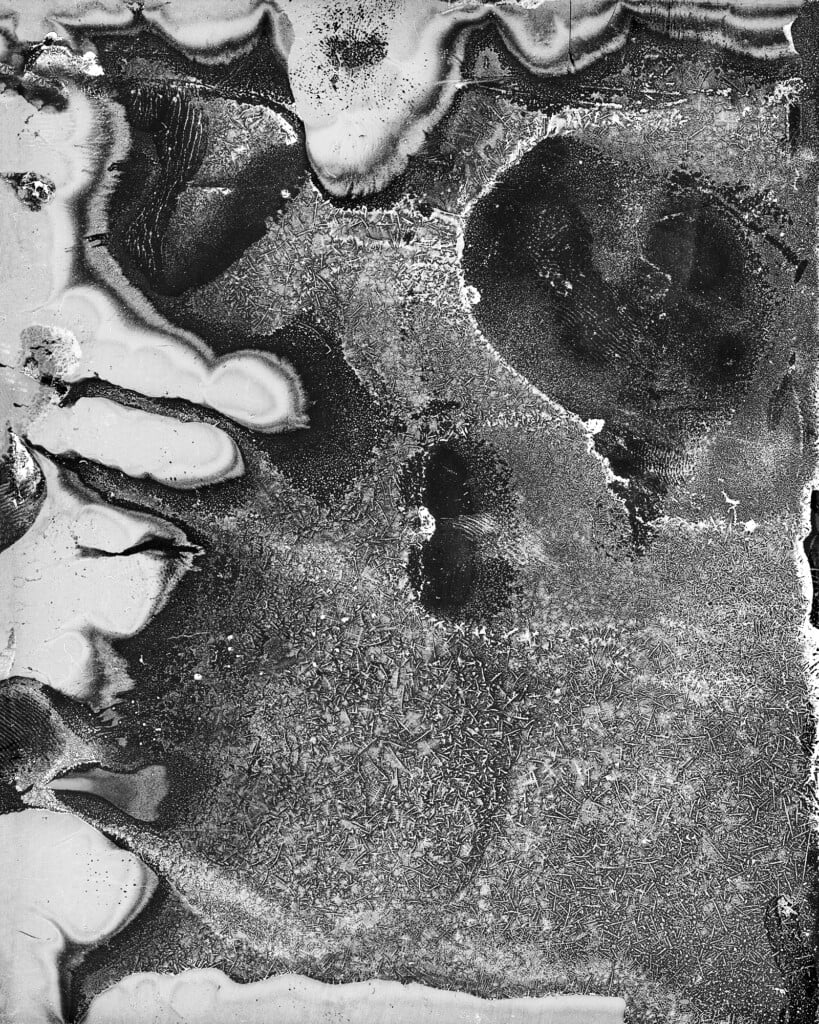
in cover: Anatomy Of An Oyster © Rita Puig-Serra – from PhMuseum Days 2024