ZeroNegativo is a nomadic festival that connects photography and nature, dissolving their boundaries and allowing them to exist as a single living organism. What guides the festival’s path is the creation of spaces for exploration, collaboration, and experimentation, where photography is embraced as a free practice, open to different languages and the unexpected possibilities that emerge from movement. It is this vision that guides the adoption of natural spaces, essential, suspended between presence and silence. ZeroNegativo is the place where photography and nature have never been so close, and for this PhotoDesk feature, Artistic Director Giuseppe Maiullari talks about it.

ZeroNegativo was born as a festival that works with the natural landscape and not simply within an exhibition space. What curatorial criteria do you use to prevent nature from becoming mere scenery and instead allow it to act as a critical device in the reading of images?
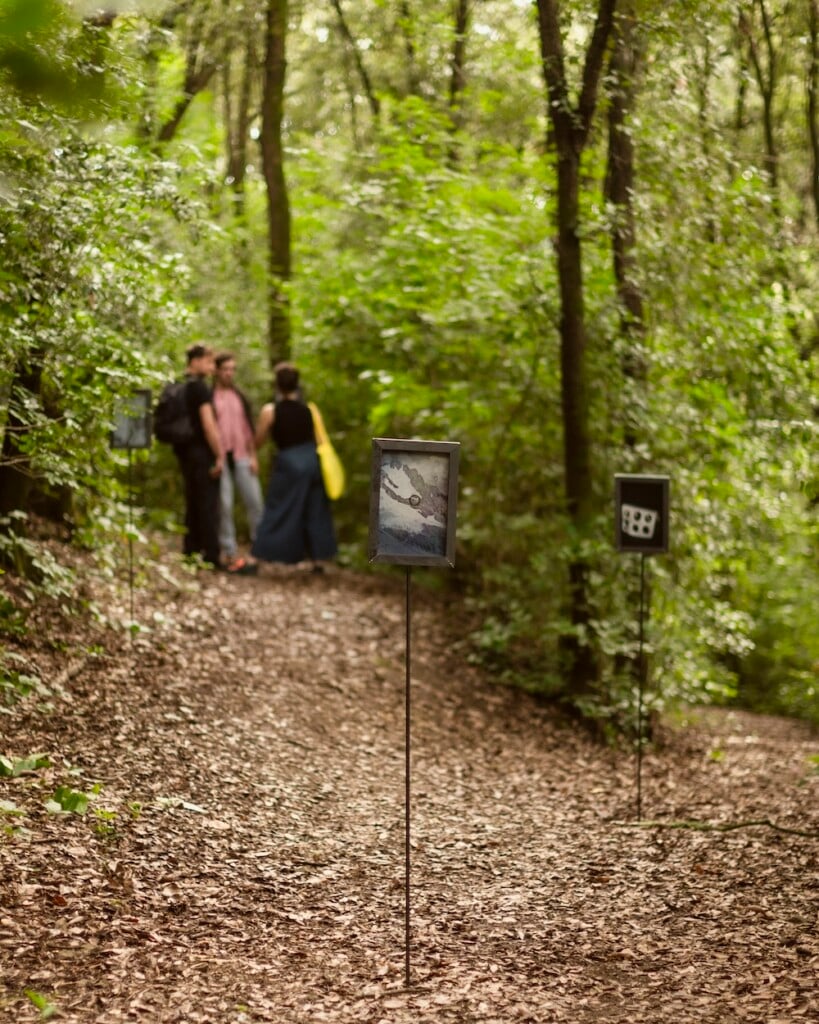
The landscape is not scenery, but co-author. Nature acts as a critical device because it removes the artwork from the protection of the gallery’s “white cube,” allowing both the artist and the audience a raw and unpredictable confrontation with reality. Thanks to the continuous movement of the sun, everything undergoes transformation, minute by minute. The spaces experienced during the festival allow visitors to observe the work not from a single predetermined viewpoint, often frontal, but with personal expressive freedom. Past experiences, carried out exclusively in outdoor spaces and dependent on weather conditions, have led us today to integrate natural spaces with designed spaces, which, like the first, will still allow the adaptation of the exhibition to the shapes of the place. The goal remains to preserve a narrative that adapts to the forms of the location and listens to its rhythms, amplifying meaning and expanding the senses.
Open calls are a central point of the festival. What kind of projects are you really looking for through these calls, and what makes a proposal “suitable for ZeroNegativo” even when it goes against formal expectations or dominant trends in contemporary photography?
Authenticity and the need to express oneself, beyond the subject matter, are the elements at the core of our imagination. For this reason, our primary and constant choice is to propose open calls that do not impose a narrative track, allowing the urgency of the artist to guide the proposal. Without external constraints, we follow a line that evolves according to our own development, remaining faithful to photography as a language and pure form of expression. This approach stems from the desire to foster both personal and collective research. Staying open to still-unknown languages allows us to question certainties and grow the festival alongside the visions we host. The choice to involve emerging guests, already active in the contemporary photography scene, is also a step toward close contact with young authors seeking space and exchange in a sector that is today extremely delicate and often saturated with pre-packaged content.

Workshops and micro-publishing paths are not collateral activities but a structural part of the festival. What is the idea of training and growth for artists behind this choice, and how does it differ from the more standardized educational formats of photography festivals?
The formats presented by Zero aim to maintain lightness in the experience itself, so that besides being a source of learning and interaction with the artists, they are also a source of connection and, in a sense, enjoyment. Rather than focusing on academic training, we aim primarily, in addition to mere transmission of information, at the sincere exchange of skills, perspectives, and opinions. Essential is the involvement of industry professionals who, embracing our approach with enthusiasm, share their knowledge effectively.
The focus is on micro-sectors, where topics are addressed collaboratively to enrich the authorial evolution of everyone, including amateurs, day by day. The growth of the artist, in our context, happens precisely in that fluid dialogue where one person’s knowledge stimulates the other. Evidence of this approach lies in the collective portfolio review experience of ZN25—a moment that was highly successful not only technically, but especially emotionally and socially. It became a true open debate hub, breaking down barriers and transforming critique into an opportunity for shared growth.

ZeroNegativo mixes exhibitions, talks, music, performances, and social moments. This is not a neutral choice: it risks dispersion but can generate community. How do you work on balancing experience and content, preventing the festival from becoming more “atmospheric” than cultural?
I believe that entertainment within the art world is fundamental: deepening new knowledge through as many circumstances as possible is a necessary enrichment, especially in a socially fragile historical moment. Although photography remains our main focus, we do not aim exclusively at that world. It is not the only possible practice, but one among many expressive forms inhabiting our space. This choice reflects our collective: we are not just photographers, but a reality nourished by constant dialogue between different disciplines and shared passions. The goal is not to create the atmosphere, but the comfort zone suitable for everyone.

You announced a new edition taking place in summer in Puglia, marking an important shift: ZeroNegativo leaves its original context and engages with a territory that is culturally and scenically very different. What have you decided not to bring with you to Puglia, and what was indispensable to maintain the festival’s identity?
We come from a Tuscan culture, rich in beauty and rigor, but carrying the risk of mirroring the past. Just as in nature, if a forest is too dense with old trees, light doesn’t reach the ground and nothing new can be born. This is why we feel the urgency to move, not remain static, and seek in Puglia a new dialogue with actors awaiting change, in a context currently undergoing strong transformation.
We bring with us an unprecedented adaptability, with roots able to reach diverse geographies, following the heterogeneous backgrounds of the group. Above all, the essence of ZeroNegativo was indispensable. Everything, as in previous editions, will always be concentrated in a single space with open boundaries.

Many festivals grow by adding numbers, names, and visibility. What kind of growth do you envision for ZeroNegativo: more scale or more depth? And what is, today, the greatest risk you feel in its development?
Our awareness is certainly that we have been thrown into a world often reduced to numbers and renown names recycled by the industry. However, growth follows a rational path, seeking to understand through comparison who we want to be and who we do not want to resemble. Today we envision the project as an artistic outlet, a form of protest against everything we endure daily and against the prejudices continuously directed at our generation. For this reason, I see no risks in our development, and we do not seek numerical growth for its own sake, but rather a depth of connections that must carve their own path.
“ZeroNegativo defines itself as an independent festival. What have been the most difficult challenges in organizational autonomy, and how have you addressed them in terms of artistic vision and sustainability?”
The most difficult organizational challenge is the complexity of accomplishing a common goal solely with our own physical and financial resources. We run the festival alongside our personal and professional lives, and inevitably fall into the trap of comparing ourselves with organizations that have very different foundations and resources. We addressed this ‘bias’ by consolidating a relationship of mutual support: where one cannot reach, the other always will. In terms of artistic vision and sustainability, our solution was to stop relying on established models and focus on our own dimension. We have learned that autonomy comes at a cost in terms of effort, but it guarantees us a freedom of choice that is indispensable for us.

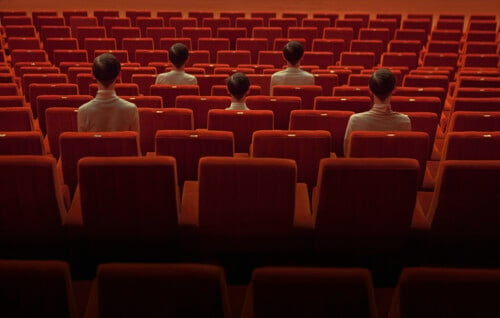
Cover ©ShantiSimonetti&SabrinaCapotorto