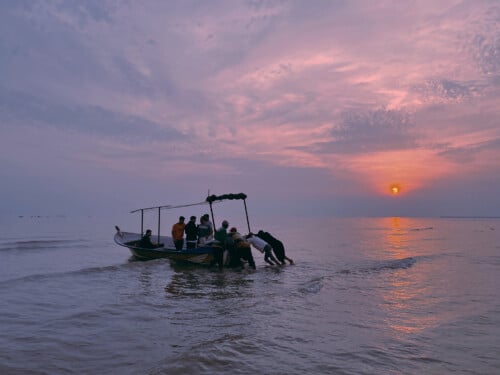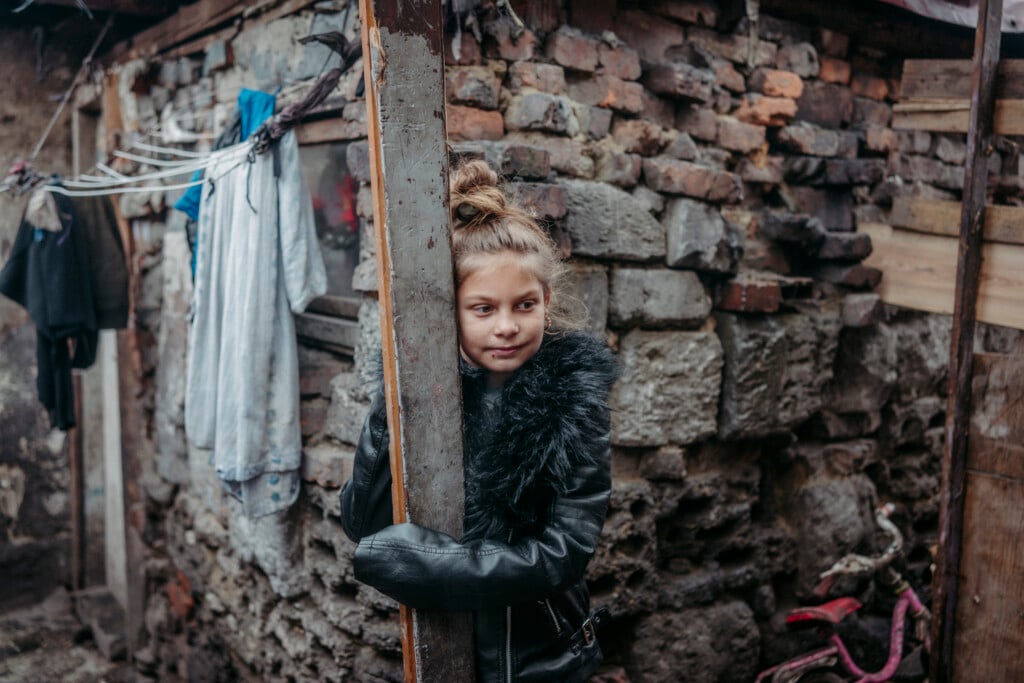
With Rome Princesses, photographer Manuela Federl builds a visual narrative that borrows the language of fairy tales to tell a reality that is anything but fairy-tale. “Once upon a time there was a princess in the Roma ghetto,” reads the project’s opening line. And from there, a rift opens between dream and social condition, between imagination and an everyday life marked by exclusion, poverty, and systemic discrimination. The protagonists are young girls living in Roma settlements in Trebišov, Sečovce, Svinia, and Lunik IX, in eastern Slovakia—places where opportunities are scarce and the future can feel already written.

Federl chooses not to depict marginalization through harsh or didactic images, but to overturn the gaze: her “princesses” are portrayed in elegant clothes, proud poses, and direct looks into the camera. It’s a conscious, almost theatrical staging that short-circuits the glossy aesthetic of the fairy tale with the real context of the Roma ghettos. The contrast isn’t there to soften the situation, but to make it even more evident. Those crowns, those dresses, those gestures are the symbol of a shared desire: to be seen, to be recognized, to have access to a different life.

The project is rooted in an extremely complex social condition. In these areas of eastern Slovakia, the Roma minority often lives under intense segregation. Children do not attend the same schools as their Slovak peers, but are steered toward separate schools or “special” institutions—a system that effectively blocks access to higher education and vocational training. For girls, the situation is even harsher: support is almost non-existent, early marriages and early pregnancies are common, and young couples find themselves having to provide for families with no economic security. A vicious cycle that is incredibly hard to break.

Rome Princesses moves precisely within this fragile space, giving visual form to a dream that many of these girls likely nurture: to be saved, to be able to choose, to have “the world at their feet.” But Federl offers no easy solutions and no redemptive narratives. The “prince” evoked by the fairy tale remains a symbolic image rather than a real promise. What remains instead is the protagonists’ dignity, their strong presence in front of the lens, and the possibility—if only for a moment—of imagining themselves elsewhere.

In perfect balance between documentary photography and conceptual construction, Manuela Federl’s work uses aesthetics as a political tool. Rome Princesses isn’t only about Roma communities in Slovakia, but about how society decides who is allowed to dream and who isn’t. And how, sometimes, making a dream visible is already an act of resistance.