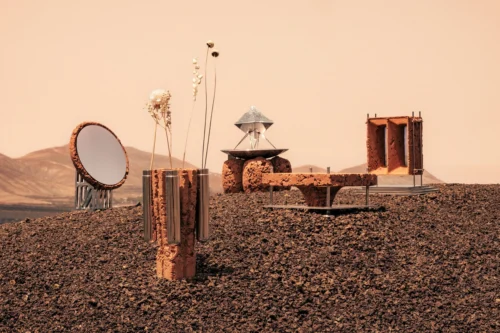
With An Empire Built on Waste, digital artist and designer Emanuele (Jane) Morelli launches a powerful visual indictment against fast fashion, particularly the hyperproduction model promoted by global giants like SHEIN. The work—generated with the help of Midjourney—depicts a landscape made of mountains of textile waste, symbolizing the enormous environmental and social impact of the fast fashion industry.
Visualizza questo post su Instagram
«Every haul, every impulsive swipe, every €2 top, feeds a mountain. A mountain that doesn’t disappear when the trend passes,» writes Morelli in the post accompanying the image. An image that, according to the designer, is not a hyperbole, but a mirror. A mirror that forces us to look at what we usually choose to ignore: opaque supply chains, synthetic fabrics, underpaid labor, and pollution. But criticism hasn’t been long in coming.
The conversation around the piece didn’t stop at analyzing its content. One comment in particular raised an equally urgent critique: «You justify using AI by saying the message wouldn’t have come through with other means, but clearly the message didn’t get through anyway. Don’t you see? Using AI destroys the planet in the same way as fast fashion and brands like SHEIN. Your message is useless if spreading it contributes to the planet’s destruction».
This observation opens up a broader discussion: can a work that criticizes an unsustainable system be beyond reproach if it’s made with tools (like generative AI) that themselves raise questions about energy consumption and environmental impact?
Morelli has previously responded to similar criticisms, stating that while artificial intelligence is not neutral, it enables the visualization of concepts that are hard to communicate through traditional media. In this case, Midjourney’s hyperreal and surreal images serve to make the invisible visible: what hides behind the labels on our clothes.
With An Empire Built on Waste, however, the tone is more direct, more political. «Fast fashion isn’t fashion. It’s a cycle of extraction, production, pollution, and waste, disguised as choice,» Morelli writes. And adds: «We can’t keep celebrating empires built on exploitation and call them innovation».
Rather than offering definitive answers, the artwork—and the debate it has sparked—poses uncomfortable questions. Is it possible to use imperfect tools to convey ethical messages? Can we separate the means from the ends? The risk of hypocrisy is real, but perhaps the value of this conversation lies precisely in the tension between ethics and technology. In the meantime, the artist’s call remains clear: «It’s time to rebuild—slower, fairer, cleaner».