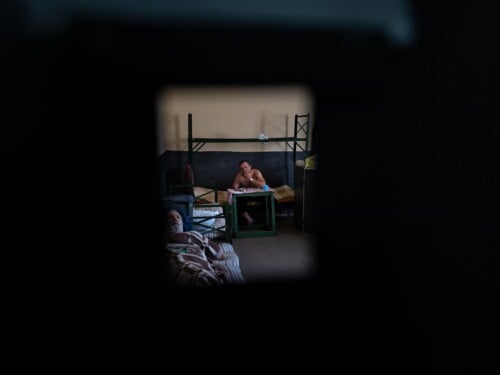
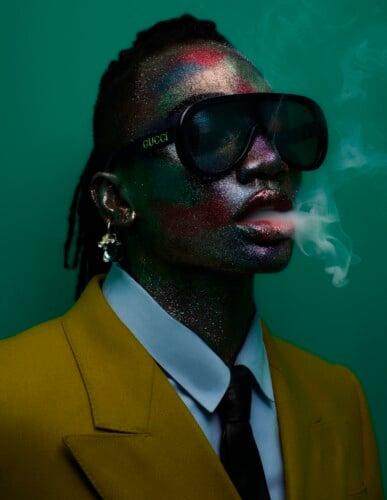
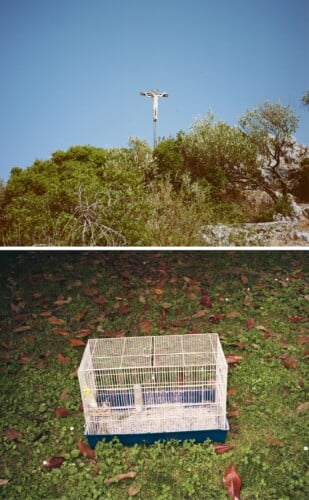
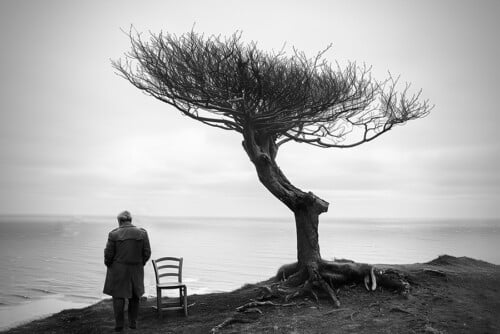
It was the early 1980s when Sophie Bramly—born in Tunisia in 1959 and raised in Paris—at just 22 years old set her eyes (and camera) on the New York hip-hop scene. After moving to New York following her studies in graphic arts and photography at Penninghen, she immersed herself in the Bronx for three years, closely following the emerging creative scene and abandoning any journalistic distance. James Brown, John Cale, Nico, Sly Stone, and Prince are just some of the artists the photographer has captured over the course of a career that has always privileged intimacy over spectacle. But Sophie Bramly is not only a photographer. A television producer and director, she has worked between France, London, and the United States, playing a key role in the spread of hip-hop culture in Europe with shows such as Yo! on MTV Europe. From her early music-related work to more recent projects—from the youth of Roubaix to the intimacy of male bodies—her gaze has remained consistently documentary, focused on fragility and marginal trajectories. We sat down with her for a conversation: starting from stories of close encounters with music stars, we arrived at the themes that now lie at the heart of her research.

Could you tell us more about your encounters with figures like James Brown, Prince, John Cale, Nico or Sly Stone? Were these assignments, personal projects, or situations that developed more organically? And are there particular stories or moments connected to these experiences that you feel were especially formative for you as a photographer?
My encounters with musicians were always a little special. We usually bonded in some unexpected way and often became friends, which allowed me to photograph what I care about most: fragile moments, off-beat moments, those tiny fractions of time your eye can’t really register but your intuition knows are there. A kind of hidden truth that only photography can catch.
James Brown was an assignment. I went to his hometown of Augusta, Georgia. He kept me and a journalist waiting for three days in a rather miserable motel, gave me exactly five minutes to shoot him in a parking lot, and then turned out to be the kindest man. We ended up having lunch together.
That contrast stayed with me. I saw him again two or three times after that, and there was always unexpected moments.

Prince was also an assignment, for Gamma Photo Agency, during the Purple Rain tour. He wasn’t very famous in Europe yet, but I convinced the agency to send me. I was a huge fan and had already met him and his team in the most unlikely situations in France: first in an empty nightclub where it was just them and me, and a few months later while he was shooting scenes for Under the Cherry Moon in a friend’s house in the south of France. I also photographed and filmed many of the artists and musicians around him, and some are still my friends to this day.


I photographed Nico when I was still an art student, temping in New York. She was staying in a friend’s apartment, just like me. It was a very dark moment for her. She would wake up with vodka and pills, often unable to find her way back to the flat. I tried to show nothing more than her sadness. I never sold those photographs.

As for Sly Stone, I remember going to some obscure club uptown where he was supposed to play. Everyone told me it was a waste of time, that drugs kept him mostly on his couch. But he showed up. There were maybe ten people in the room, in a club built for hundreds. I only sold those images last year, when he died.

John Cale was at a friend’s house. Later that evening we went to see Grandmaster Flash and the Furious Five at the Ritz. I was intrigued by his interest in hip-hop. He was so quiet, so low-key. The contrast was fascinating.

Throughout the 1980s and 1990s, I focused on artists on their way up and artists on their way down. That’s when fragility appears. At their peak, artists tend to be full of confidence, and I find that less interesting. I was a music fan, so that was my entry point, but I gradually understood that I wasn’t there to make glamorous images of brilliant performers. I was there to look for the only two things I’ve ever really searched for in people: intimacy and fragility, which often go hand in hand.
Looking at your broader practice, how did your approach evolve from those early music-related works to later projects such as Roubaix? What motivated that shift toward documenting social contexts and everyday realitie
First, there’s a reality I have to deal with. I may be wrong, but I don’t think I could do today what I did back then. Artists now tend to show their intimacy on social networks, photographed by people from their own circles. Photographers are mostly asked for glamorous moments. I often ask myself: could I show up today at Cardi B’s house, or Doechii’s? Would management and all the people around the artist let me in? I doubt it. And I’m not even sure I would see the same things anyway.The industry has become even bigger than it was, with issues we didn’t have in the last century.

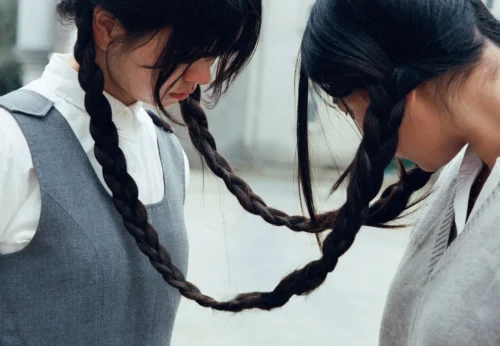
I think I moved toward projects like Roubaix or the unknown suburbs of Paris for two main reasons. First, I’m not a competitive person. As soon as I’m surrounded by too many people doing what I do, I feel the need to run away and look somewhere else. Second, when I was a child, I wanted to become a lawyer. I couldn’t stand injustice. That feeling never really left me. So looking at people no one looks at, or at places that are abandoned or ignored, is that part of me still hoping for justice. And ironically, their fragility often carries more hope than what I find in privileged environments.
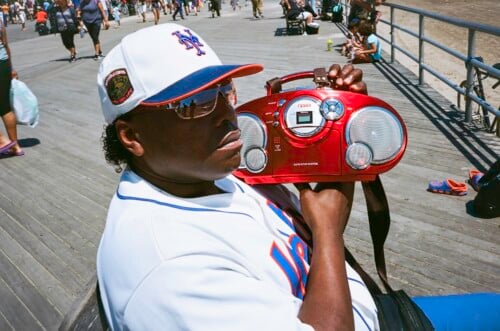
I know it’s hard for people to see a link, but it is clear to me that what I did then and what I do now, is also based on the influence the hip-hop scene had on me. The Bronx was devastated and yet kids were full of hope, joyful, incredibly creative, full of energy, something I couldn’t see in the privileged world I was accustomed to. There was a lesson to be learned there and it stuck with me all my life.
We were also very interested in your project on non-stereotypical male bodies. Could you expand on your idea of the “female gaze” in this context, and on why you feel this perspective has been largely absent or overlooked?
I’m quite obsessed with that question. For years, I’ve wondered why women artists haven’t really developed a female gaze and never heard an answer I could be satisfied with. Feminist artists have existed since the early twentieth century, yet many have looked at women in ways that are not so different from how men do. How feminist is that? Some people tell me I’m wrong, that women look at women with sympathy and shared understanding and it is a crucial focus for now. Maybe. But how can we truly overturn stereotypes if we never really look at men? Apart from artists like Louise Bourgeois, Marlene Dumas, and a very small number of others, I don’t see much of that, female photographers included.

Maybe it’s because women are still kept under a form of control. A woman addressing sexual issues is still perceived as a threat. But it is precisely for that reason we should look into it. It makes women stronger and men more vulnerable: there we should be able to find a balance. Maybe it’s also because it’s not easy. Showing up in an apartment and asking a man to undress can mean very different things for him. I wasn’t always comfortable myself.

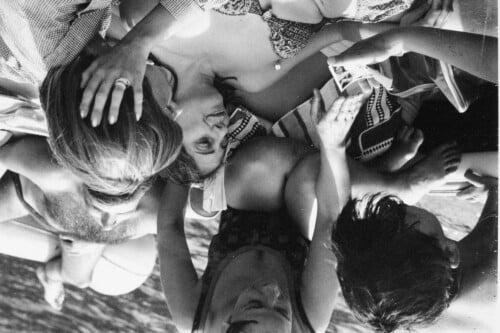
Eventually, I started working with my daughter, who is also a photographer, though in a different field. We photographed men one after the other and mixed our views in a book we released last year. Since then, I’ve started a new project of male nudes with more confidence. I’m asking for no erections, as I’m still looking for fragility. That turns out to be a problem for some men, who struggle with the idea of not presenting their virility at it’s “best.”
Finally, thinking about your most recent work on the 26 French suburbs, how do you see this project fitting into your journey today? What themes or questions feel most central to your practice at the moment?
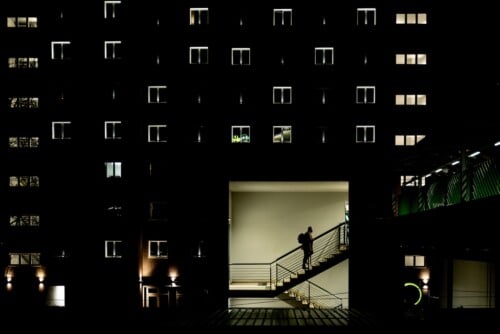
We live in an interesting time. Truth is slowly disappearing, while egos and narcissism are growing at high speed. Everything leans toward fiction, and the more obsessed people become with falseness, the more obsessed I become with reality. The suburbs I chose are unknown even by name to most French people. No one really looks at the people who live there. Their daily lives are relatively peaceful, almost uneventful, yet marked by a kind of structural fatigue.

But because no one pays attention to them, they live with a certain freedom, spared the constant weight of judgment. My ambition is neither to denounce nor to glorify, but simply to give a visual existence to these territories. At a time when suburbs are often framed as problems or threats, this project proposes a counter-narrative: that of quiet, anonymous, altruistic towns, where contemporary ways of living together quietly unfold. For me, it always comes back to justice. Why ignore them just because they are neither stars nor the so-called dregs of society? And it always comes back to fragility and intimacy.

These places don’t perform and people don’t dramatize themselves. The absence of a grand narrative is precisely what interests me. Within this invisibility, another reality is at work. Some of these places are accessible only after one or two hours by train. That distance is both literal and symbolic. As in Roubaix, I use a medium format camera, which plays a key role. It gives the images a certain formal nobility, creating a balance between documentary precision and a tender gaze, far from exoticism or pathos.
image courtesy Sophie Bramly
Read also: The Forgotten Punk Photos Left in a Drawer