Born in Turin in 2018, Tamango is not just a band but an artistic collective where music, imagery, and performance intertwine to create a narrative with a strong visual and sonic impact. Alberto, Federico, and Marcello—longtime friends—have developed a project that blends singer-songwriter influences, soul, and electronic music, gradually shaping a distinctive aesthetic suspended between nostalgia and experimentation. From their early live shows in Turin to their viral success on social media and then the stage of the MI AMI Festival, the trio has captivated an ever-growing audience with high-energy performances and visionary music videos.

Tamango is, therefore, an open creative ecosystem, a collective that brings together artists from various disciplines, including Massimo Dubbini—one of the many talents who have collaborated with them. In this interview, we explore the behind-the-scenes of their journey, their approach to music and art as a shared experience, and what it means to build an artistic vision that extends beyond the music itself, alongside Dubbini and his talent for stop motion.
During the launch of their project for MI AMI, one of the most striking videos was this one, where, on the landing page of their website—both on mobile and desktop—visitors can interact with the interface. The result is undoubtedly innovative, blending various mediums such as stop motion, 2D animation, mixed media, illustration, models, and miniatures, along with a monologue from Chi ha paura dello sparviero?
But let’s start with Massimo.
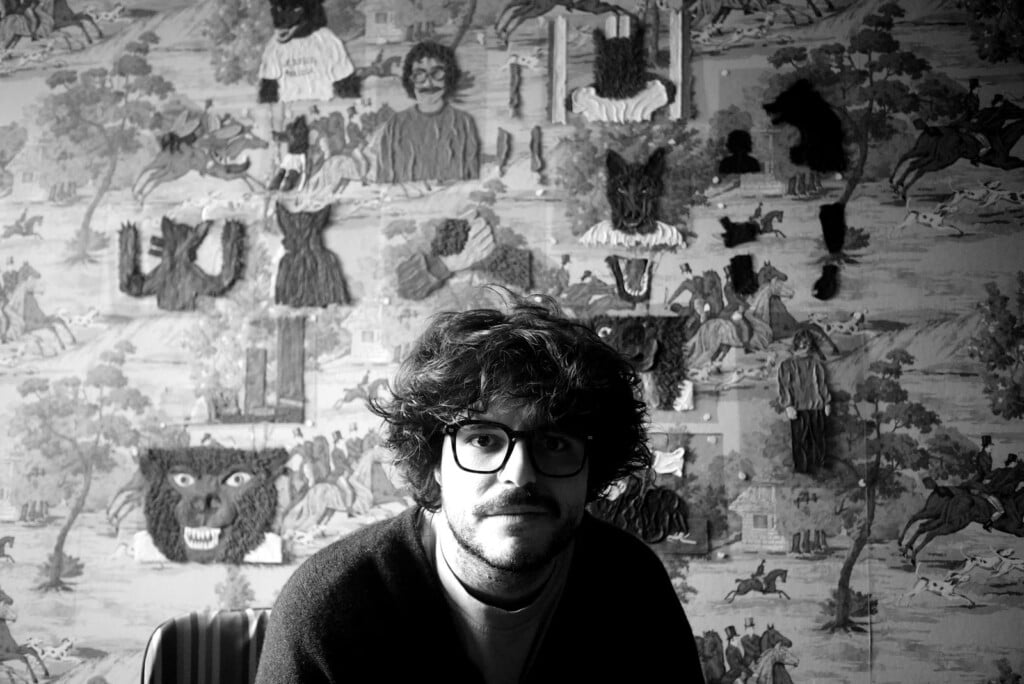
What has your relationship with creativity been like from the beginning until today?
Massimo Dubbini: I come from a family of “makers”—people who build things with their hands. I was born into an environment where everyone around me was always “creating something.” Nothing particularly artistic: my grandfather installed air conditioners, my father built houses, and my mother accumulated enormous stacks of papers, the contents of which I still don’t understand. According to my relatives (since I don’t remember much), I was inclined toward building things from an early age. I would spend my afternoons locked in my room, making toys out of wood and masking tape, soldering together wobbly structures, and customizing store-bought toys by painting them white with tempera and then—quite badly—recoloring them with markers.
As I grew older, I discovered art school. Fascinated by the huge machines that could be used to build anything, I decided that would be my path. I enrolled in the jewelry-making program, where I learned many things—including the unfortunate fact that jewelry cannot be soldered with masking tape. After five years and still slightly bewildered by this harsh truth, I decided to continue my studies at the Academy of Macerata, this time in Graphic Design (of which I knew nothing, not even how to turn on a computer). Nevertheless, I ended up learning a lot, including the fact that graphic design can also emerge from a physical and material approach.
After completing my three-year program, I had the opportunity to continue my studies. This time, completely sure of my choice, I enrolled in a two-year Art Graphics course at the Brera Academy— a program that looked much more to the past, emphasizing patience and meticulous craftsmanship rather than the rush of digital tools. During my time there, I learned new printing techniques and, through various courses, reconnected with the material world. Beyond expanding my technical knowledge, this experience reminded me of the importance of using my hands as a tool for creation, bringing me back to the child in me who built “beautiful things.”
How did you get into stop-motion and clay animation?
MD: Let’s say my approach to stop-motion was born out of necessity: I had to pass my first Animation exam. It was my first time using an animation program, and, to put it mildly, we didn’t get along well. So, I suggested to my professor that I complete the project by animating manually. His response was more than positive—he was actually thrilled with the idea. He immediately started sharing handouts and video tutorials on stop-motion techniques with me.


Realizing that clay could be a medium for illustrating images was a completely accidental discovery, born out of boredom and a desire to experiment with new techniques. I created a small artwork featuring three puppies stacked on top of each other, as if they were about to perform a choreography, framed within a clay-lettered caption that read “AHAHAH.” While working on it, I realized how much fun this technique was, so I started making more small artworks to further explore this new visual language.


After several months, while discussing the cover art for Cani with Tamango, the idea of creating it in clay came up. Partly because the song called for a direct, clear, and immediate image, and partly because we were amused by the contrast between the childlike nature of clay (essentially a toy) and the themes and sounds of the track, which created an interesting creative tension.
What I love about clay as a technique is precisely this: it carries the atmosphere of a child’s world, visually light and playful, allowing you to create compelling contrasts with the subject matter you’re illustrating.
How did you approach the project with Tamango, and what is your relationship with their music?
MD: I wasn’t familiar with Tamango’s work; my girlfriend introduced me to them by playing Platani, a song that evoked musical sensations I hadn’t felt in a long time. So, my initial approach was that of a fan—first drawn to their themes, sound, and lyrics, and then to their way of communicating visually as well.
After some friendly “pen pal” exchanges with Luca Giraudo, I suggested collaborating on something together. That’s how we found ourselves sitting in front of a plate of pasta with tomato sauce, cooked by Marcello, discussing ideas and projects to bring to life.
Now let’s move on to the questions we asked Tamango, from their beginnings to their vision on collaborations.
How did the idea for Tamango come about, and how has the project evolved over time?
Tamango: Tamango was born in 2018 from an idea by Marcello, Federico, and Alberto. Over time, the project grew in awareness and shape, involving various artists and professionals. Today, there are 20 of us working on it—some write, some compose, some illustrate, some act, some photograph, some film, and some code. It’s a crew that collaborates across different mediums to expand a narrative and create an imaginative world where the listener can lose themselves. A prime example of this is Sirene e Pirati, an EP with three songs, brought to life through an eight-minute short film shot in Sicily.
An even more evident and recent example is L’anno del cane. A phase, a moment, an era of the Tamango project launched in February 2024 with a loud, pompous proclamation, followed by a single (Cani), a concert (Mi Ami 2025), a video (Cani), and finally a party—La festa del cane. (An event where we opened the doors of an apartment in Turin, which, for the occasion, transformed into the Casa del Cane. In each of the four rooms, we staged a different artistic performance to mirror the varying languages of the four acts from the Cani video).
Our projects don’t have a precise categorization. The latest one we’ve created is Con la faccia al sole e gli occhi chiusi. What is it? A single? A video? A poem? It’s something undefined, conceived as an expression of our self-imposed drive to pursue originality and not categorize what we do. The choice of form and language we use is the result of an effort to make the very soul of the project accessible to those who listen. We don’t believe in art that is understandable to only a few, detached or elitist. Part of the creative process must be focused on defining the best form to reach people.
In the case of Con la faccia al sole e gli occhi chiusi, releasing the video before the song was not a random choice; we thought it was the best way to immerse the listener in an environment and guide them through a journey that starts in the fog-filled apartment of the Wolf and culminates with the listening of the song.
How does it feel to be an independent entity in the Italian scene?
T: It feels great! Of course, it requires a lot of hard work—we have to think about everything! We’ve always tried to build a project strong enough to sustain itself. While the soul of Tamango is collective and finds its strength in the artistic community, independence imposes great individual responsibility on each of us. Every penny, every minute, every thought is invested with care and attention. To keep our focus on the best ideas, we often remind ourselves, almost like a mantra: “Not just because we can do it, does it mean we should.”
Being able to create a system that allows us to be the metronome of our time, without having to follow the unwritten rules imposed by the more polished sector entities, allows us to see things from a different perspective, with a broader view.
Visualizza questo post su Instagram
This isn’t by chance; it’s the result of choices and thoughts that have guided the project since the very beginning. In a time when the direction of the market, both musical and otherwise, is increasingly focused on following what works* (I’m using a word banned from our vocabulary) without taking the time to give things the proper space (at best, the time of a reel—if that second doesn’t work…), it will become increasingly difficult to evolve and stand out, especially if you try to do so by following the same market patterns that aim to standardize everything it touches.
Starting from the special relationship you have with your collaborators, how do you manage all collaborations, and with what spirit do you approach them?
T: The principle we base every collaboration on is the artistic one. I think it’s important to clarify this because it implicitly excludes a whole series of more strategic and economic factors. For us, “strategic” is “artistic,” regardless of who the artist is or how large their following may be. In fact, I actually think collaborations are crucial opportunities to give a voice to artists who, on their own, wouldn’t have the means to fully value their art. It’s as if Tamango becomes an artistic enabler, capable of enhancing the final work through dialogue, ideas, and the resources and people we have at our disposal.
At this stage of the project, with the number of people involved constantly growing, to consolidate and foster further collaborations, in addition to having the right ideas, a suitable space is necessary. For months, we imagined a place in Turin where music could be made while someone paints, shoots a video, writes a poem, sews a flag, or builds a 3-meter papier-mâché sun. After a long search, we found it, and soon we’ll reveal more about it.