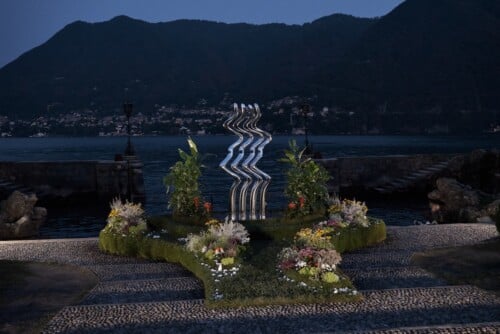
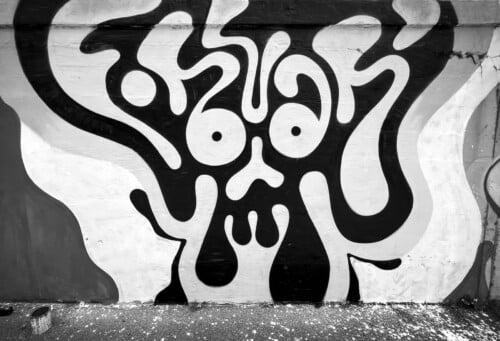
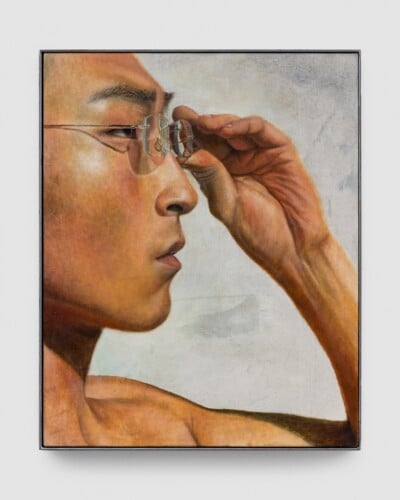
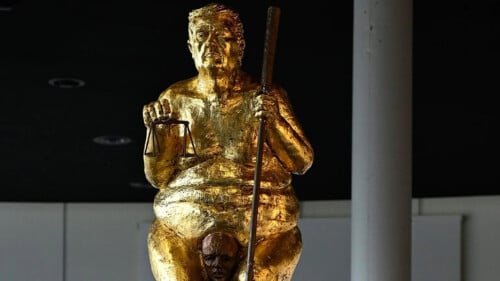
Last weekend, the twenty Italian villages involved in the project Una Boccata d’Arte – which we told you about here – finally inaugurated the installations created by the international artists, selected by Fondazione Elpis, Galleria Continua and Threes Production.
Today we are going to take a closer look at the first ten projects which, for the sake of convenience, we have identified in the northern part of the peninsula. A journey from east to west, which for today will end in Umbria, passing through Tuscany and Emilia-Romagna. Our journey south will continue next week, with a new appointment to discover the other ten village-artist pairings.
#1 Leonardo Meoni, Se si resta sul posto (Liguria)
Starting from the east, we encounter beautiful Liguria, which brings us to the village of Castelvecchio di Rocca Barbena (SV) with an installation by artist Leonardo Meoni (Florence, 1994). The village, with its only 140 inhabitants, is awarded the title of one of the most beautiful villages in Italy and, unsurprisingly, is incredibly quiet. Meoni reasons precisely about this, about the relationship between Castelvecchio and its silence. The installation, entitled Se si resta sul posto (If you stay in place), is a diffuse intervention that translates recurring elements and forms in the territory – from stained glass windows to the plough furrow – into work. One of the three installations in the village is located in the lower square. Entitled Passaggio (Passage), the work is a sort of tunnel made up of hand-painted glass windows through which the viewer admires the landscape outside, filtered by the colours and light that strikes them. In the upper part, on the other hand, in the Tower Square, there is a narrator’s ‘window’ illuminated at night, entitled Una luce temporanea.

#2 Invernomuto, VICTIMULA (Piemonte)
The artistic personality of Invernomuto is made up of Simone Bertuzzi (Piacenza, 1983) and Simone Trabucchi (Piacenza, 1982), who observe reality from a documentary perspective, while rendering an abstract vision of it. Inverno muto develops outputs through different media, audiovisual, sound and performance. In the small village of Vermogno, in the province of Biella, Invernomuto experiments with technology, conceiving the work VICTIMULA. The artists are inspired by the history of the place where gold panning has been practised for millennia. Tradition dictates that, once found, the gold is not sold but used to create wedding rings. Following this practice, Invernomuto virtually recreates the village of Vermogno and invites visitors on a hunt for ‘virtual’ gold that is nothing more than tokens (virtual coins fungible in future contexts designed by Invernomuto, through blockchain technology).

#3 Stefanie Egedy, BODIES AND SUBWOOFERS (Valle d’Aosta)
Stefanie Egedy (1996) works on the project BODIES AND SUBWOOFERS (B.A.S.) 8.0: PERMANENCE, a site-specific sound installation curated by Matthew Noble for Threes. The Brazilian artist reflects on the therapeutic effects of low-frequency sound, such as the reduction of stress and anxiety. Unfortunately, at the basis of the decision was the incompatibility that emerged during the installation between the nature of the artistic intervention and the limitations imposed by the village, Fondazione Elpis was forced to remove the artistic intervention in the village of Fénis and find a new location, which will be communicated later.
#4 Jacopo Benassi, SERENATA AGITATA (Lombardia)
Located on the Lombard shore of Lake Garda is Gardone Riviera, also known as the ‘Garden City’. Best known for being the site of the residence of the poet Gabriele d’Annunzio, the artist Jacopo Benassi (La Spezia, 1970) chose one of the poet’s evocative relics, the prow of the Nave Puglia, as his site. In front of the prow, Benassi’s ten flags fly, not as a symbol of any country, but as an image in constant movement. On each flag are printed photographs of the sea reproduced in black and white, except for one, the largest, which depicts a skull. The image undoubtedly recalls the tradition of pirates and, at the same time, one of the most recurrent elements within Benassi’s production.

#5 Diego Perrone, Il frullamento del mare di latte (Veneto)
Diego Perrone (Asti, 1970) he realised the installation Il frullamento del mare di latte in the small village of Costozza, whose particular geological origins the artist studied, thus being able to draw inspiration from them for the creation of his intaglio prints on chalk. “Layers of hundreds of metres of this stone (from Vicenza) were formed by the crushing and accumulation of sand, shells, crustaceans and organic residues. The presence of a warm, oxygenated sea started this process, while the collapse of an ancient coral reef, the emersion of its seabed and the subsequent retreat of the water brought it to an end,” reads the curatorial text by Giovanni Giacomo Paolin. Perrone’s works are thus a journey of discovery of this environmental process, dating back more than thirty million years, accompanied by a selection of explanatory books.

#6 Benjamin Jones, To Live Inside a Second (Trentino Alto Adige)
In Pieve Tesino, in the province of Trento, Benjamin Jones‘ diffuse work is inserted, with the intention of creating moments of pause in front of elements significant to the history and morphology of the village. These works consist of two overlapping photographs. The artist photographs the sun in the sky with different exposures. Each image contains two suns, always positioned at the edges, far from each other. In this way, Jones represents simultaneity and distance at the same time, reasoning about the two distinct souls of the place. On the one hand, the starting point of those men who brought prints with the subjects of the time all over Europe, and on the other, the homeland of Alcide De Gasperi, the founding father of the European Community.

#7Judith Hopf, Relation Rests (Fiuli-Venezia Giulia)
The artist Judith Hopf (1969) investigates the relationship between the ancient and the contemporary in the area of Aquileia. The two sculptures, one in cement and one in clay, depict two human figures intent on using a smartphone. The artist reflects on the everyday use of the device, a mechanical and common action on a par with a fisherman casting his net or a shepherd calling his sheep. The appearance of the two sculptures – Phone User 1 and Phone User 4 – refer to an ancient sphere, as if they were archaeological relics of our time.

#8 Raghad Saqfalhait, La montagna è ancora in movimento (Emilia-Romagna)
Emilia Romagna takes us to the province of Piacenza, specifically to Travo with La montagna è ancora in movimento (The mountain is still moving) by Palestinian artist and architect Raghad Saqfalhait. This stage, curated by Sofia Baldi Pighi, presents a project that reflects the stories of the inhabitants and the thousand-year geological history of Travo. The sculptures are made from materials of different durability, from clay to marl. All to arrive at a result that approximates the imaginary image of the Perduca and Percellara Stones. The artist consulted the local archives and produced a video and an affective mapping of the inhabitants of Trevo, starting from the assumption that landscape and community are organisms capable of influencing one another. What remains is an Artist’s Path – a true physical and mental journey – to discover the works in the area, an aesthetic device for the re-appropriation of spaces and times dedicated only to listening and attention.

#9 Theodoulos Polyviou, Rosa Mystica (Toscana)
The video work by Theodoulos Polyviou (1989) located inside the Church of San Remigio in Fosdinovo, traces the past events of the statue of an Announcing Angel that allegedly disappeared in 1628. According to the story, after a few years, the statue of a Madonna appeared instead, right inside the Church of San Remigio. The artist, having become aware of this history of the place, realised a video installation with digital scanning and animation techniques, in which the bodies of the Madonna and the Angel stage an eternal mutation.

#10 Mattia Pajè, Pila Thinkerwiller (Umbria)
Our journey, for now, ends in Umbria, more precisely in Toscolano in the province of Terni. Here, artist Mattia Pajè (1991) installs two engraved plates, one in copper and one in zinc, placing them in opposite parts of the village (north and south). The engravings on the copper plate are the result of the dialogue between the artist and the inhabitants of the place that “describe possible and impossible urban, architectural and artistic interventions that still do not exist” – reads the curatorial text by Marco Di Ieso. The one in zinc, on the other hand, shows geometric shapes, numbers and diagrams that are nothing more than symbols and numerical sequences that should facilitate the realisation of the ideas engraved on the first plate.

For more info click here: Una Boccata d’Arte.