In August 1990, Saddam Hussein’s Iraqi troops invade Kuwait. A few months later, when Operation Desert Storm begins in January 1991, war enters the television schedule as a continuous and apparently “readable” event.
During the Gulf War, journalists’ access was often controlled by the armed forces and the result was that most of the images “circulating” were compatible with an already prepared narrative: the just war, the surgical war. Iraqi suffering remained out of frame, the story felt somehow sanitized or homogenized.
For the first time we all found ourselves facing a great ambiguity: extremely powerful images were showing and hiding at the same time. The more visible the war became, the more abstract it felt. Suitable to be watched.
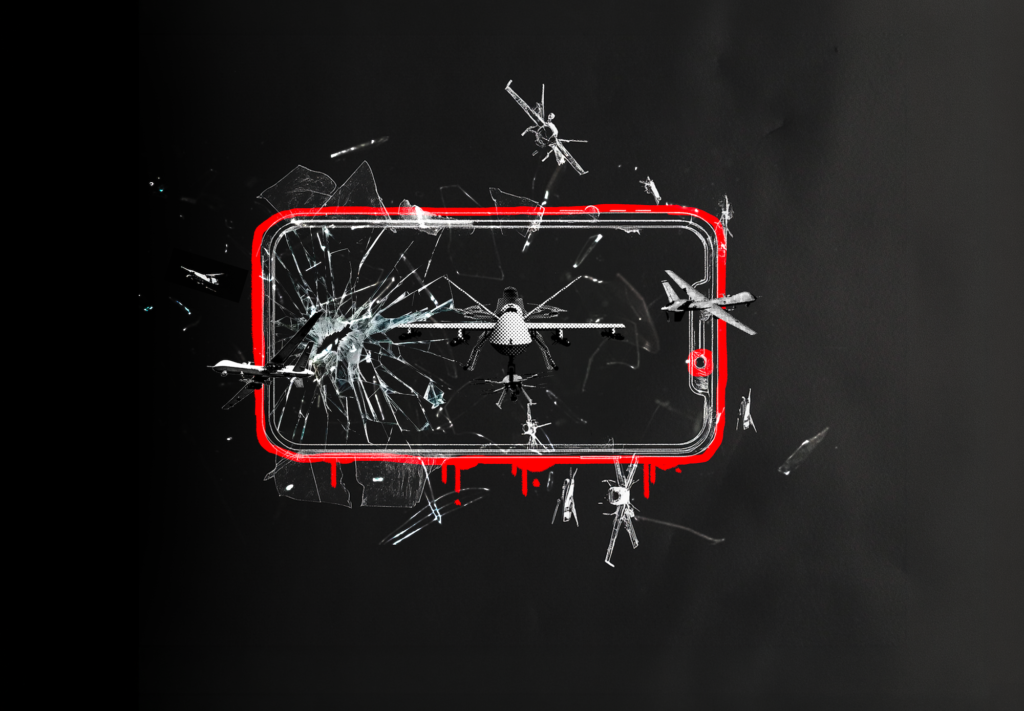
Thirty-six years later, scrolling through videos published by the official accounts of the White House and the IDF (the Israel Defense Forces) during military operations against Iran, we are witnessing a further step. War is not just communicated, it is packaged “native” for platforms, following the aesthetic and narrative rules of Instagram Reels and TikTok: rhythm, emotion, recognizability, seriality, catchy music and a moral frame that can be decoded immediately.
Watching their content gives the impression of being in front of something profoundly wrong, yet perfectly coherent with the world we live in.
We used to think that institutions adopted a sober language to separate the language of power from the language of the crowd, to make the institution recognizable as an institution and not as part of the brawl. Sobriety long functioned as a form of legitimacy that promised emotional control.
That equation has cracked. Politics now speaks within a media environment where attention is competitive, and therefore chooses to adapt to the algorithm, to play on what divides, polarizes and gets rewarded. Or has it become its slave?
Comments and definitions are pouring in by the thousands, calling this kind of communication “delirious” and “dystopian”. Adjectives born from the feeling that something is deeply out of place: war told with the same tools and the same style used to talk about sneakers and food.
But before dismissing everything as a moral anomaly of the social media era, perhaps it is worth pausing for a moment and asking whether the real problem is this propaganda (well, of course it is), or whether, beyond all this, we have simply lost our taste for indignation.
The idea that power wants to use the most popular media of its time to tell its own story—and to legitimize itself—is at least as old as media themselves. So old that by now we should probably be used to it.
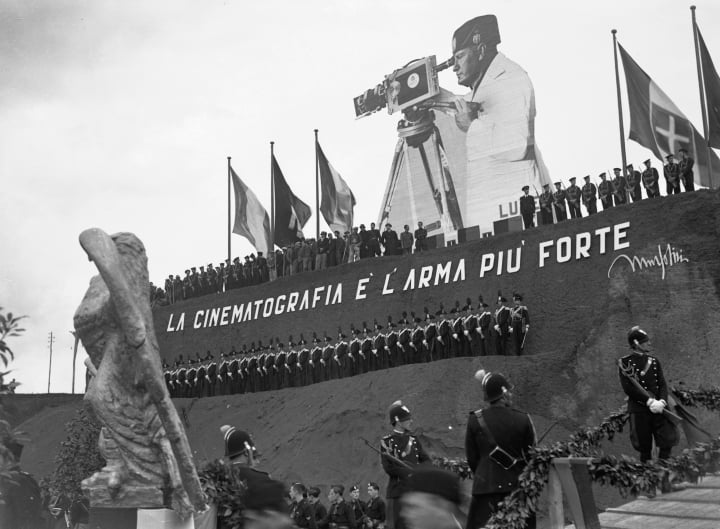
We, in particular, cannot forget how, in the 1920s and 1930s, it was Mussolini who first understood the crucial role cinema could play in supporting the fascist cause. That is precisely how the Istituto Luce was founded in 1924, with the explicit goal of producing newsreels that had to be shown in every cinema before films. Images of Mussolini driving tractors in the reclaimed Pontine Marshes, inaugurating infrastructures, addressing massive crowds—these entered everyone’s minds without permission.
Then came the brilliant—diabolical, but brilliant—idea: Cinecittà. Inaugurated in 1937, the largest film and television studio complex in Europe became a perfect cultural and ideological machine in the hands of the regime and entirely at its service.
Press, advertising, cinema: everything became extremely coherent and aligned with the regime.
With a small effort, we can also jump forward eighty years and notice that things have not changed that much. We all remember Berlusconi’s first TikTok, right? What seemed like an anachronistic move—an eighty-year-old politician landing on the platform that symbolizes Gen Z—actually followed a precise logic: reaching a younger electorate.
Even more evident is the strategy of Matteo Salvini, perhaps the first politician in Italy to adapt—if not outright build—his communication following the rules and grammar of social media. Remember “La Bestia” and the social media machine built over the years?
We have all seen at least once a photo of him on the Riviera Romagnola during the summer, a selfie with supporters, or content that follows the trends of the moment.
The platform is always in charge, and whatever lands on it must surrender and adapt to it: its language, its formats, its algorithms.
The form is content. Or, to quote Marshall McLuhan, the medium is the message.
Donald Trump has certainly understood the potential of these platforms—Instagram and TikTok—and has been using them every day since the very beginning of his second term as the main tool of his political narrative, fully aware that he has the attention of millions of users. It should therefore not surprise us to find, within this macabre game, the official accounts of institutions such as the White House or the IDF.
The fact that these contents are perfectly consistent with the tone of voice of the platforms hosting them does not mean they are right, but it does reveal the real paradox.
We live in a digital environment in which any topic is translated into the language of social media and reduced to short videos, appealing graphics and viral memes: from healthy diets to surgical procedures, from education to information.
We have no problem accepting that a surgeon explains an operation on TikTok. That a nutritionist summarizes years of studies and possible health issues in sixty seconds. That geopolitical issues become vertical videos we watch at 2x speed.
But when the same grammar is used by an institution to narrate a military operation, suddenly we discover that this language feels “dystopian”.
Is it really that surprising?
War exposes what we had silently accepted: the platform is not just a place through which content passes, but a device that transforms it—and by transforming it, it also changes us, our way of feeling and judging.
The point is not just propaganda—that has always existed—the point is that we have lost the ability to feel outrage in the right way. Or perhaps that our outrage has become just another mode of the feed, another piece of content with the same fate.
We get outraged by fake news, yet we are often the first to share articles without even reading them.
We get outraged by influencers’ earnings, yet we continue to follow them, comment on them, buy their products.
We get outraged when Trump posts a bombing video with the Macarena soundtrack, but his penguin post was turned by dozens of brands into advertising campaigns.



Living-room outrage.
An outrage that still cannot admit that form is content. If the goal is to shift attention from atrocities to military power, or to transform the narrative from “the United States are the villains” to “the United States are the coolest,” then the strategy in place is as terrifying as it is deliberate—disgustingly deliberate. Because when war takes on the rhythm of a reel, when images of bombings are edited like a trailer, when epic music or a Latin remix accompanies a military operation, perception changes. Distance shrinks. Gravity fades. The surreal spectacle replaces reality.
After all, we are the same generations raised on Hollywood films that normalized and aestheticized war, turning it into toy weapons to be sold at Christmas. What is there to be surprised about? How can this appear to us as an exception? In reality, it is the coherent consequence of a long cultural process.
And meanwhile, while outside our small screens the war continues, roles between countries are overturned and economic interests guide political decisions, we keep getting outraged, comfortably sitting on the couch, convinced that our outrage helps us oppose something—without realizing that our attention is part of the spectacle we believe we are criticizing.
In a world where war can become content, politics can become content, and even outrage can become content, how do we rebuild a public space in which not everything has to perform in order to exist—and where moderation, analysis and contradiction are not perceived as communicative weaknesses?