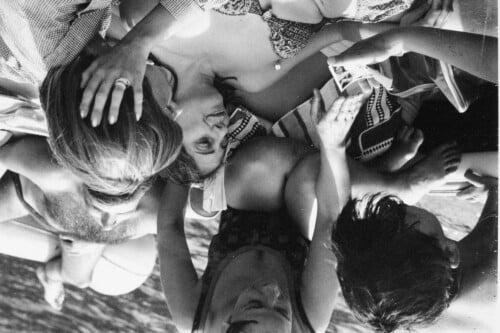
“Fashion+Klein”, this is the title of the first retrospective dedicated to William Klein and his ability to upset, change and revolutionize fashion photography. A journey of 60 years in which the famous American photographer and director has subverted the rules through his ironic, non-conformist approach and through the use of unusual photographic techniques that have led him to be considered one of the most influential photographers of all time.
The first exhibition focused on his work in the world of fashion at the Polka Galerie in Paris will end on January 15, thanks to which you can take a look at the nonconformity, rebellion and experimentation that has always characterized his work.


William Klein was born in New York in 1928 to a Jewish family with great economic difficulties. He graduated from high school at a very young age and at only 14 he enrolled at the City College of New York where he began studying sociology. The outbreak of the Second World War led him to enlist in the U.S. Army being sent stationed first in Germany and then in France, where he would settle once he was discharged.
After the end of the war, in 1948, Klein, who at the time was mainly interested in painting and sculpture, enrolled at the Sorbonne to study painting and where he was a student of the French painter, sculptor and filmmaker Fernand Léger.
Visualizza questo post su Instagram
His is a natural predisposition for the arts and in 1952 he arrived in Italy with two personal exhibitions in Milan, where he met and began a collaboration with the architect Angelo Mangiarotti and worked with Fellini as an assistant. It was during this period, at the beginning of the 1950s, that Klein became interested in photography, but for the moment it remained only a secondary method of expression for him.
He began experimenting with kinetic art and it was during an exhibition of his kinetic sculptures that he met Alexander Liberman, then art director of Vogue.


Liberman immediately sensed the potential of this young artist and hired him. Klein thus began his work as a fashion photographer for Vogue, also producing photographic essays on various cities, including one on New York that brought him to international prominence thanks to the Nadar prize, immediately demonstrating a unique ability to overturn the dynamics that dominated that world and immortalize with directness and immediacy the lifestyle of the Big Apple.
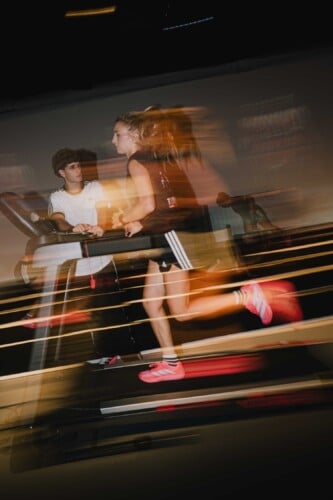
His ironic and equivocal style led him to abandon the classic “fashionable” stereotypes of the time and to leave the studio to “finally take real photographs that remove taboos and clichés”. Photographs with models in motion, deliberately out of focus, multiple exposure, the use of wide-angle and telephoto lenses, natural lighting are just some of the peculiar aspects of Klein’s photography that represent his “uncompromising rejection of the rules then prevailing”.

One of the fathers of street photography, Klein has always refused any kind of compromise and rule, even overturning the concepts of femininity and gender.
He left Vogue in 1966 dedicating himself to the naked and raw reportages of the most important cities in the world and to cinema. Just the fashion world will become the subject of his first feature film, Who Are You, Polly Maggoo? just in ’66, a biting satire on the entire fashion world that Klein has overturned and renewed.
In conclusion, if you are planning a trip to Paris in the next few days, drop by the Polka Galerie and enjoy a special date with the history of fashion photography.