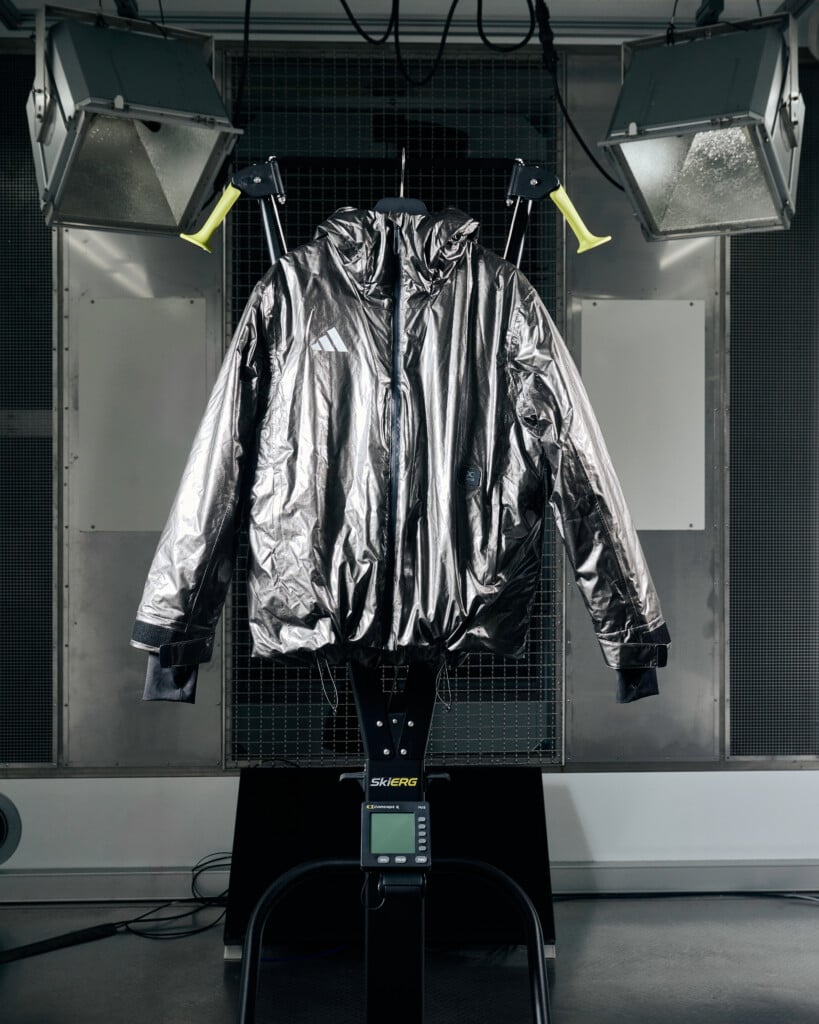
The CLIMAWARM SYSTEM was conceived and developed by adidas for a very specific moment: the one right before competition—around twenty crucial minutes for athletes, especially with the Winter Olympics on the horizon. The jacket and pants that embody this technology are made with a low-bulk fabric, and the way the system works immediately sparked our curiosity.

To understand what it means to design a technology that doesn’t just protect from the cold but actively supports performance, we spoke with Margherita Raccuglia, Director of Athlete Performance at adidas. Together we dug into the origins of the CLIMAWARM SYSTEM, the constant dialogue with athletes in disciplines such as cross-country skiing, bobsleigh, and skeleton, and the way innovation can turn a waiting period into a tangible competitive edge.
Raccuglia leads all research and development initiatives tied to performance at adidas. With a background in sports physiology and a strong focus on applied design, her job is to translate scientific data into concrete solutions—working directly with athletes to understand limits, needs, and the specific conditions of competition.
“My work is to apply scientific research to the development of performance products, but above all to work with athletes who put time and mind into pushing their limits and improving their performance,” she explains.
The process starts with listening and observation: lab and field testing, physiological and biomechanical measurements, and studying how the body responds in extreme environments. “We try to understand what their problems are, their limits, and their needs in relation to their sport and the conditions they find themselves in.”
The first development of a technology designed to intervene in the pre-competition window dates back to the London 2012 Olympics. Track cyclists were the ones to point out a very specific issue: between the end of warm-up and the start of competition, they could be waiting 20 or even 30 minutes in air-conditioned environments. From there, the CLIMAWARM SYSTEM was born.

“That time gap would practically erase the thermogenic effect—especially in terms of muscle temperature—which is instrumental for speed performance, explosive strength, and power.” In the run-up to the Milano Cortina Winter Olympics, that same insight was revisited and refined by working with bobsleigh and skeleton athletes from the British team. In disciplines performed between zero and minus ten degrees, maintaining muscle temperature becomes even more critical.
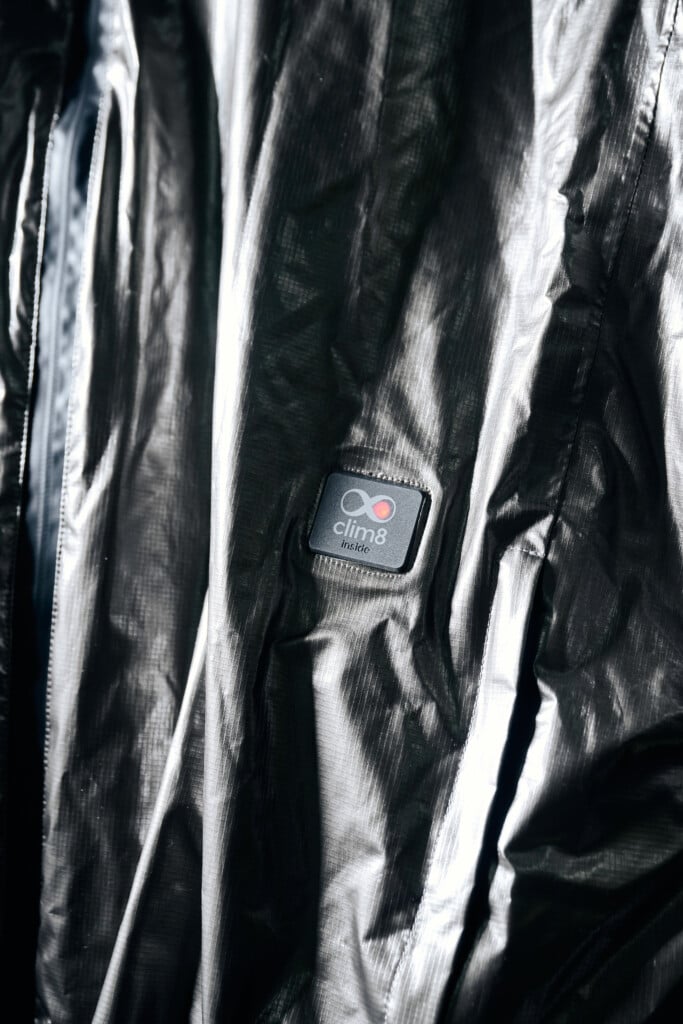
“They had this kind of issue because they’re operating in sub-zero conditions. After warm-up, the risk of losing the benefit was even more pronounced.” The challenge wasn’t only to warm the body, but to do it without interfering with mobility. The heating pads developed for the CLIMAWARM SYSTEM are extremely thin and integrated inside jackets and pants in an almost invisible way. “The technology had to be there, but it couldn’t block or compromise mobility,” she says. And the athletes’ feedback was immediate: “I feel the temperature is optimal, but I can still move through a full range of motion. I don’t feel restricted.”

The system can be activated with a simple tap, allowing athletes to switch from boost mode—maximum power—to a more moderate heat level. “We want to give athletes a range of options, and the freedom to adjust, turn on, and turn off based on their needs.”
Internal sensors constantly monitor the microclimate between fabric and skin, stepping in automatically if the temperature approaches critical levels. Safety was a key step in the project.
“We studied what the maximum temperature was that we could deliver to the body to provide a muscular benefit without overheating,” she explains. Through research conducted with partner universities, a safe maximum limit of 45°C was defined. “If sensors detect that the microclimate near the skin is reaching the limit, the system shuts off and recalibrates automatically.”
Born for high performance, the CLIMAWARM SYSTEM could also have broader applications for athletes who would use this technology outside competition contexts. “It makes sense for a technology like this to be made available to the public,” she concludes. “It’s something we’re working on, with the goal of commercializing it.” In short, adidas is already preparing to bring this system to consumers—beyond races and beyond the logic of competitive performance.