In a landscape where documentary and social photography is increasingly exposed to the risk of simplification and fast consumption, the Festival della Fotografia Etica continues to question the very meaning of “telling stories” through images: how to select them, contextualize them, return them to the public, and turn them into a pretext for deeper analysis, education, and dialogue.
For this reason, we couldn’t help but include it in our PhotoDesk column and interview Alberto Prina, artistic director of the Festival della Fotografia Etica, to explore the visions, curatorial choices, and responsibilities of a project that—well beyond the festival format—reflects on the relationship between photography, ethics, and society.
Your festival was born and is defined around the word “ethics,” a term that is often used generically. What does it concretely mean for you to select and present projects that truly meet this criterion?
For us, ethics means paying close attention to the values contained within a photographic project. It is therefore essential to choose stories with a strong message, regardless of whether they focus on human-related issues or environmental protection. We also believe there is a need to truly understand reality and to reduce filters between ourselves and the real world as much as possible; in this sense, documentary photography and photojournalism allow for highly reliable, grounded, and respectful field observation of the subjects portrayed.
At the same time, we are aware of the inherent complexity and tension between documentation and interpretation. For us, this issue is addressed through careful work on the informational and textual components that accompany the photographic project. This approach allows for a cross-reading alongside the photographer’s vision and makes it possible not so much to overcome personal interpretation, but to integrate it with a more objective reading, conveyed through a language different from that of photography alone.
By “ethical photography,” we therefore mean work that respects the subjects portrayed, generates awareness, stimulates reflection, and encourages dialogue on the most urgent contemporary issues: human rights, inequality, the environment, migration, and historical memory.
Your audience is diverse and often drawn more by the themes than by the photographers’ names. How does this characteristic influence the construction of exhibition paths and your curatorial choices?
For us, the fundamental goal is to inform the people who visit the festival, but also to engage them, because we believe that information—without emotional and empathetic involvement that respects the subjects being told—cannot generate real impact or foster positive change.
The themes we address are often linked to current events, and even when they have a historical dimension, they remain connected to an analysis of the present. This allows for comparison and dialogue between different periods. We believe that photographic language must first and foremost be a tool for communication, and that the freedom to make it engaging, emotional, and compelling is an extremely important element.


You have often stated that for you photography is a means, not an end—a tool to talk about urgent issues. How does this vision guide the selection of works and the structure of each edition?
The selection process stems from the ability to identify relevant elements that have focused—or are currently focusing—contemporary attention, alongside the informational and journalistic components. The author’s name or notoriety is not central; on the contrary, for us it is essential to constantly search for new photographers, in order to present, highlight, and discover different visions through diverse perspectives. The outlook is always strongly international, because the themes we address are numerous and concern global challenges. For example, in the latest edition, Giles Clarke’s work on Sudan anticipated issues that later became central in current affairs, highlighting the importance of drawing attention to certain areas of the world.
Our research therefore aims, on one hand, to present works that address important and relevant themes and, on the other, to inform audiences about less-covered topics that we nonetheless consider universal. Knowledge of these issues generates value, strengthens visitors’ critical capacity, and contributes to raising awareness.
As one of the longest-running photography festivals in Italy, you have closely observed the evolution of visual language before and after the advent of social media. What changes have you noticed in the way ethical issues are told?
The way ethical themes are narrated has certainly changed profoundly, both thanks to greater professionalism and awareness among new generations of photographers, and due to strong cross-pollination with social media languages and interaction with these new forms of communication. While documentary and journalistic photography have not lost the values related to respect for reality, documentation, and the subjects portrayed, it is also true that languages and aesthetics have evolved. In this context, our festival seeks to intercept new aesthetic forms, while firmly maintaining the principle that content remains a central and indispensable value.


The OFF circuit brings exhibitions into unconventional spaces around the city, becoming one of the festival’s defining features. What curatorial logic guides this choice, and what value does it add to the audience’s experience?
The curatorial logic of the OFF circuit is intentionally very flexible and broad: it allows the inclusion not only of documentary or journalistic photography, nor exclusively projects tied to human or ethical themes, but offers the possibility to traverse all photographic languages and subjects. The added value for the audience lies, on one hand, in discovering photography dispersed throughout the city, making it present and accessible in unconventional locations; on the other, the experience is also fundamental for the authors themselves. Participation, engagement, and the creation of a community—made up of advanced amateurs and early-career professionals—are central moments of the project. Gathering in the city during the festival fosters a continuous cultural flow; in this sense, OFF becomes a privileged space for dialogue, particularly dedicated to those who use photography as an active tool and feel personally involved in employing photographic language as an expressive and communicative medium.
Your program brings together established photographers and emerging authors. What criteria guide this combination, and what kind of dialogue do you seek to activate between these two levels of experience?
The desire to tell stories is certainly the main element: the urge to communicate and document the contemporary world. The opportunity for encounter, sharing, and exchange between established photographers and emerging authors holds immense value for us, as it fosters the transmission of professional expertise, the sharing of values, and the exchange of experiences. This dialogue unfolds continuously throughout the festival’s five weekends, becoming a central component of the overall experience.

You work extensively with schools and communities. Do you believe festivals can truly play a real role in visual literacy, or do they risk remaining “one-off” events? Do you adopt concrete strategies to avoid superficiality and ensure long-term impact?
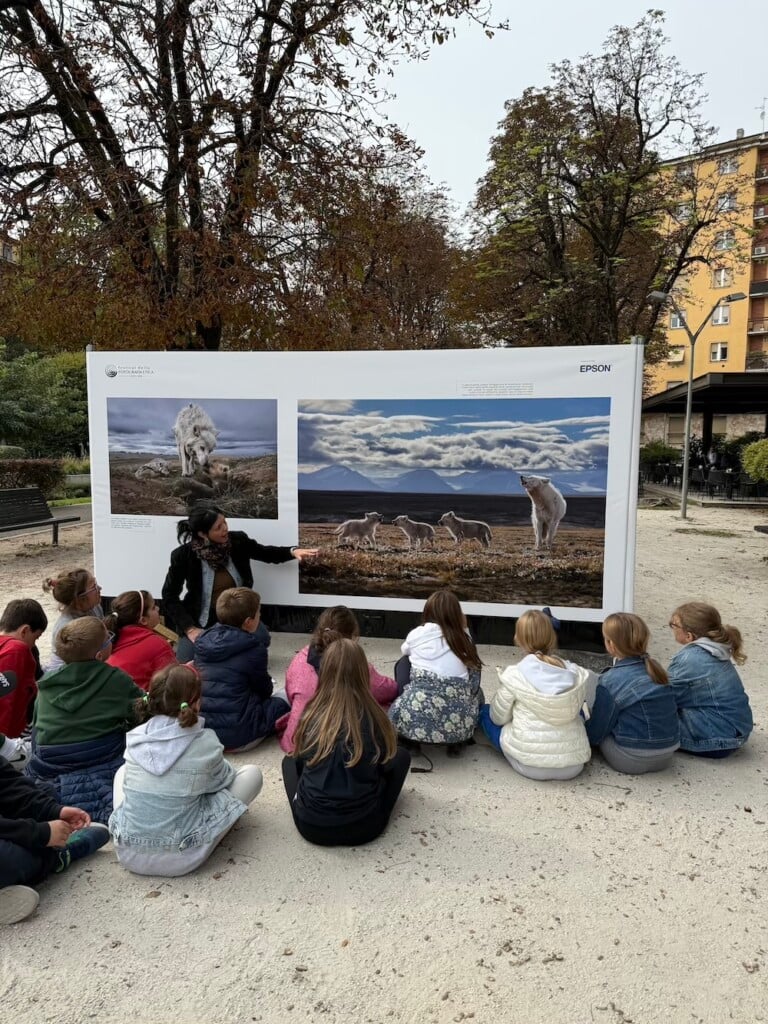
Visual literacy for today’s generations of students and teachers is a central part of the Festival’s mission. We firmly believe that events like ours can play a real and meaningful role in educating people about photographic language, provided they do not remain mere “one-off” events. The Festival’s educational team works year-round with schools of all levels to bring photography into classrooms, ensuring it becomes not just image display, but a tool for education, awareness, and critical reflection.
To avoid superficiality and guarantee long-term impact, we adopt several concrete strategies. First and foremost, we develop dedicated educational programs for schools, including guided tours, workshops, and interactive labs. Students are not limited to viewing photographs, but are encouraged to interpret them, discuss them, and relate them to the social and cultural contexts in which they were created.
Collaborations with photographers, journalists, and associations allow us to create educational pathways that extend beyond the festival itself, generating a network of knowledge and critical awareness. In short, our goal is to transform photography into a shared language capable of fostering more conscious and active citizens—also because our non-profit association hosts students every year as part of school-to-work training programs.
Lodi is not just the festival’s location—it is a living interlocutor of the project. How does this local rootedness influence the content you present, and what cultural impact have you observed over time?
Local rootedness does not directly influence the content, as the project is primarily conceived for visitors who, in most cases, do not come from the local area.
However, over time we have observed very significant cultural effects on the city of Lodi and its cultural fabric. In particular, the possibility of purchasing a season pass has made the idea of return and gradual deepening central: a slow approach to visiting that represents one of the key elements in the festival experience and in the ability to absorb and understand the information presented.
Although we do not adopt direct or structured tools to measure the growth of visitors’ critical capacity, we consider certain indicators meaningful. The continuous growth of the audience—composed both of visitors from outside the area and, above all, of an increasing number of people who choose the season pass—leads us to believe that interest, engagement, and the desire to further explore the festival’s themes are deeply rooted and constantly increasing.
In the latest edition, reaching nearly 30,000 visitors represents a concrete sign of this trajectory: an audience that grows year after year, demonstrates maturity, and recognizes the festival as a meaningful moment to dedicate time and presence in the city of Lodi.
Your calls—from the World Report Award to the Student Award—are a central gateway to the program. What role do they play in defining the festival’s identity, and what criteria guide the selection of projects you choose to exhibit through these calls?
The World Report Award calls certainly represent a central gateway to the festival program.
A fundamental element is the presence of an international jury made up of professionals with very different backgrounds, training, and experiences. This allows for the construction of a plurality of perspectives, a truly international vision, and an independent approach to artistic direction. The jury operates in complete freedom, while respecting the coherence and quality of the submitted projects.
The exhibitions generated by the competition are among the spaces that attract the greatest interest from visitors, as they address very different themes with depth and significance. However, the festival’s identity is not built solely around the winners: projects that do not receive awards often still possess great value and are selected to be exhibited within the festival, in sections separate from those strictly linked to the competition.


Operating within a rich yet competitive international ecosystem, you are called upon to define a clear positioning. What specific space does the Festival della Fotografia Etica occupy today, and compared to other festivals dedicated to documentary and social photography, what concrete opportunities for personal growth do you offer photographers—through portfolio reviews, workshops, masterclasses, or educational pathways—that they might not find elsewhere with the same quality or intensity?
Supporting photographers’ growth is certainly a very important element for us, which we seek to foster through encounters with some of the most relevant professional figures in the national and international photographic scene. The jury of our competition is one way for photographers to be seen and followed by reference figures. A deliberate choice has been the portfolio reviews in collaboration with the FIAF world, which we consider an extremely relevant scouting and photographic culture dissemination space—particularly for advanced amateurs and early-career professionals.
For years, the Travelling Festival has also been active: exhibitions conceived, produced, and curated in Lodi that travel across Italy to reach an ever-wider audience and continue amplifying photographers’ voices.
For the moment, however, we have chosen not to offer masterclasses, workshops, or specific training programs, as we believe the market is already highly characterized and offers a very broad range. It is a possibility we may evaluate in the future, but one we have decided not to activate at this time.
Our primary objective remains not so much the training of photographers, but of visitors: an educational pathway that we also pursue through basic and advanced photography courses and image-reading activities, with the aim of increasing awareness, critical capacity, and understanding of photographic language.