Before on the cover of the spring issue of Flash Art, then the long-duration performance at spazioSERRA in Milan, remembered by many as “the siren at Lancetti station.” Agnes Questionmark‘s (1995) performances have resonated widely within the art world and beyond, emerging, in our opinion, as one of the most compelling artists this year. Today, we want to revisit her journey and delve deeper into her research, which both captivates and evokes that feeling of repulsion typical of squalor, as we’ve previously discussed here. But let’s start from the beginning. Who is Agnes Questionmark?

Agnes Questionmark and the body as medium
Agnes Questionmark defines herself as a transmedial and transpecies artist, as highlighted in Elisa Carollo’s text for the Quadriennale in Rome. These terms provide an initial hint to understand the focus of the artist’s research, utilizing her own body as the primary medium. Agnes considers the human body as an object of investigation, subject to transformation. In other words, Agnes Questionmark hypothesizes various bodily evolutions in response to environmental changes. Undoubtedly, the aquatic world constitutes one of her primary fascinations, reflective of an autobiographical element tied to her childhood spent extensively on her father’s boat. Another reference in this regard is the concept of Homo Aquaticus, theorized by Max Westenhöfer, prophesying that technological humanity would create devices capable of surviving in water, readapting to the primal dimension of its evolutionary development. Therefore, the artist ventures into an intersection of fantasy and science, delving into possibilities that straddle the realms of reality and imagination.

There is a mermaid at spazioSERRA in Milan
Staying in the aquatic theme, we arrive at the long performance at spazioSERRA. Known as “the mermaid,” Agnes actually presents herself as an undefined hybrid being. Suspended for twelve hours a day, for sixteen consecutive days, from a metal structure using cables and medical straps, her body becomes a political vehicle challenging power dynamics within our socio-economic structures. Agnes Questionmark transforms into a monstrous figure, evoking elements of marine biology with fins, tails, and sails, easily classified as a “mermaid.” This long performance underscores the artist’s intention to test her own body and, more broadly, that of our species in terms of endurance.

The latest performance in Berlin
On December 14th, at the Berlin branch of KÖNIG GALERIE, Agnes Questionmark’s personal exhibition, OB/GYN, opened with one of her much-discussed performances. Agnes’s work challenges the boundaries of gender identity, connecting humans with the non-human world. In this case, the artist’s operation aims to contest the morphological and conventional norms of a normative society that reshapes bodies through incessant artificial reproductions, organ transplants, genetic experiments, and synthetic drugs. The science fiction here is less remote. The artist doesn’t stray far from the reality we know, questioning the medical-patient power dynamic. The focus lies in the science-nature and human-machine duality, depicting the transformation of the body as a personalized, pathologized, hospitalized, and mechanized experiment.

At this point, we wait to find out what will be the next operations of the artist who, despite being criticized for her closeness to the world of science fiction, is able to speak about extremely topical issues from a contemporary perspective. Undoubtedly, the raw aesthetic of Agnes Questionmark’s works generates a reaction, fitting into the current of bleakness that counteracts the aesthetics of beauty as now ineffective from a reflective point of view.
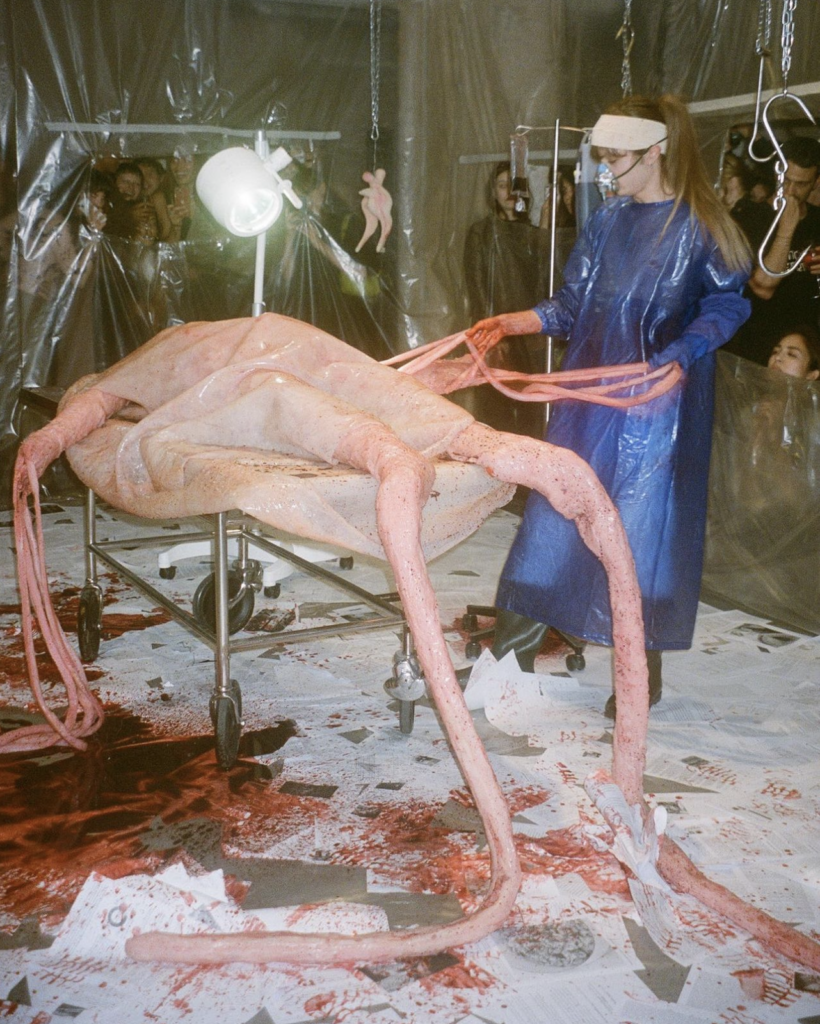

Courtesy Agnes Questionmark