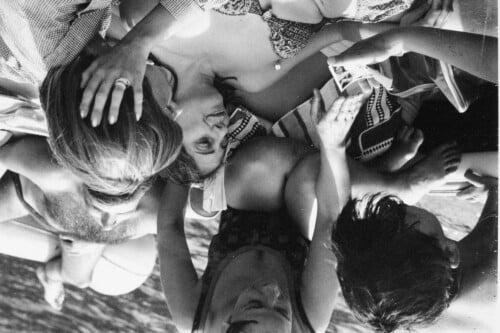
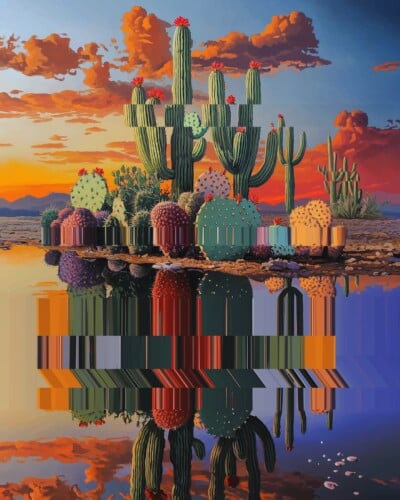
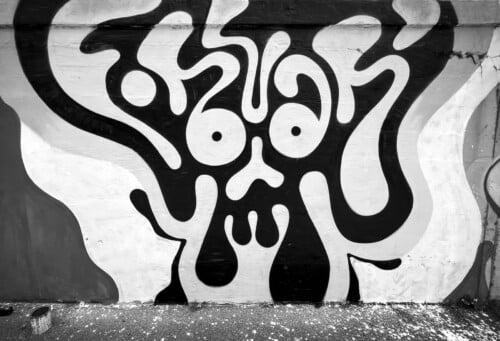
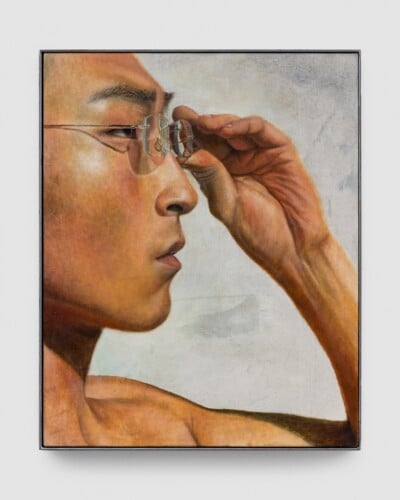
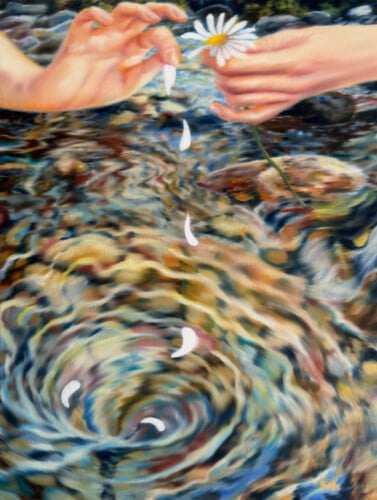
If in the past Eliza Douglas has poked fun at the elitism of the art world by transforming gallery spaces into mock public institutions, today at Contemporary Fine Arts she presents her first solo show titled GIFT, adding a further veil of criticism of the art system. The works she presents here in Berlin are all oil canvases depicting distorted hyperrealist images then wrapped with a bow, unambiguously reminiscent of a gift package. The conceptual layers are many, from the use of AI, which for the artist represents a technological advance, to the bow, which may or may not be seen as a symbol but, in any case, obscures the content, bringing up a fundamental truth about painting: rather than an image, it exists primarily as an object on the wall. But let us explain further.

A challenge to standards of perfection
In GIFT, Douglas explores a wide range of themes, from the deeply personal, such as a portrait of her brother, to visions of impossible landscapes and eerie close-ups of boys laughing for no apparent reason. The hyperrealist and distorted images challenge conventional notions of beauty, combining traditional techniques with a modern twist. Douglas uses artificial intelligence to explore art history and interrogate its relevance to contemporary society. Abandoning the museum aesthetic, she imagines her works in a department store context, equating commercial galleries with department stores as dispensers of luxury. This choice is not simply a critique of the art market, but a challenge to standards of perfection and the roles they play in highlighting social, gender, and class differences.

What are the new icons?
A central focus of Eliza Douglas’ work is how paintings are perceived and consumed. The artist does not see this process as a sign of cultural pessimism, but as part of the mechanisms of cultural reciprocity, recognizing that “culture does not exist without someone creating it.” Some critics might say that everything was better before, that we are far from “real” art, and that meaningful conversations have become jokes and memes. But just as Warhol’s Campbell tomato soup represented 1960s consumerism, today the cute but slightly repulsive kitten is the icon of digital natives. Warhol shocked by equating food with art, and now, in an age of unbridled consumption, Douglas challenges us to reconsider these dynamics.


Images courtesy of Courtesy of Contemporary Fine Arts Gallery, Berlin. Photoes by Nick Ash