The five sculpture-houses we present today represent an extraordinary fusion of architecture and sculpture, giving life to unique inhabitable works of art. These projects challenge the traditional boundaries of construction, creating structures with organic and innovative forms where art and functionality synergize. The architects behind these works have pushed the limits of creativity and construction, using advanced materials and techniques to transform the concept of a home into a genuine artistic experience. The residences we will explore are true masterpieces that demonstrate how architecture can be more than just a place to live. Each sculpture-house tells a unique story, defying conventions and inviting residents to live in an extraordinary and stimulating environment. We will discover how these projects have redefined the concept of “home” and made it possible to inhabit art itself.

#1 The Dome, Arch. Dante Bini, Costa Paradiso (Sardinia)
We are in Costa Paradiso, in an extensive tourist village, a symbol of elite tourism but also of real estate speculation. The buildings blend into the landscape, but two gray and empty domes at the northernmost part of the settlement stand out for their peculiarity. These domes were created by the filmmaker Michelangelo Antonioni and the architect Dante Bini, constructed using an innovative technique called Binishell. Despite their neglected appearance, these domes are the subject of study in European universities. They are now privately owned and cannot be entered, but they can be admired from the outside.

#2 Casa Dinosauro, Arch. Vittorio Giorgini, Baratti (Tuscany)
In Baratti, Tuscany, hidden among the dense park vegetation, lies Casa Dinosauro – better known as Casa Saldarini – an exceptional architectural gem designed by architect Vittorio Giorgini. The house was built in 1962, but the project originated in 1960. This house is considered the world’s first example of architecture constructed using an isoelastic membrane of net and cement, anticipating the contemporary architectural movement of buildings with organic and fluid forms. Some claim – including architect Glauco Gresleri – that Casa Dinosauro was pioneering and preceded Frank Gehry’s work by a quarter of a century, such as the Guggenheim Museum in Bilbao. Its sinuous and elastic structure raised doubts about its solidity, but it underwent tests that demonstrated its robustness.

#3 Castellaras’ villa, Arch. Jacques Coüelle, Mouans-Sartoux (France)
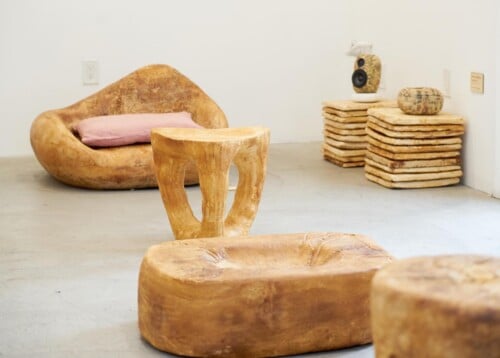
Jacques Couëlle’s unique architecture is characterized by its close relationship with nature and the creation of environmentally friendly homes. Couëlle employs a unique design method called the “Tristan test,” where the ground is covered with sand, and clients are invited to simulate their daily activities. This influences the final designs of the houses, which are devoid of right angles and adapted to the owners’ needs. The one in the photo is one of the most striking examples, it is the interior of one of the villas in the Castellaras estate, the Castellaras-le-Neuf, a complex of houses overlooking the bay of Cannes in France.

#4 Private House, Arch. Daniel Grataloup, Anières (Swiss)
Daniel Grataloup was a pioneer of perspective architecture, a style that sparked significant debate in the Geneva scene in the early 1970s. His unique works, described as “sculptural architecture” by French art critic Michel Ragon, incorporated concrete, organic forms reminiscent of mollusks, and “multi-shell” structures.

#5 Bubble House in Minzier, Arch. Claude Costy e Pascal Häusermann, Minzier (France)
Claude Costy is famous for her innovative “bubbles,” futuristic houses composed of interconnected spheres, resembling mysterious yet profoundly human organisms. Costy is not only an architect but also a sculptor, and this is clearly visible in her work. Her most emblematic work is the Bubble House in Minzier, Haute-Savoie, characterized by soft facades and bubble-shaped windows, created in collaboration with her husband Pascal Häusermann, with whom she would go on to create many “bubble houses.” Inside the house, there are no right angles, but rooms that blend into each other. The interiors evoke a primitive dimension where even the furniture is carved from the walls.

Selection by Violetta Schautz
Read Also 5 Brutalist Buildings to Visit