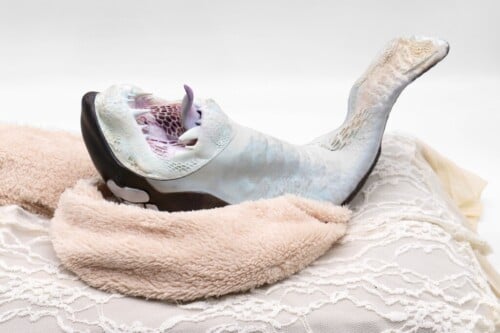
The artist Léonore Chastagner shapes clay as if it were an extension of the human body, a living material capable of holding gestures, emotions, and traces of everyday life. From the chromatic variety of the natural clays she works with, sculptures are born that seem to breathe. It is a practice that does not represent so much as it observes, listens, records. «I use clay as one uses a diary,» the artist tells Colossal, «to note down the feelings of everyday life and the things that surround me.»


Her gaze always starts from intimacy, from what happens when she is alone with her surroundings: an apartment, a crumpled garment, a small gesture of the body. But her background in art history slips into the process as an additional, almost archaeological layer. Chastagner seems to look toward the small figures of the past, the ritual objects placed in tombs to accompany the soul into the afterlife, those talismans that cross the centuries without ever fully revealing their function. Her sculptures appear to belong to this same suspended territory, ready to be interpreted as relics of an everyday life that has just gone by.


Clay, for its part, thus becomes the perfect medium for this operation. A simple, primordial, malleable material that responds immediately to touch and gives the artist an unfiltered freedom. It is a practice that lives through its own rhythm, its imperfections, the intrinsic fragility of the material.


In recent months, as she also shares on Colossal, Chastagner has broadened her narrative horizon, moving from objects to places. Small bedrooms, living rooms, domestic environments reconstructed as miniatures that evoke an immediate sense of nostalgia, that of dollhouses and scaled-down worlds that contain entire lives. These are scenes that hold human presence without showing it, building a collective body made of absences and memories.