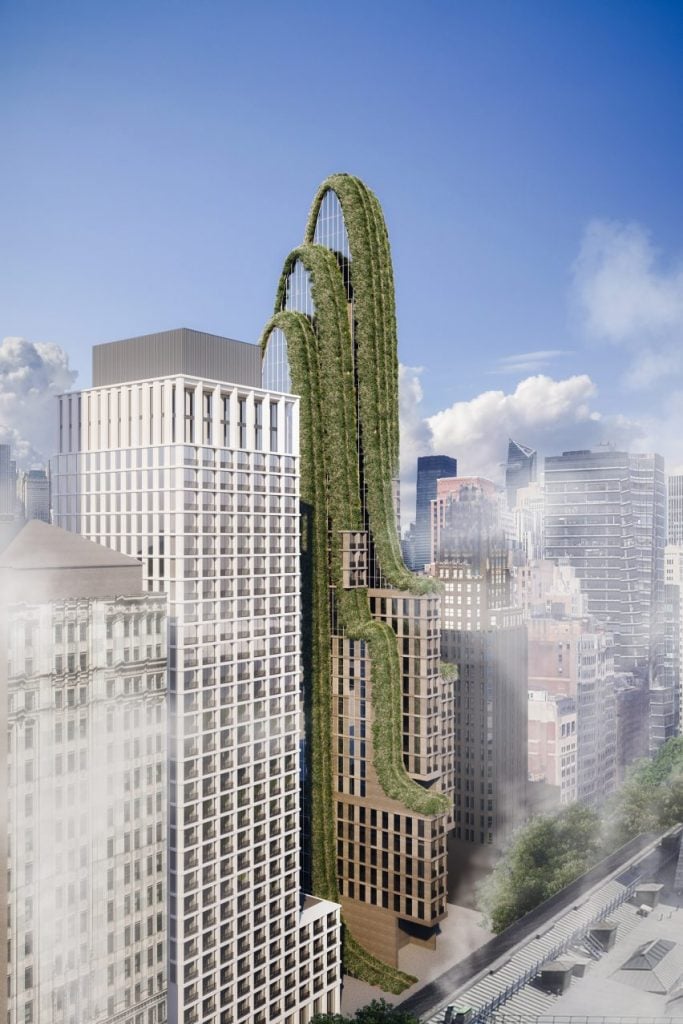
An architectural revolution is underway in Manhattan, aiming to make the New York borough’s iconic skyscrapers more sustainable and self-sufficient. From the beginnings with solar panels ten years ago, the focus has now shifted to models and houses capable of generating energy organically, guaranteeing total efficiency. A “silent” revolution, as defined by Selim Vural of Studio Vural, who recently presented Lilly, a low-energy skyscraper project in Bryant Park, near the American Radiator Building, a 1920s Gothic building in Midtown.

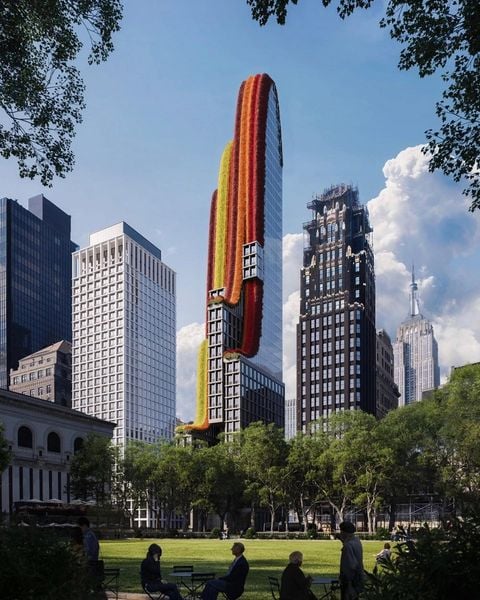
The influence for the building’s concept comes from the Centre Pompidou in Paris, but also from the steep rice fields typical of some areas of Asia. Nature is at the heart of Studio Vural’s design: the chute of coloured plants chosen to characterise the building is made of Asiatic lilies, a very colourful species which blooms in spring and remains green all year round, keeping the building alive even in the cold New York winter.
The building will be able to produce its own energy, and light will play an important role, designed to completely illuminate Lilly thanks to the glass facades. This is only a concept for the moment, but imagining a perpetual spring in the “concrete jungle” is fascinating nonetheless.