Off Screen is the column that looks beyond the screen.
It tells the stories of directors who don’t limit themselves to cinema, but bring their vision to painting, installations, and hybrid visual languages. Because some films continue even when the film ends.
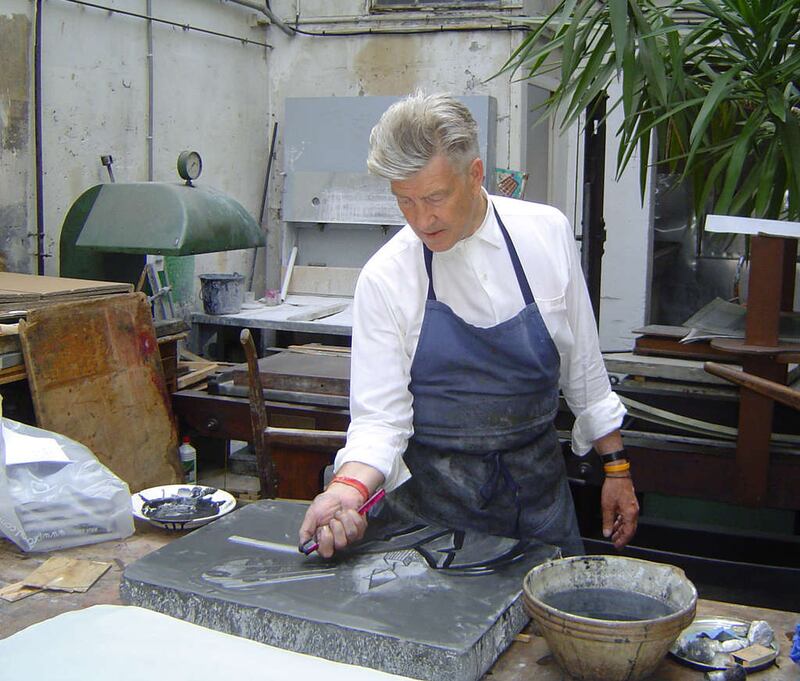
There is no adjective more apt than “Lynchian” to describe an atmosphere that encompasses mystery, surrealism, dreamlike suspension, and a measured dose of unease. It is a term that has transcended the boundaries of cinema to indicate a total sensory experience. Transgression is probably the gesture that has held together David Lynch’s entire career from the 1960s until his departure.
A multifaceted, transmedia, and transdisciplinary artist, Lynch is best known as a filmmaker, author of works such as The Elephant Man (1980), Blue Velvet (1986), and Mulholland Drive (2001), to name a few. But to reduce him to cinema alone would be to ignore the original matrix of his language: painting. That is where his vision comes from.
Even before becoming a director, David Lynch was a visual artist in the fullest sense of the term. Painter, sculptor, installation artist: a creator who recognizes no boundaries between languages. Not so much parallel disciplines, but different ways of embodying the same imagery. Cinema, in fact, does not come as a break but as a natural extension of a quest that moves from the canvas to the screen.
The formative years of David Lynch
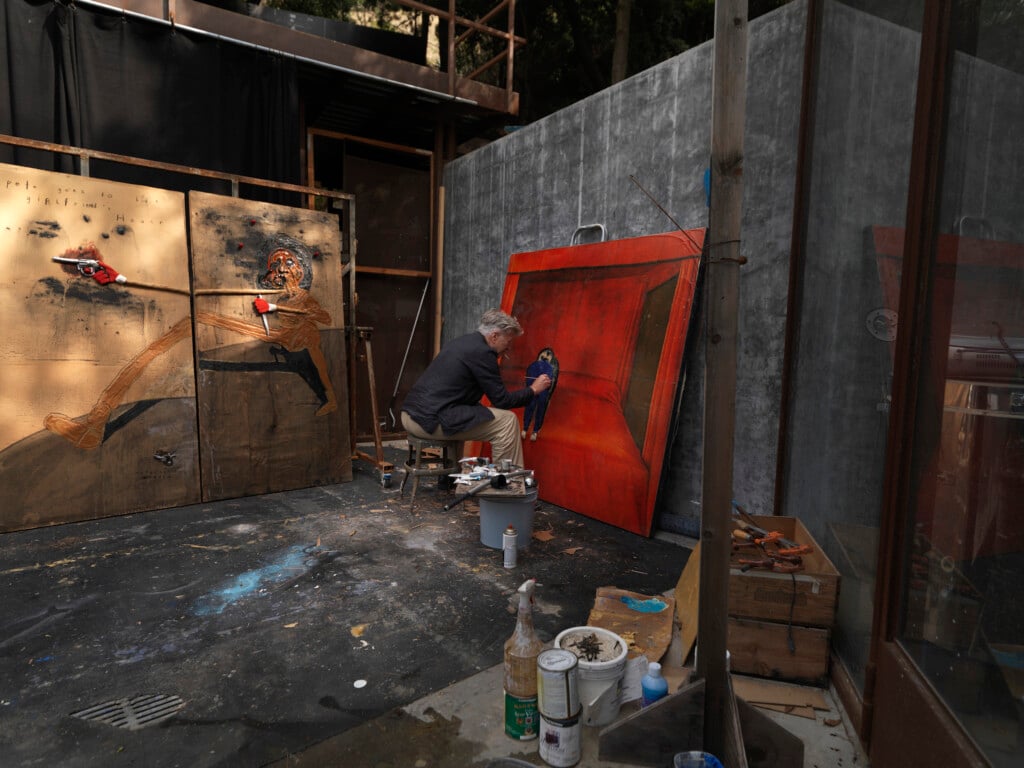
Born in 1946 in Missoula, Montana, Lynch moved to Philadelphia in 1965 to study painting at the Pennsylvania Academy of the Fine Arts. The city, with its gloomy, industrial appearance, would have a profound impact on his imagination. It was here that he became acquainted with contemporary American art, in particular the Action Painting of Jackson Pollock and Franz Kline: violent marks, material accumulations, and radical gestures, which Lynch absorbed and reworked in his own personal style.
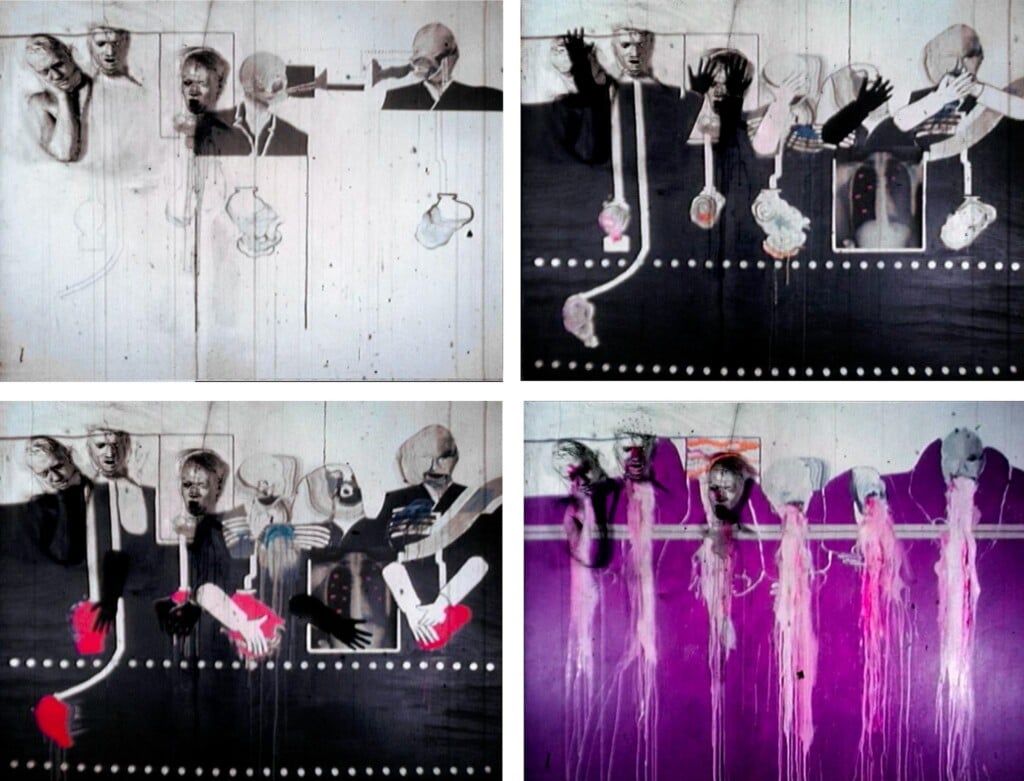
In 1967, at the age of just 21, he exhibited for the first time at the Vanderlip Gallery. But it was in the same year that the founding episode of his career took place, with his first experimental short film: Six Men Getting Sick (Six Times). A “moving painting,” six animated sequences projected in a loop depicting demons writhing and vomiting. Although he was still a student, this short film marked the beginning of Lynch’s artistic career, as it represents one of his first attempts at animation and his obsession with the macabre.
After Six Men Getting Sick, Lynch’s universe of bodies takes on new and more complex configurations in The Alphabet (1968). This short film transforms letters and bodies into monstrous and convulsive entities, where the body undergoes a process of abstraction without losing its material characteristics, almost in the manner of Francis Bacon. Here, handwriting becomes organism, linguistic signs become flesh: language itself, incarnate, becomes a threat. It is a work that anticipates the central role of the organic, of the body in metamorphosis and of living matter in all his subsequent production.
David Lynch: painting as his primary focus
David Lynch has never hidden what his first goal was: to become a painter. “All I wanted was to become a painter. It was the most liberating thing: you smoke cigarettes, drink coffee, and paint,” he said in a 2018 interview with Border Crossings. Painting was not just a formative phase for him, but the constant root of his imagination. Even when cinema took over, Lynch continued to paint, working with different materials and experimenting with techniques that make his canvases true extensions of his creative universe.
His paintings are distinguished by their often monumental format and the presence of deformed figures, monstrous anatomies, and landscapes that convey claustrophobia. The material, rather than the image, becomes the protagonist: thick oils, enamels, sands, and objects incorporated into the surface transform the canvas into a living body. Lynch himself describes the act of painting as a physical and direct act, where fingers replace the brush and mistakes, rather than being corrected, become part of the result. Painting is thus a field of experimentation open to chance, where the unexpected is not an obstacle but a possibility.
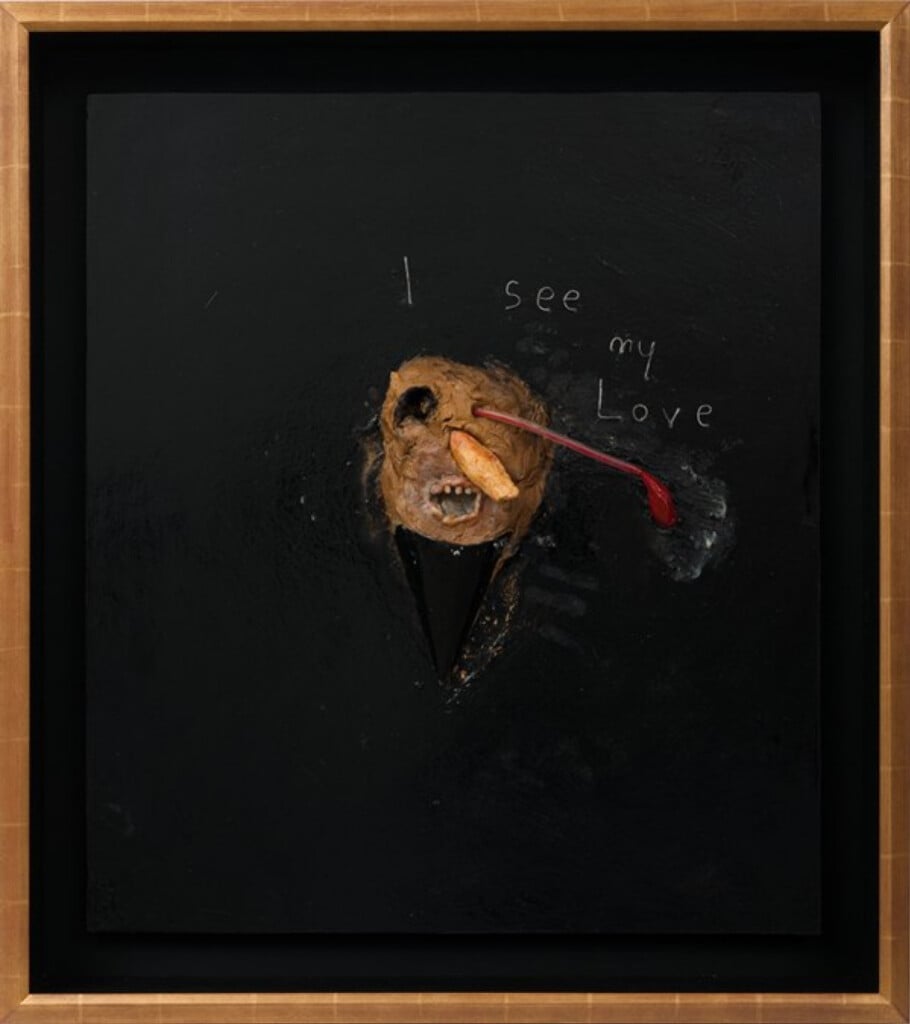
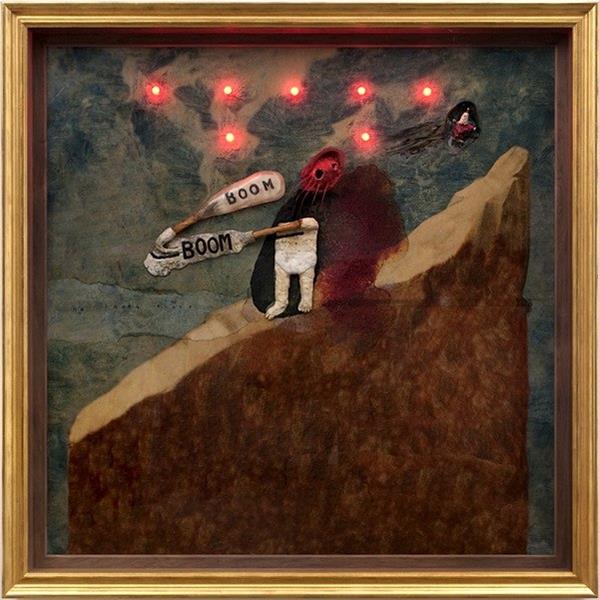
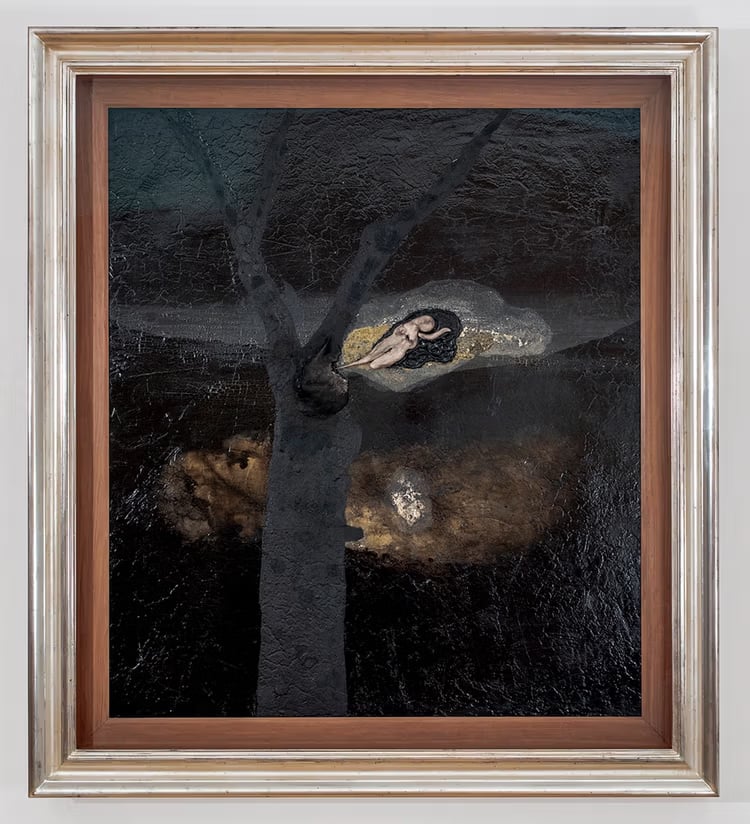
In the 1980s and up until the mid-1990s, his paintings focused on the theme of the home, understood as a place of memory but also as a space that can become distorted and disturbing. A prime example is Shadow of a Twisted Hand Across My House (1988), where the familiarity of the domestic environment is overshadowed by a menacing shadow, revealing the fragility of everyday life and its potential for corruption.
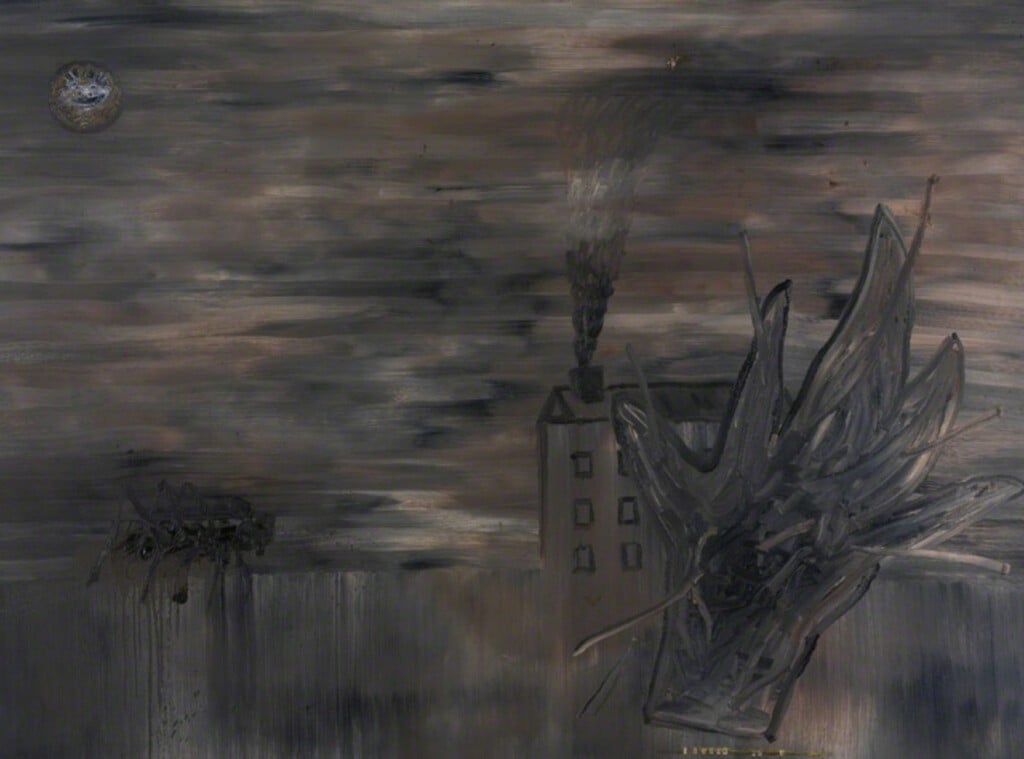
Over time, Lynch broadened his themes, but maintained the tension between the recognizable and the disturbing. In the early 2000s, he created works such as Bob’s Second Dream (2011), in which the reference to “Bob,” a demonic figure who also returns in Twin Peaks, confirms the continuity between painting and cinema. In this painting, the combination of painting and plastic elements produces an image that seems to emerge directly from the unconscious, rather than from an orderly dream. Another significant work is Pete Goes to His Girlfriend’s House (2009), which mixes irony and horror in a fragmentary and grotesque narrative.
These works are not mere digressions from his film work, but true keys to understanding his visual language. In his paintings, as in his films, Lynch insists on the theme of deformation, on the presence of altered bodies and on organic matter that invades the space of representation. Painting allows him to explore these motifs with immediacy and freedom, without the production constraints of cinema, but the imagery that emerges is the same that we find, in narrative and audiovisual form, in his films.
Painting in motion: artistic references
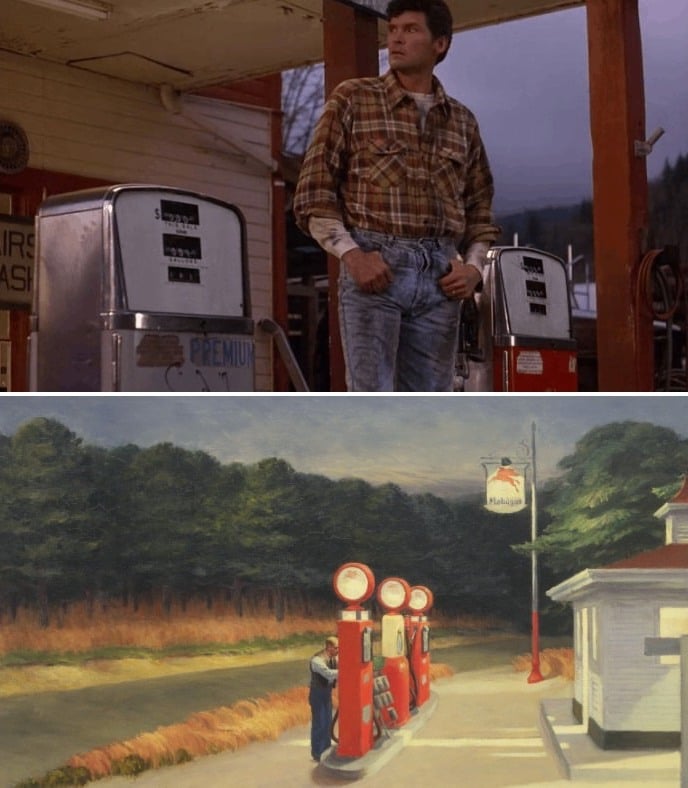
If painting represents the original core of Lynch’s imagination, his films are its extension in motion. It is no coincidence that many visual solutions refer to the lessons of the great masters of surrealism and modern painting. Salvador Dalí and René Magritte offer him the possibility of combining the everyday with the uncanny: from the former he inherits the logic of dreams and metamorphosis, from the latter the ability to introduce unreality into the most familiar scenarios, as happens in the suspended atmospheres of Twin Peaks. Edward Hopper, with works such as Night Highway, provides the model for silent interiors and urban landscapes, seemingly ordinary but charged with underlying tension, which recur in the empty streets of Blue Velvet and the diners of Mulholland Drive.
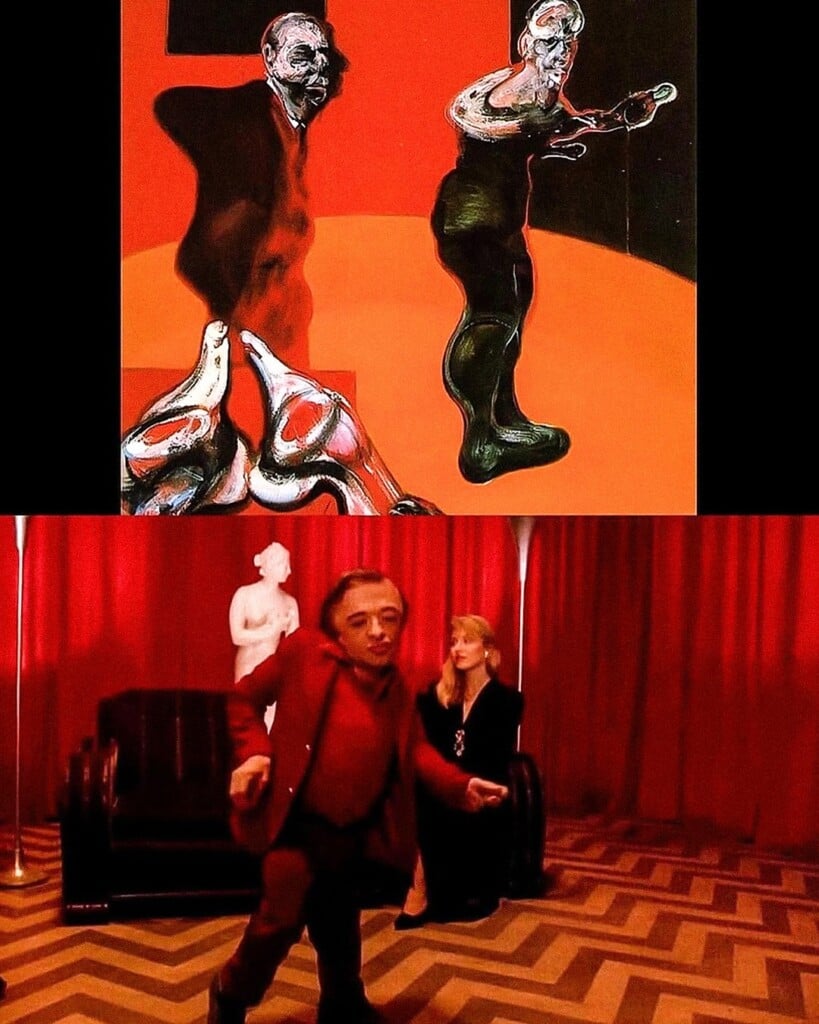
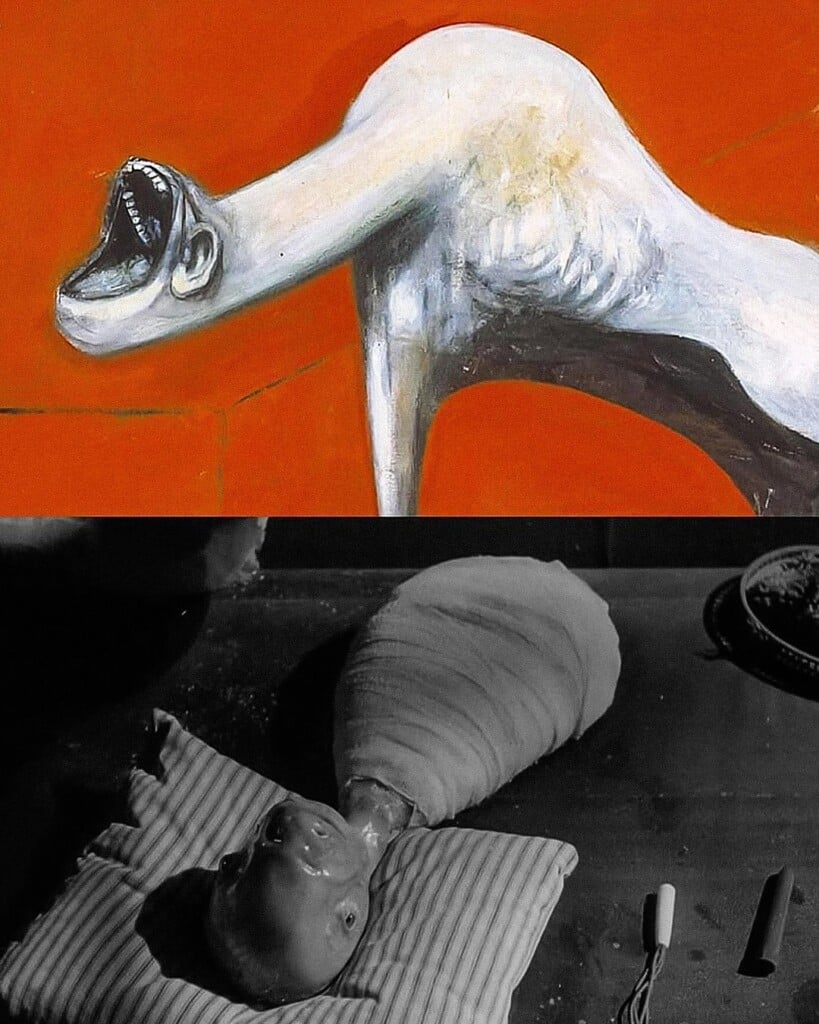
Finally, Francis Bacon is perhaps the most obvious reference: the deformations of bodies and distorted figures in works such as Seated Figure find a direct parallel in the convulsive faces and gestures of the apparitions in the Red Room in Twin Peaks. In this dialogue with painting, Lynch constructs a cinema that does not merely tell stories, but transforms the image itself into a sensory experience, capable of conveying beauty, disorientation, and menace all at once.
David Lynch, a transmedia artist
David Lynch’s work demonstrates how the boundary between painting and cinema has always been porous, if not non-existent. His strength lies in his ability to conceive of every visual language as part of a single creative ecosystem, in which canvases, installations, and films share the same imaginative core. Looking at Lynch therefore means recognizing the artist before the director: a transmedia creator who never stops moving between different means of expression, taking the viewer beyond the screen, into a territory where the familiar becomes disturbing and the image continues to live even when the projection stops. This is where the most authentic meaning of the term “Lynchian” lies: not a style, but an experience that transcends the boundaries of cinema and extends into the art, dreams, and visions of those who are touched by it.
Read also: Off Screen: Peter Greenaway, the fine line between art and cinema