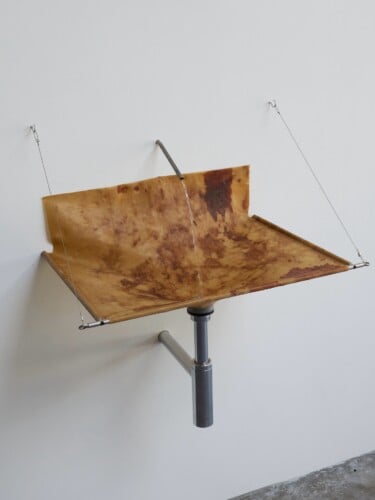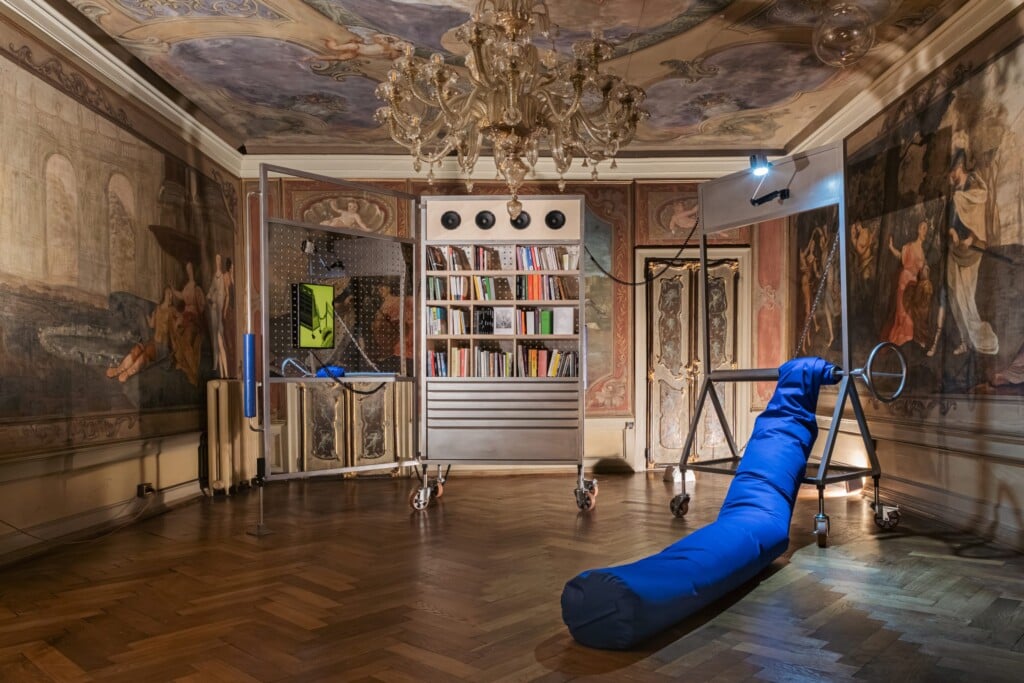
A library that dismantles, travels, and reassembles elsewhere, becoming something slightly different each time. The Library of Bees, conceived and designed by interdisciplinary studio 2050+ and commissioned by MUCIV – Museo delle Civiltà in Rome, resembles no archive you have ever encountered. Books are not objects to be preserved, but elements of a system that stays in motion: modular shelves on wheels, perforated panels, exposed cables, a soft fabric running across the floor to interrupt the metallic rigidity of the structure. Everything can be moved, added, removed.
View this post on Instagram
The reference to bees is not incidental. Bees have no fixed centre: knowledge moves between them through contact, spreads, overlaps, branches out. This is exactly what the system wants to do with books and those who use them: put knowledge into circulation rather than keeping it in a stable place. The first two exhibited components, Pollen 1 and Pollen 2, carry the promise of dispersal in their very name: not an archive, but pollination. Developed as prototypes for a potentially expandable family of nomadic objects, they pose a precise question about what a museum should be today. More inclusive, genuinely intersectional, capable of reckoning with the complexities of its own past, often entangled with colonial history.

What strikes most, though, is the deliberate rejection of a finished form. The installation has an intentionally incomplete appearance: exposed joints, visible connections, no surface treatment concealing how it was made. Inside a historic palazzo, surrounded by frescoes and chandeliers, this industrial and provisional structure makes no attempt to blend in or compete: it occupies the space as a temporary layer, a presence that could leave tomorrow. It is in this gap, between the permanence of the historic architecture and the mobility of the system, that the project’s most compelling critique opens up. Cultural institutions, 2050+ seems to suggest, should not settle. They should remain open, reconfigurable, attentive to whoever passes through them. Like a hive. Like a library you never quite know where you will find.