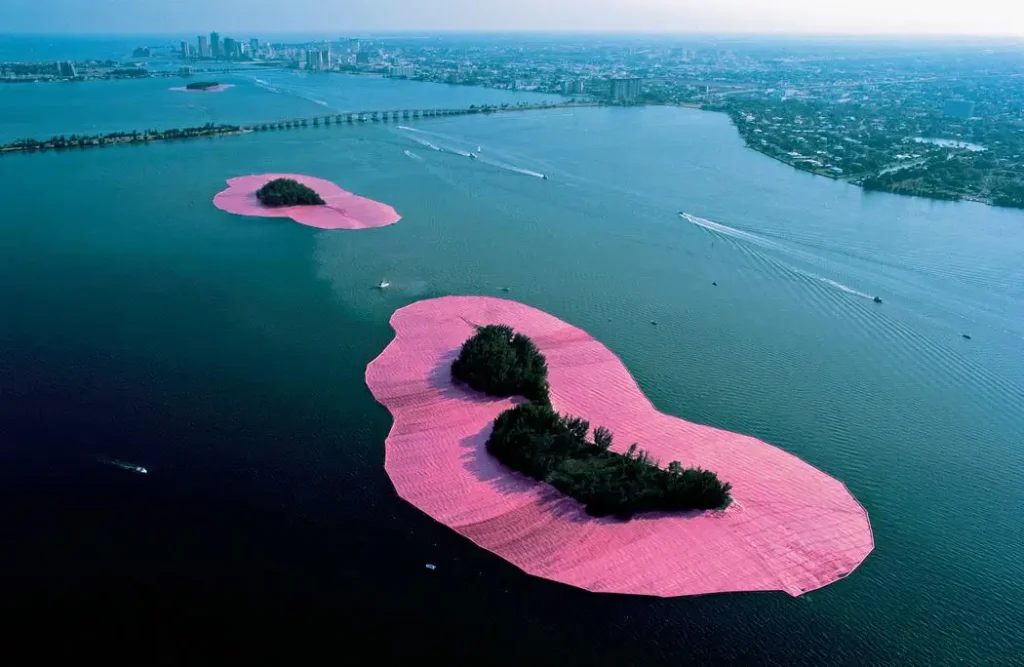
Some works of art cannot be hung on a wall. They are born in a desert, above a lake, inside a dark room — and they make sense only there, only like that, often only for a limited time.
Site-specific installations are perhaps the hardest form of art to love from a distance. And yet photographs, videos, and the accounts of those who were there still manage to convey something rare: the feeling that the world, in that place and at that moment, was different.
This is a list of works that made us want to book a flight. Some no longer exist. Others are still there, waiting.
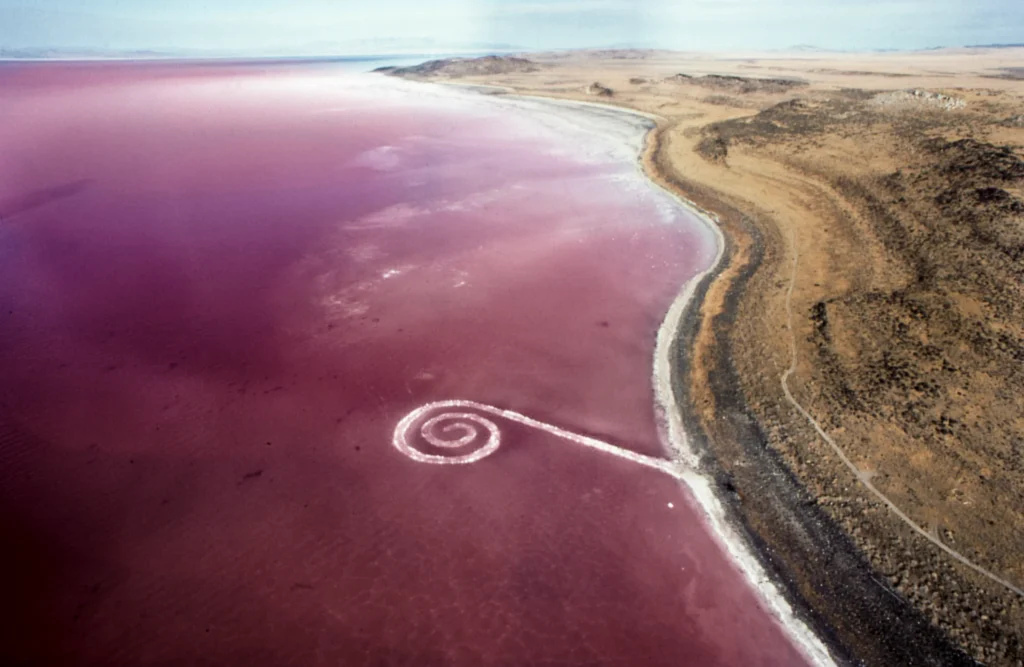
Spiral Jetty — Robert Smithson, 1970 Great Salt Lake, Utah, USA
An enormous spiral of black rocks coiling into a rust-coloured lake. Smithson built it when the lake was dry, then the water rose and submerged it for thirty years. Today it has resurfaced, encrusted with salt crystals. Every time you see it, it is a different work.
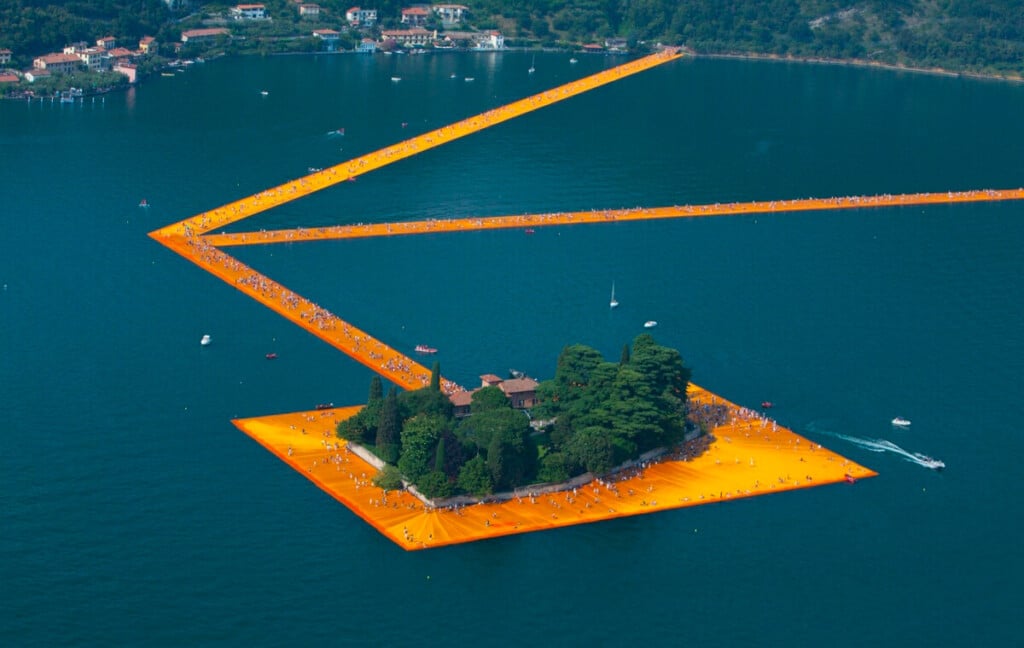
The Floating Piers — Christo and Jeanne-Claude, 2016 Lake Iseo, Italy
Three kilometres of saffron-coloured walkways on the water. Some 1.2 million people walked across them in sixteen days. Then Christo dismantled everything, as always. What remain are photographs and a summer that those who were at Lake Iseo have not yet finished talking about.
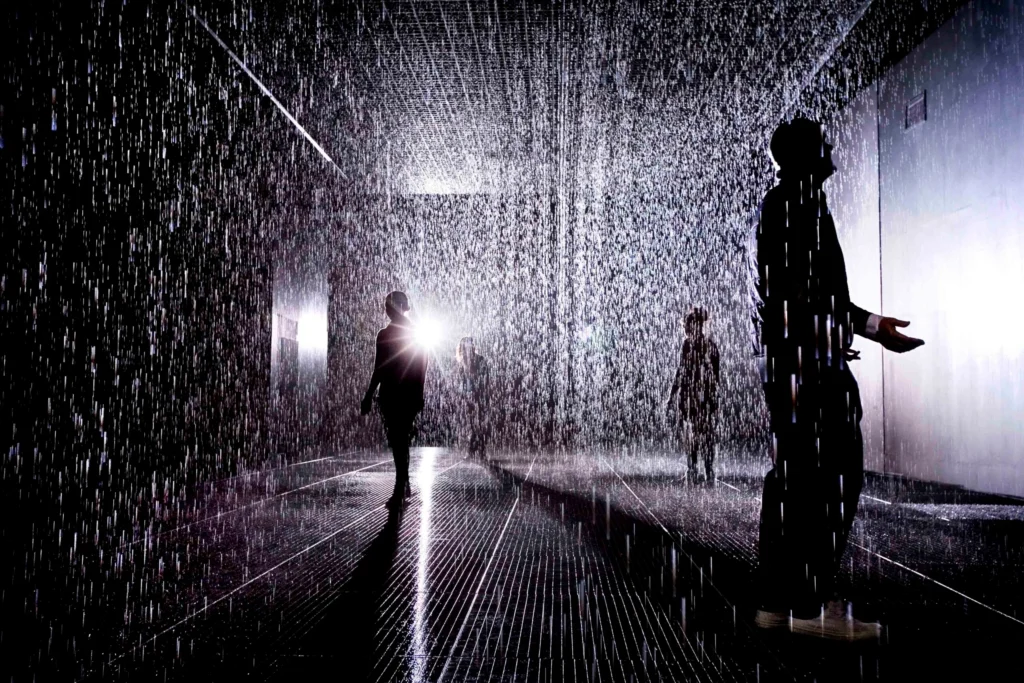
Rain Room — Random International, 2012 Barbican Centre, London (then MoMA, New York)
A room where it rains incessantly — except around you. Sensors detect your presence and stop the rain exactly where you stand. Walking inside the eye of a storm that follows you everywhere: one of the most sensorially perfect experiences of the last twenty years.
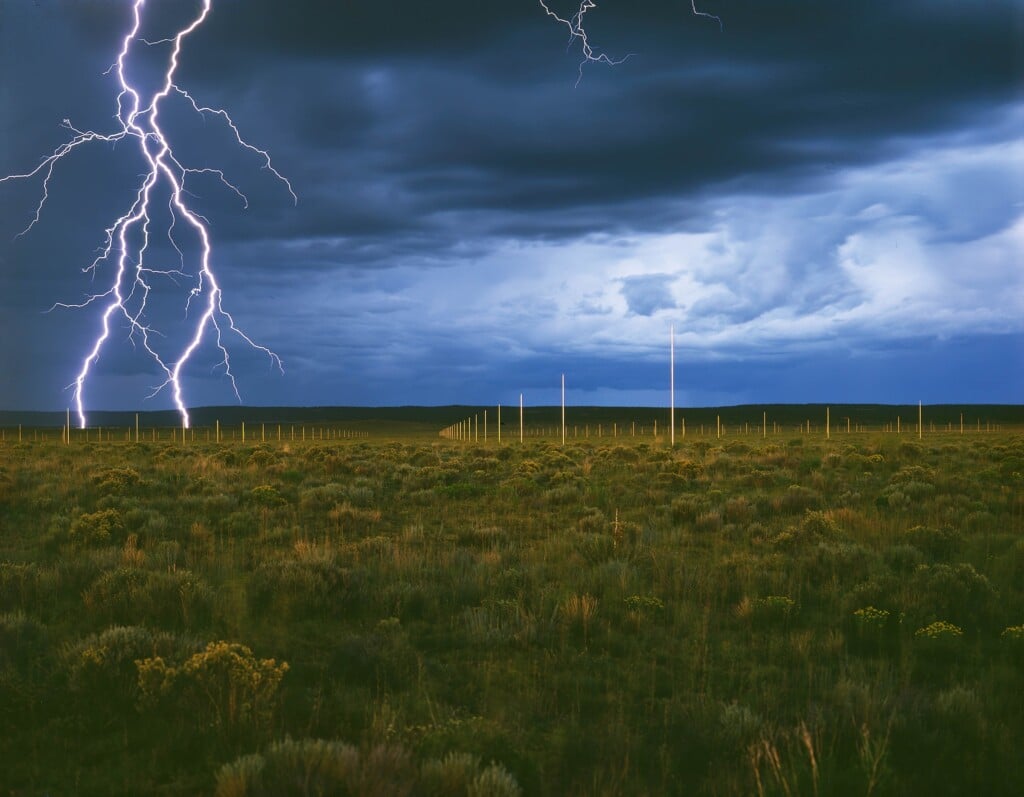
Lightning Field — Walter De Maria, 1977 New Mexico, USA
Four hundred steel poles arranged in a grid across the New Mexico desert. You must book in advance, reach the site by jeep, and spend the night there. Lightning is not guaranteed — but even without it, the field transforms the perception of landscape in an irreversible way.
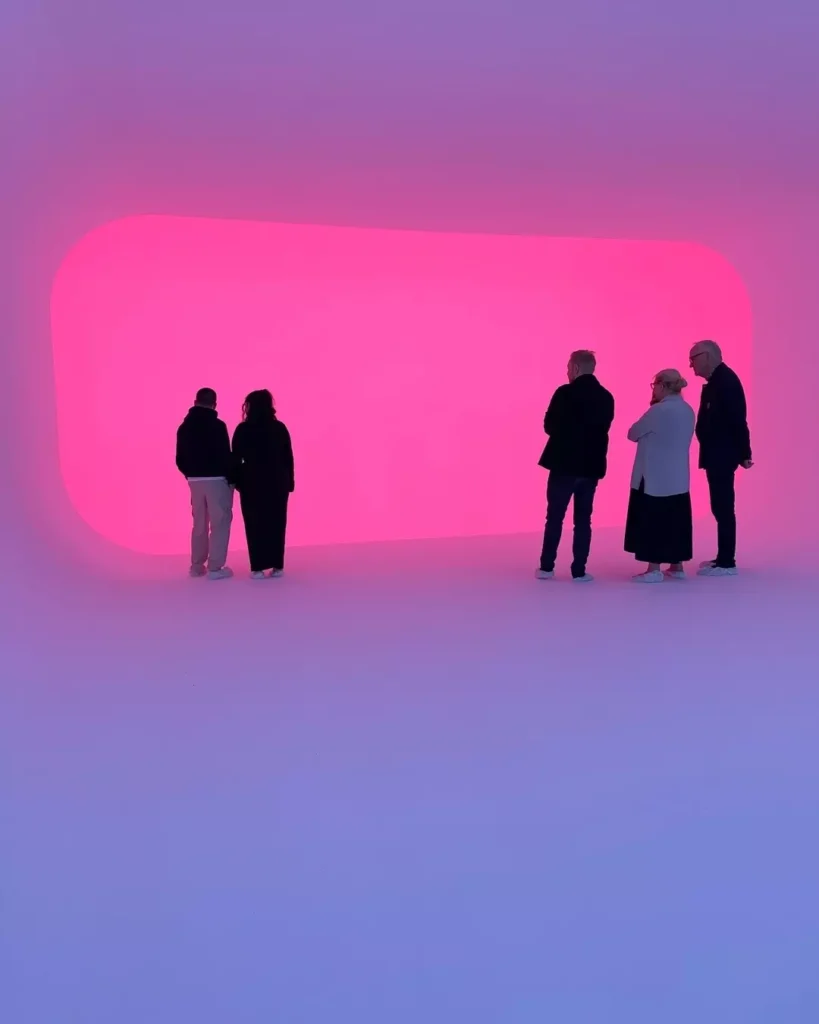
Breathing Light —James Turrell
Turrell has built dozens of these oval chambers with an opening in the ceiling that frames the sky. Seated inside, at dawn or dusk, the light shifts in ways the brain struggles to process. You never quite understand what you are looking at — and that is precisely the point.

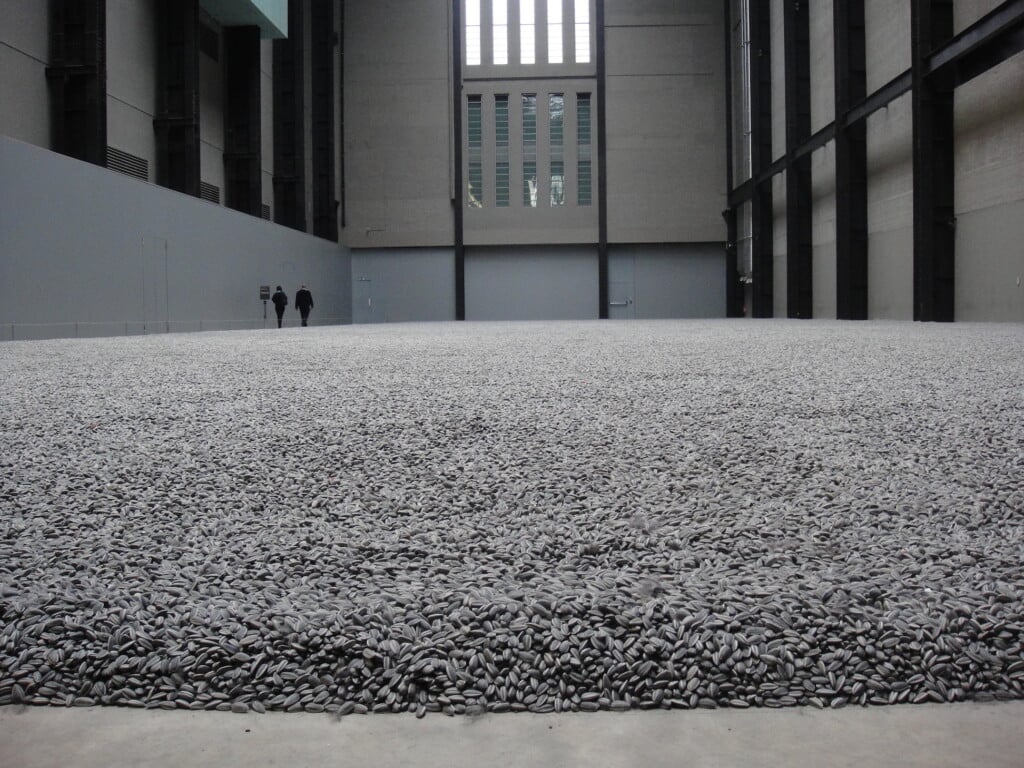
Sunflower Seeds — Ai Weiwei, 2010 Tate Modern, London
100 million porcelain sunflower seeds, each hand-painted by artisans from Jingdezhen. A carpet covering the entire Turbine Hall. Every seed was identical to the others and unique at the same time. A work about mass production and individual identity — and also about China.

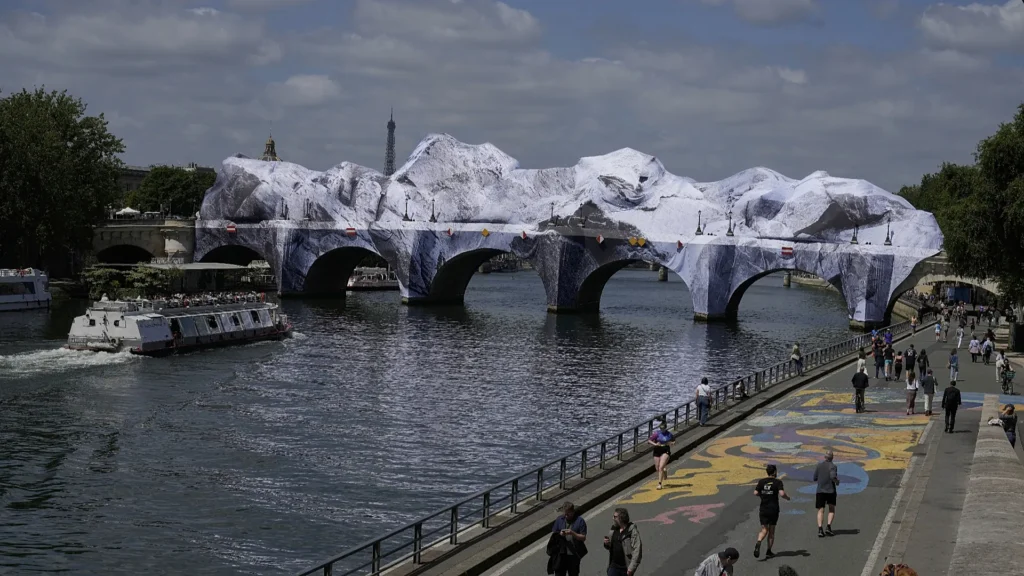
La Caverne du Pont-Neuf — JR, 2026, Paris, France
JR transformed Paris’s oldest bridge into a 120-metre-long, 20-metre-wide artificial cave reaching up to 18 metres in height: an inflatable structure that covered the entire Pont-Neuf, steps from Notre-Dame, open on foot 24 hours a day. The soundscape was created by Thomas Bangalter — yes, the one from Daft Punk — with the sound of dripping water, simulated stalactites, and a diffuse light that made Paris disappear around those who passed through it.
If you were in Paris in June, we hope you went. If not, welcome to the club of those who wish they had.
Read also: 5 brutalist buildings to visit