Everyone knows how fun it is to spend afternoons building thousands of structures using colorful LEGO bricks. Then, almost without realizing it, that changes, and our passion for building no longer has an outlet. But what if there were a design object capable of fueling that passion? What if a single object could become a thousand different things and transform a space?
The answer to these questions has a name: USM Haller, and it has an incredible history.
The history of USM Modular Furniture—and thus UMS Haller—is closely tied to the Swiss Schärer family. It all began in 1885 when Ulrich Schärer opened a hardware store in Münsingen, a small town near Bern. In the 1920s, the business was transformed into a factory, initially specializing in window fittings and later expanding to include metal component manufacturing and sheet metal processing.
The turning point came in the 1960s when Paul Schärer Jr., the founder’s grandson, wanted to modernize the company by focusing on design, starting with a complete renovation of the factory. The task was assigned to architect Fritz Haller, who was not yet the renowned professor at the University of Karlsruhe. Haller designed a functional building structured as a system of linear, expandable metal modules.

This transition from large-scale to small-scale design led to the birth of the USM Haller furniture system, initially developed solely for USM’s offices and not intended for commercial sale.
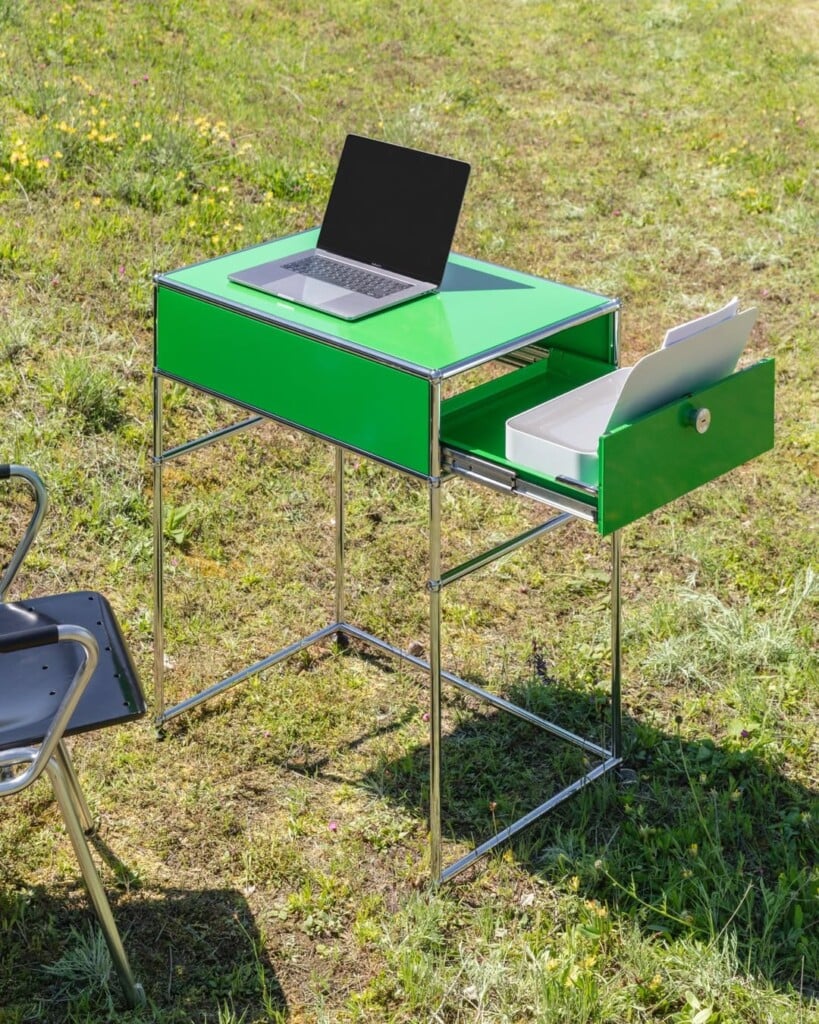
The USM Haller modular system is built on just three structural elements: the most important is the chrome-plated sphere with six openings (so iconic that it became the company’s logo), followed by steel tubes and metal panels. With just these three elements, countless configurations are possible.


In the mid-1960s, an executive from Rothschild Bank saw the USM Haller system and decided to place an order to furnish the bank’s Paris headquarters. At the time, since the system was not yet for sale, Paul Schärer Jr. and Fritz Haller set the price list based on the metal costs used for the Volkswagen Beetle’s structure.
From that moment, success grew exponentially. Over the past 60 years, very few modifications have been made, with the most notable being the addition of integrated lighting and a new olive-green color, added to the original 14 color options. In fact, for a piece as iconic as the USM Haller—so much so that it is part of the permanent collection at MoMA in New York—the biggest innovation is that there are no major innovations.


However, there is a twist. While the rigorous, sleek, and somewhat urban design of this furniture system has been the key to its longevity—making it perfect for homes, offices, and even hospitals—for its 60th anniversary, USM has introduced a radical new feature at Milan Design Week 2025.
As part of an installation within the Porta Venezia Design District, USM unveiled new felt panels that can be applied to the metal panels of the USM Haller system. With a simple gesture, these panels allow users to completely change the look of their furniture while also adding a soft, warm touch—perfect for cozier environments.
The UMS Haller installation will be open to the public until Sunday, April 13, at Viale Piave 27. Visit the Porta Venezia Design District website to explore all the other events happening in the district.