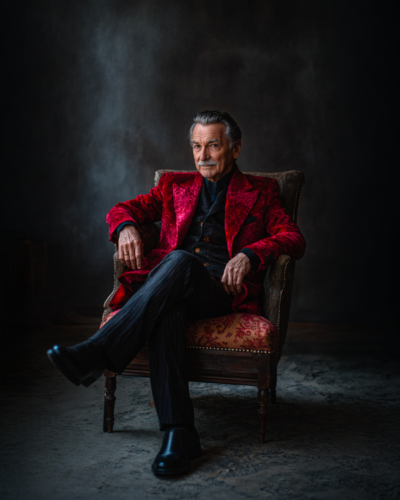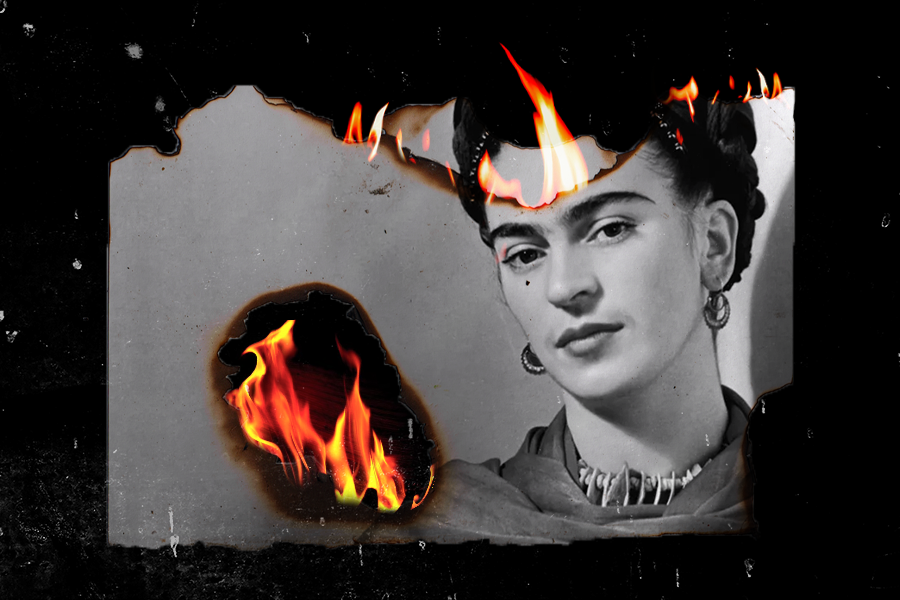
In his black jacket, slung tightly over his shoulders and painted with splashes of colour, Mexican art collector Martin Mobarak is holding a party in Miami, the guests are smiling poolside, about to watch a Frida Kahlo painting burn.
The crowd is looking right at Mobarak and this is not a performance like those seen in the past, where attention-seeking acrobats deface this or that masterpiece of art. Our anti-hero lives in a different timeline from the one that considers Frida to be one of the most intense artists of the 20th century, he lives in the one where the Mexican artist makes works in the metaverse, and it is there that Mobarak wants to take the painting Fantasmones Siniestro, which the meta-collector claims to have purchased in 2015 from the New York gallery Mary-Anne Martin Fine Art, who however claim to have never heard of him, as Vice reports.
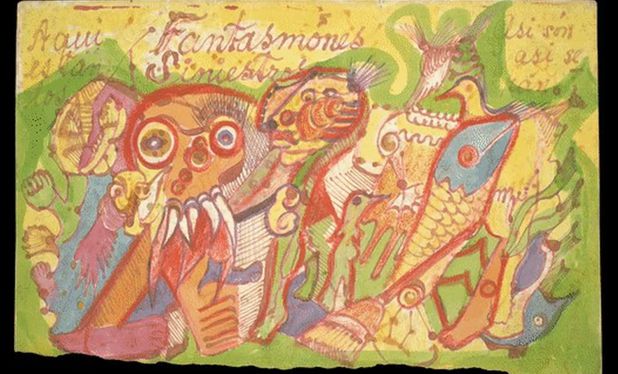
In an aperitif atmosphere with plastic cups, Martin Mobarak pulls the work out of a black case, removes the cloth protecting it and starts unscrewing the frame with a screwdriver. Having completed the bricolage work, the meta-carpenter proudly displays the work that Frida Kahlo had created in 1944 for the Venezuelan art critic Juan Rohl, later exhibited in New York and sold first in 2004 to the Vergel Foundation and then to a private collector in 2013.
It is here that the meta-bartender places the work in a giant Martini glass, filled with ice and fuel (not even an olive, come on!). Flames start burning Fantasmones Siniestro, while in the background to make everything more surreal, the volume of Cielito Lindo (Ay, Ay, Ay, canta y no llores) is turned up. The cup is then transformed into an altar, on which a piece of art is sacrificed in the name of the future, the ritual of the ‘alchemist of art, who transforms physical art into digital gold’, as the meta-shaman called himself, is completed.
The ritual is nothing more than a stunt by Mobarak to present his Frida.NFT blockchain project, which plans to make 10 thousand NFT digital copies of the work, each worth 3 ETH, about $4,000, for a total figure of $40 million, not very meta, very neoclassical. Part of the proceeds, however, will go to associations supporting children, a statement that does not conceal doubts about the value of the project.
The collector claims not to have destroyed the work but to have “consigned it to the metaverse”, to have thus introduced Frida’s work into a dimension that would “This community-driven initiative has a vision to introduce Frida’s work into the metaverse and leverage her powerful likeness to bring together a community of collectors, creators, and art lovers on a mission to merge the traditional art world with the digital art world’s expanding potential and immortalize humanities story”. A concept that does not convince insiders in the first place, who have doubted the provenance of the work, causing the case to reach Mexico’s National Institute of Fine Arts and Literature, which has opened an investigation in recent days.

In Mexico, in fact, the destruction of an artistic monument constitutes a crime by law, and then there is the added doubt as to the provenance of the work (now a crypto work) authenticated by the merchant Andres Siegel on 30 July 2022, the day of the ceremony.
It no longer seems a coincidence, then, that the performance took place in Miami and not in Mexico, a grand entrepreneurial project perhaps, which has cast shadows on the management of artistic heritage in the possession of large investors unconnected to institutions.
Who knows if Fantasmones Siniestros is really in the metaverse, for the time being it is certain that we have lost a page in the diary of Frida Kahlo’s story, in which a giant weight, a broom, a duck, a bird and spectral creatures represented all the complexity and magic of one of the greatest artists in the history of art.