Before they had the budget, they already had the vision.
The music video was, for an entire generation of directors, what the short film could never quite be: a free, fast format, funded by the music industry and capable of reaching millions of people. Three minutes with no dialogue, no forced narrative structure, none of the pressures of a studio. A place to experiment. Scorsese put the Rolling Stones in it. Fincher built the visual aesthetic he would later use in Seven and Fight Club. Michel Gondry invented a language made of handmade tricks and daydreams. Spike Jonze turned every set into an idea no one had ever had before. What all of these works share, beyond quality, is instant recognition: twenty seconds in and you know who shot it, even without seeing the credits — that’s the signature of an author.
Talking about this piece in the newsroom, a discovery came up that — I’ll admit — made me feel behind: the Directors Label. A DVD series published by Palm Pictures collecting the work of some of the most important music video directors in history. The first three volumes, dedicated to Spike Jonze, Chris Cunningham and Michel Gondry, came out in 2003. Four new volumes arrived in 2005, featuring Mark Romanek, Jonathan Glazer, Anton Corbijn and Stéphane Sednaoui. Today most of these videos can easily be found online — it’s worth setting aside an afternoon to watch these brief masterpieces. Here’s a selection of the ones that struck me most for storytelling and cinematography.
01. Martin Scorsese: Bad — Michael Jackson, 1987
Scorsese shoots Bad as if it were a West Side Story short film filtered through Taxi Driver. The subway sequence is pure urban choreography: tension, territory, masculinity put to the test. You recognize his New York immediately: dirty, theatrical, electric. The same latent sense of danger that would run through Goodfellas three years later.
02. David Fincher: Express Yourself — Madonna, 1989
Fincher was 26, and the video is a work of dystopian architecture inspired by Metropolis by Fritz Lang: chained workers, muscular industrialism, Madonna as a figure of absolute power. It’s already all Fincher: symmetrical composition, light controlled to the millimeter, an aesthetic that crushes its characters inside the frame. The same cold, magnificent gaze from Seven and Fight Club, applied to an imaginary dance floor.
03. David Fincher: Vogue — Madonna, 1990
A year after Express Yourself, Fincher returns with Madonna and invents something opposite: where the first was industrial and dark, Vogue is white, icy, almost abstract. High-contrast black and white, models like Greek statues, slashes of light that look like they belong to a 1940s film noir. The same formal perfection, but this time in the service of lightness.
04. Michel Gondry: Around the World — Daft Punk, 1997
Gondry builds an impossible choreography: five groups of characters (robots, skeletons, swimmers, rock stars, old women) move across different levels of a circular stage, each one following its own instrument in the song. It’s a perfect system, almost mathematical, and yet delirious. The Gondry of the films (Eternal Sunshine, The Science of Sleep) is already all here: dream logic applied with engineering rigor.
5. Michel Gondry: Protection — Massive Attack, 1995
An open homage to Rear Window by Hitchcock: the same voyeuristic structure, the same building as a stage for parallel lives. Gondry replaces the thriller with something softer and more melancholic, but the logic is identical: watching without being seen, and finding a story in that gaze.
06. Michel Gondry: Star Guitar — The Chemical Brothers, 2002
A train window. A passing landscape. Nothing else, except that every element of the landscape corresponds exactly to a sound in the song. Gondry synchronized the real world with the music so precisely that the video becomes hypnotic. It’s one of the most technically sophisticated music videos ever made, and it looks like the simplest thing in the world.
07. Spike Jonze: Sabotage — Beastie Boys, 1994
A fake 1970s cop-show trailer, shot with degraded film quality, fake mustaches and thoroughly convincing car chases. Jonze hadn’t yet made Being John Malkovich, but the irony and the ability to turn an idea into its own self-contained world are already fully formed. One of the most quoted and imitated music videos in MTV history.
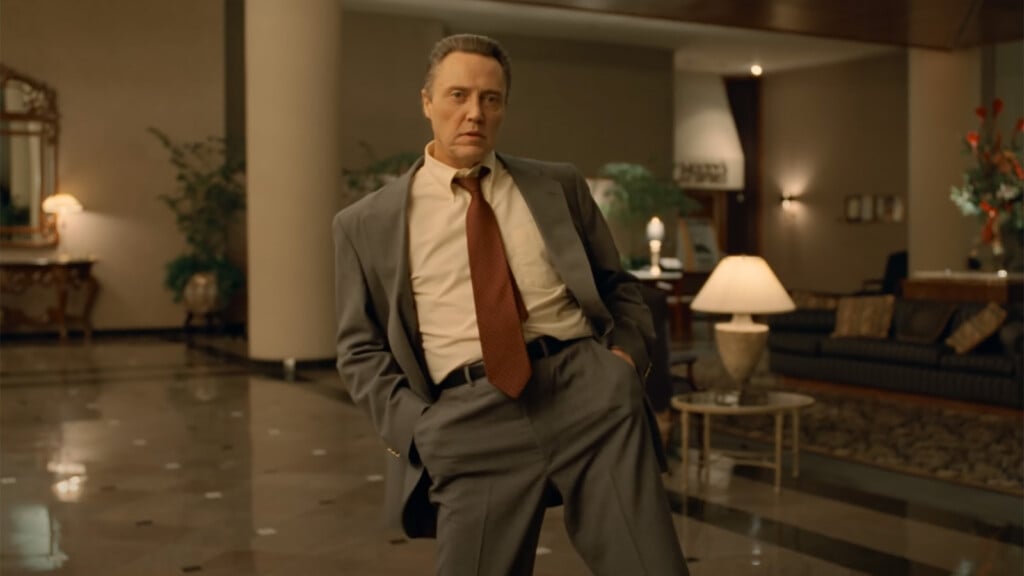
08. Spike Jonze: Weapon of Choice — Fatboy Slim, 2001
Christopher Walken dances alone in an empty hotel and, by the end, flies. There’s nothing else, or rather, nothing else is needed. Jonze takes one of Hollywood’s most unsettling actors, gives him a song and an empty space, and gets something both moving and surreal. It wins four MTV Video Music Awards. Walken had never danced in public before.
09. Jonathan Demme: Once in a Lifetime — Talking Heads, 1980
Three years before The Silence of the Lambs, Demme films David Byrne in a neutral white space. It’s a piece of direct cinema, with no mediation. The same documentary intensity he would bring to Stop Making Sense (1984) and later to his thrillers.
10. Anton Corbijn: One — U2, 1992 / Heart-Shaped Box — Nirvana, 1993 / Electrical Storm — U2, 2002
Corbijn isn’t a filmmaker in the strict sense — he’s a photographer who became an auteur — but his music videos are where he built the aesthetic he would later bring to film: burnt-out black and white, static frames, faces as landscapes. Heart-Shaped Box is his visual manifesto: the field of poppies, the old man on the cross, the little girl in the white hood. Four minutes that feel like a surrealist film. Electrical Storm, ten years later, confirms that his eye hadn’t softened one bit.
11. Mark Romanek: Hurt — Johnny Cash, 2002
Hurt is perhaps the most cinematic music video ever made. Cash, old and ill, in his crumbling mansion, archival footage, light that looks like it’s out of a Terrence Malick film. In four minutes, Romanek builds a film about time, loss and mortality. Rick Rubin has said he cried the first time he watched it.