In 1961, during a New York lecture titled Where Do We Go from Here, Marcel Duchamp observed that artists of the future, like Alice, would need to step through the mirror of the retina to reach a deeper form of expression. It was a prescient insight, because eight years later, in 1969, an editor at Random House turned that parallel into a concrete editorial project, commissioning Salvador Dalí to illustrate Alice’s Adventures in Wonderland, the novel Charles Lutwidge Dodgson, writing under the pseudonym Lewis Carroll, had published a century earlier, in 1865.
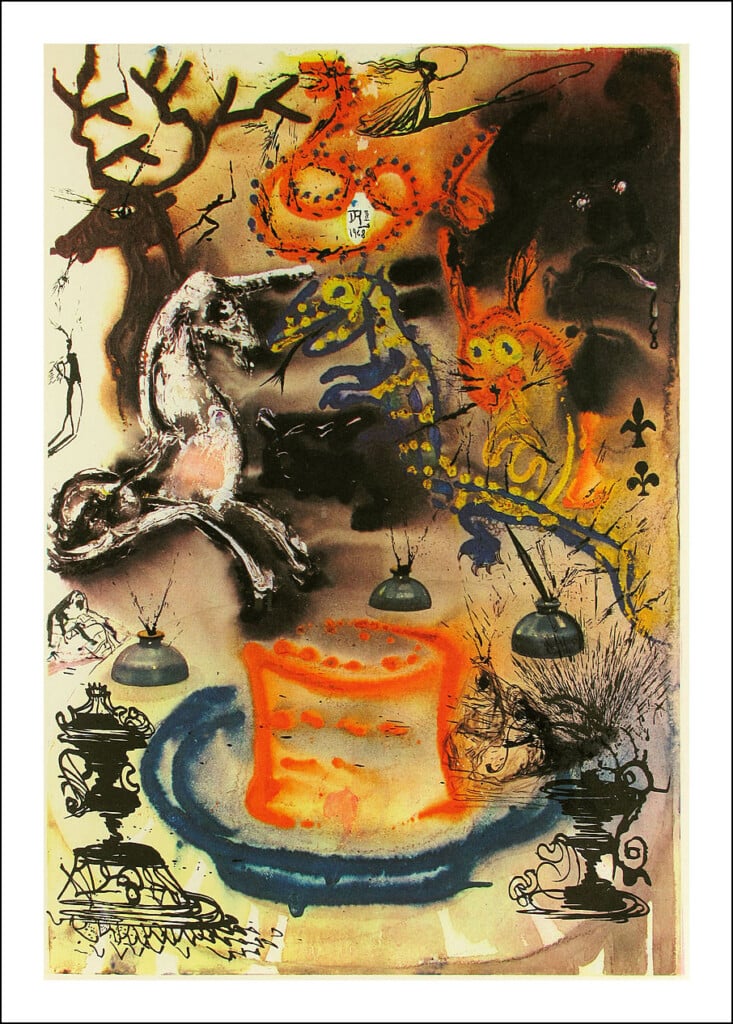
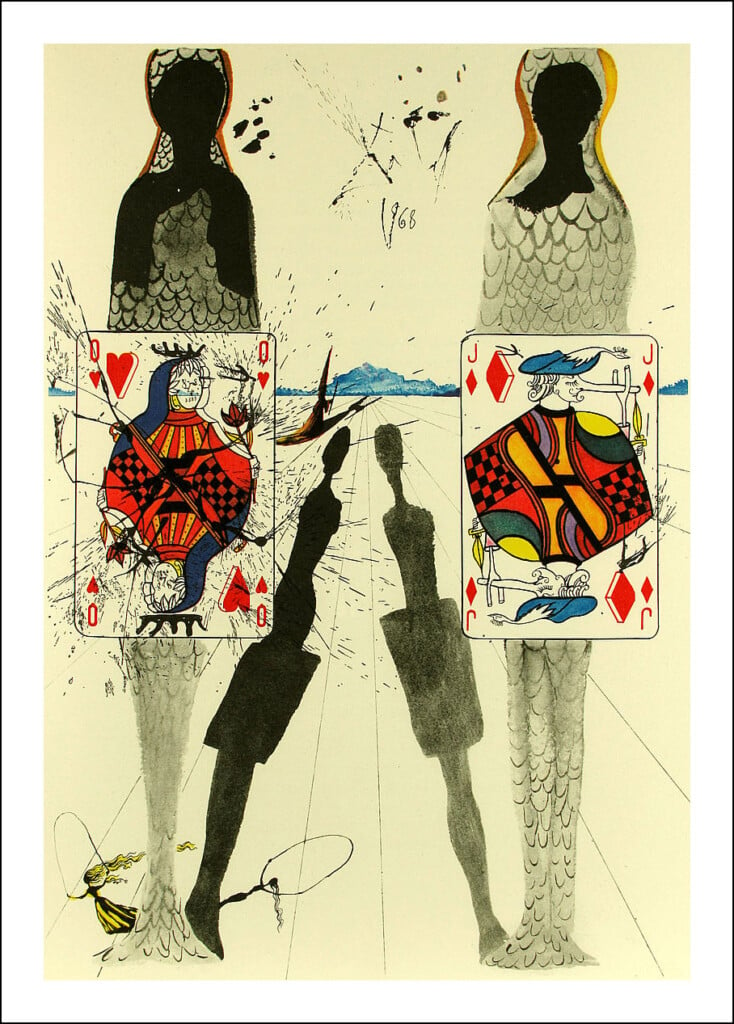
The result was one of the most eccentric collaborations ever conceived between Victorian literature and twentieth-century avant-garde. Dalí produced twelve colour heliogravures, one for each chapter of the novel, plus an original etching in four colours for the frontispiece, signed and numbered in pencil on each copy. The edition, published by Maecenas Press, had a print run of roughly 2,700 copies — already a limited number for the time, one that over the following decades turned the volume into one of the most sought-after pieces in Dalí’s entire graphic output, now valued in the tens of thousands of dollars on the antiquarian market. It wasn’t an arbitrary pairing of a big name with a children’s classic: Carroll’s world, built on skewed proportions, unstable identities and upside-down logic, shared with Dalí’s surrealist imagery the very same obsession, namely the destabilising of ordinary perception through images that hold together only according to an internal, self-contained logic that ignores the rules of the world beyond the page.


The bond between Dalí and Carroll’s young protagonist, incidentally, didn’t end in 1969: the artist returned to her image several times over the years, eventually going as far as producing a bronze sculpture of her. The illustrations move through pastel, watercolour-like tones — pinks, ochres, blues — that soften otherwise dizzying scenes, almost as if setting the strangeness of the content against a delicate palette. The landscapes stretch into dreamlike horizons and symbolic deserts, populated by elements typical of his imagery — melting clocks, elongated figures, unstable architecture — grafted onto Carroll’s characters. The result is an illustration that doesn’t accompany the text descriptively, but reinterprets it, layering its own visual language over that of the original story.

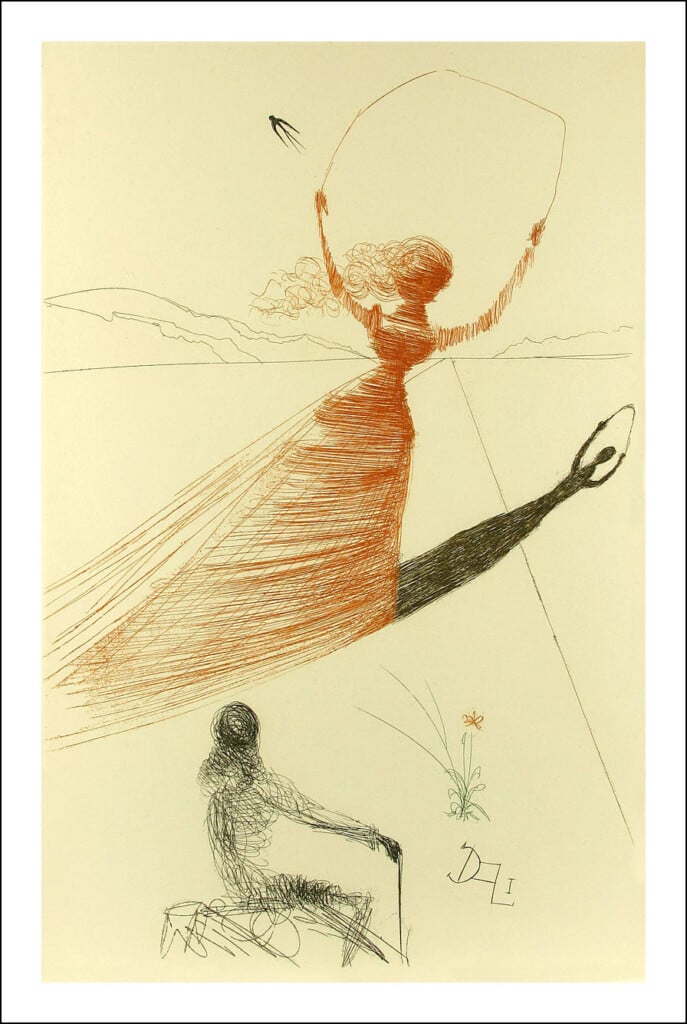
For half a century, the original plates remained an almost mythical object, reserved for collectors and specialist libraries, out of reach for the wider public. The turning point came in 2015, when, to mark the hundred and fiftieth anniversary of the original publication of Carroll’s novel, Princeton University Press released a new edition, finally making Dalí’s illustrations accessible to a general audience — illustrations that until then had been visible almost exclusively through the digital reproductions held by the William Bennett Gallery in New York, custodian of the original works.

Nearly sixty years after its first publication, the volume remains a rare case of an artist’s book capable of working on two levels at once: as a collector’s object for Dalí enthusiasts, and as an alternative visual key for those who know Carroll’s novel only in its more tamed version, the Disneyfied one. The 1969 plates, now more accessible thanks to the Princeton reissue, restore instead the more unsettling and mathematically vertiginous soul of a text that, beneath the surface of a children’s story, has always hidden the very question that obsessed Dalí: what happens when logic stops obeying the real world and starts building one of its own?