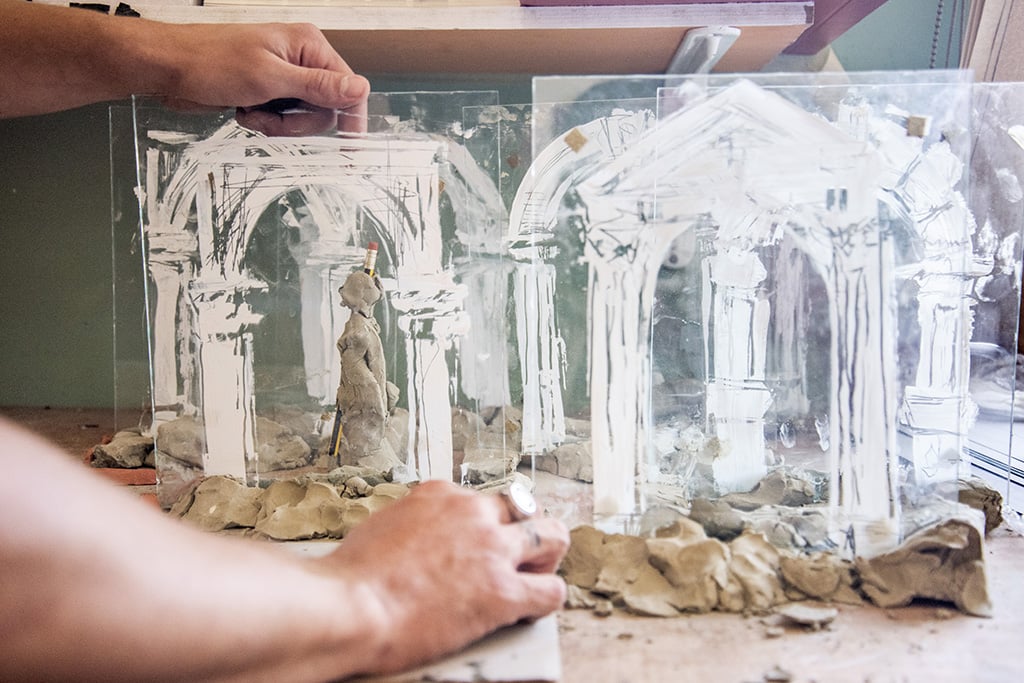
Born in 1989, Spanish artist Gonzalo Borondo is known for his works that are closely linked to the context in which they are exhibited, exploring the relationship between art and its public. On November 16th he will present a preview of his screen-printing on glass installation entitled Non Plus Ultra at the MACRO in Rome. The work was created with the help of Arturo Amitrano, founder of 56Fili, a screen printing project founded in 2008. The installation will be presented in occasion of MARCO ASILO and will remain on display for three days, before moving to Ex Dogana, where it will be open to the public from November 30 to December 30.
With Non Plus Ultra, a work composed of fifty-two sheets of glass two meters high with two graphic-pictorial images printed on both sides, Gonzalo Borondo wants to reflect on the concept of limit, on the need that man has to overcome himself, to go beyond the known, an idea reiterated by the curator Chiara Pietropaoli:
“The limit attracts and rejects, projects the viewer to infinity, between perspectives and reflections, transparent symbols that merge and are lost, are confused in the multitude, and multiplied through screen printing, raise questions.”
We have had the fortune to meet Gonzalo Borondo and to talk with him about his work.
In your works, man, his nature and his emotionality are often the protagonists. For this your new work you have decided to represent a man with wide shoulders that refers to the iconography of the crucifixion. Why did you choose a symbol so strongly linked to sacred art?
I chose this symbol, like the column, to speak about faith, about the need for faith that I feel strongly and that I feel belong to everybody, an ancestral need that is failing. Today political, religious and social beliefs are disappearing, in favor of an extremely superficial approach to the ideal, as well as to the real. Faith must not disappear, behind faith there is hope, we need to believe, to hope, we need to know how to look beyond what we see.
“Creer y crear”, are for me two concepts deeply linked, there is an act of faith behind each creation. Without creation, there is nothing, there is death.
The figure represented is a symbol, an icon, no matter what its identity is, it is a universal figure and it is there, from behind, to talk about something bigger and it does it with another symbol, the column, together they tell us about eternity. It is no coincidence that I chose three symbols that characterize Rome because there is also the arc given by the proximity of the figures. It is inevitable that the surrounding scenery has a direct influence on my imagination.
Limits, boundaries and the possibility of crossing them are very important themes of our present. Is it a coincidence or with this work did you also want to send a message?
My intention has never been to send a unidirectional message. Yes, often at the base of the work there may be a concept that I feel like I want to explore, to question, but with my works, I don’t want to give answers or to put myself in front of a specific problem. I think that the strength of art is precisely this, generating emotions, sensations that, like a rational thought, can make you reflect, if not more. I think that memory is made of this, of images, sensations, and my works, if anything, have the intention, the ambition to enter into this intimate sphere. Experience, above all, is what remains, what forms us as human beings, and it is what interests me: to create experiences. Non Plus Ultra was conceived in this way.
By this I don’t mean that I’m not influenced by what’s going on around me, certainly, I am because I’m sensitive, but I’m more attracted by eternity than by current events, I prefer poetics to politics.
Non Plus Ultra reflects on the concept of limit, and glass, a material with which you often work, seems to have a lot of them. What was, in this case, the biggest one to overcome?
The glass is a very fragile material and it is certainly not advisable to create a work of art in glass, especially if it is large; but it is the very limits of glass that attract me, it is a magical material that I have always loved, it is a living material. I am fascinated by the reactions of this material, in light, for example, the transparency and reflections allow me to play and I like how it reacts to an action, I like it intact, like in a thousand pieces.
The glass is the material with which I have established the strongest relationship and that has given me the most research, and just beyond the limits that the material has placed me, I found the most interesting creative solutions. The title of the exhibition tells just that, the relationship that we can establish with a limit and in this sense the glass represents a threshold: you can go beyond, beyond there is something, you can perceive it, but you can also hurt yourself. I find it very poetic that glass creates a sort of transparent limit, at the same time fragile but dangerous in its breaking… I think that this material alone functions as a metaphor for personal “limits”.
This time the limit to overcome was not glass. The greatest difficulty was the choice of the two images to be used together on the sheets. Multiplication has a strong value in terms of meaning and the great difficulties are yet to come.