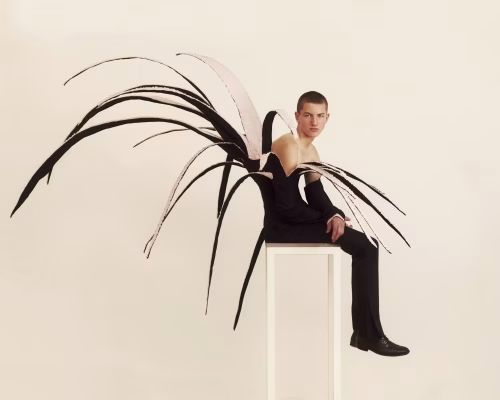
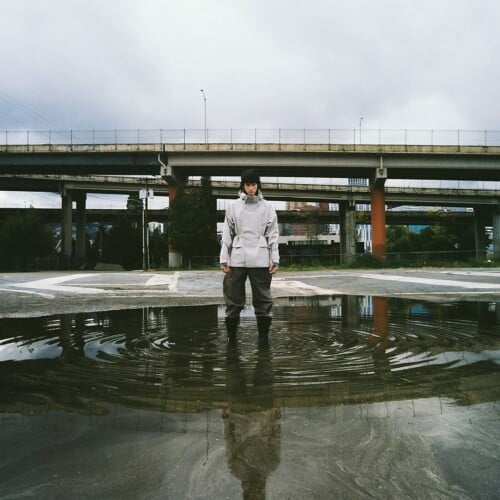
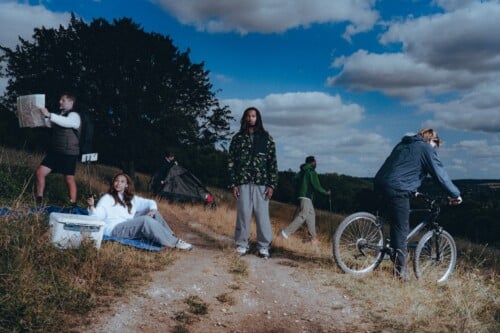
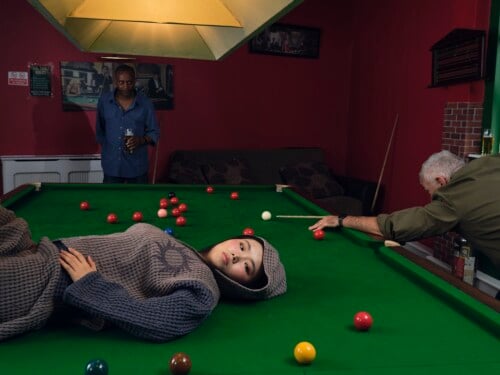
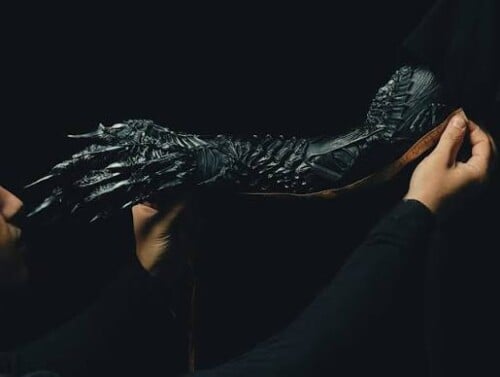
In recent years, AVAVAV has become one of the most unpredictable projects at Milan Fashion Week. The brand, founded and led by Swedish designer Beate Karlsson, builds a visual universe that blends art, sculpture, and humor—translating these influences into experimental silhouettes, accessories, and objects that often oscillate between provocation and irony, and inevitably end up capturing social media’s attention. For FW26, Karlsson set out to question not only the language of clothing, but the mechanics of the fashion show itself. With The Female Gaze, she literally flips the runway structure: guests are invited to enter the space one by one and walk through it as if they were the model, crossing a room where models—arranged in two lines—watch in silence. In this role reversal, the viewer becomes the viewed, turning the show into a performative experience.

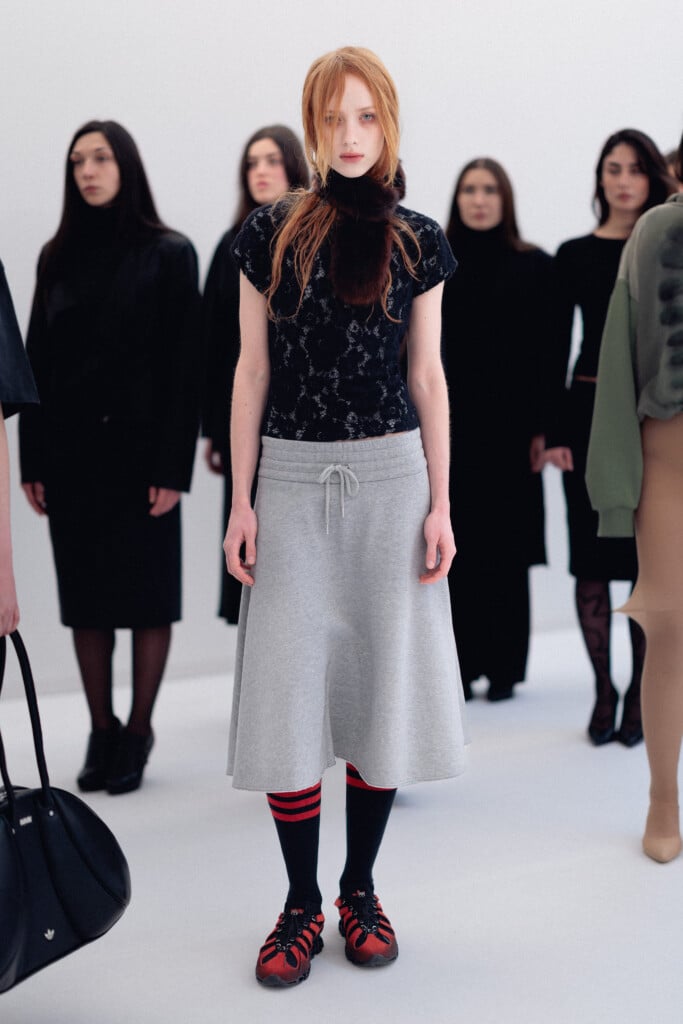
The collection begins as a research project: what happens to femininity when it stops being built for an external gaze? Tailoring and traditionally feminine codes merge and mutate—suit trousers become skirts, shorts reveal hybrid silhouettes, while hyper-feminine signifiers like pearls, stockings, and garters are reworked with a balance of nostalgia and irony.
We spoke with Beate Skonare Karlsson to uncover what’s behind this collection, her relationship with the body and with form, and the way AVAVAV continues to build a visual language that moves between vulnerability and experimentation.
If you had to describe this phase of AVAVAV in a single word, what would it be — and why?
Reflection.
Where does your obsession with exaggerating shapes and body parts come from?
It’s something that has been with me for as long as I can remember. As a child, I loved sculpting with clay, constantly working with my hands, reshaping things, inventing new bodies—in a way, building my own little worlds or creatures. There was something magical to me about how form could be stretched, softened, distorted, and still feel completely alive.
I am deeply influenced by early cultural memories, characters and universes like Pingu, Barbapapa, Miyazaki’s films, The Moomins. They all share this emotional generosity in their shapes. Nothing is rigid; everything breathes, expands, transforms. Those worlds made exaggeration feel natural and expressive rather than strange.
I’ve always been drawn to form in general, to design as a language of silhouettes and proportions. Exaggerating shapes and body parts feels less like a conceptual decision and more like an instinct. It’s a way of amplifying emotion, of making the invisible visible through volume and proportion.

Is there another obsession that’s been with you lately — something that keeps resurfacing in your work and that we can also see in this collection?
Yes. Lately I’ve been interested in taking the sculptural forms that I naturally gravitate toward and translating them into something more wearable. They often start from a place of strong artistic integrity, almost like small artifacts, and I’m curious about how they can be brought into a fashion context without losing that intensity.
I’m interested in finding a balance, keeping the emotional and sculptural quality intact, while applying it to more relatable, commercially associated products. By placing these forms into familiar garments, they can become more accessible and easier to connect with, without compromising their character.
In this collection, for example, I loved working with hosiery. The idea of a vintage, feminine stay-up stocking that instead of ending in a traditional foot grows into a finger-like shape felt exciting to me.


Your shows often manage to wrong-foot the audience. When you started working on this show, what expectation did you want to overturn?
For me, the most important thing was that people would actually feel something. I love this collection and the theme behind it, it’s personal and meaningful to me, and the worst outcome would be indifference. I wasn’t necessarily trying to overturn a specific industry expectation, but rather the expectation of passivity. I wanted the audience to be emotionally present, to care, to think.
At the same time, I was excited about how intimate and slightly uncomfortable the experience might become. There’s something interesting about how people behave at fashion shows, often they just want to get to their seat, they look at their phones, they try not to feel self-conscious. I liked playing with that tension. The theme itself is sincere and important to me, but the execution has an element of irony, almost like a prank, or a Japanese game show. I’m always drawn to that balance: something deeply personal presented with lightness, humor, and a bit of disorientation.


What images, artists, or cultural references are influencing you right now? Is there anyone in particular you feel close to in your most recent research?
Because of the concept of this season, I’ve been researching a lot of women, particularly women in fashion, and it’s given me a deeper respect for what many of them must have navigated and endured. Even if I don’t know them personally, studying their journeys has shifted something in me. It’s made me more aware of the structural and cultural resistance they’ve worked against, and the strength it takes to build something lasting within that.
I’ve also always felt close to Rei Kawakubo of Comme des Garçons. Of course, the design language is incredibly inspiring, but what moves me even more is how she built her business. There’s such integrity and innovation in it, a company that holds radical artistic vision at its core, yet operates in a creatively sustainable and intelligent way. It’s not trend-driven or short-term. It feels like a structure where art and business coexist without compromising each other, and I find that deeply inspiring as I think more about my own long-term path.


AVAVAV has built a very strong identity by playing with irony and provocation, but also with failure, mistakes, and social pressure. How did that intuition come about? How do you evolve that language without turning it into a formula?
I think it comes from dealing with real things, real emotions, real insecurities, real social dynamics. The irony or provocation is never the starting point; it’s usually just the surface. Underneath that, there’s always something that feels true to me at that moment, something I’m experiencing, questioning, or struggling with.
As long as the work comes from something genuine and present, it can’t really become predictable. The themes might echo, but the emotions evolve, and so does the expression. For me, staying honest is the most important safeguard against repetition.


Once you’ve finished presenting a collection, what interests you most about everything that happens around the final result?
I would be lying if I said I’m completely detached from the reaction. I’m still growing, and in the immediate aftermath I sometimes catch myself looking for validation in the noise. I’m getting better at it, but when you’ve put something very personal into the world, it’s hard not to listen.

More than praise, though, what interests me is whether people felt something. I hope the work doesn’t pass by unnoticed. There’s something powerful about realizing that a feeling you had privately can resonate collectively, even if that vulnerability comes from insecurity. In many ways, it’s about facing your fears. At the same time, being part of a small team means I can’t fully step back, I’m still involved in making sure everything moves forward. It’s a balance between sensitivity and responsibility.


Social media has played a decisive role in the brand’s rise and in shaping its language. Beyond their communicative power, how do you view their impact on contemporary society today?
I have a very double relationship with social media. There’s so much that’s beautiful about it. I’ve met some of my closest friends through it—you discover each other because you respond to the same references, the same images, the same sensibilities. That ability to find your people across geography is incredibly powerful, and it has definitely shaped our brand.
At the same time, I think the speed can be problematic. Sometimes it feels like physical experiences become secondary to their documentation. People are so quick to record or share that they don’t fully inhabit the moment itself. You see events being experienced through screens rather than in real time, and that creates a strange distance, almost like we’re outsourcing our own feelings. I find that tension both troubling and fascinating. It’s something I’m still trying to understand, and maybe even something I’d like to explore more directly in future work.