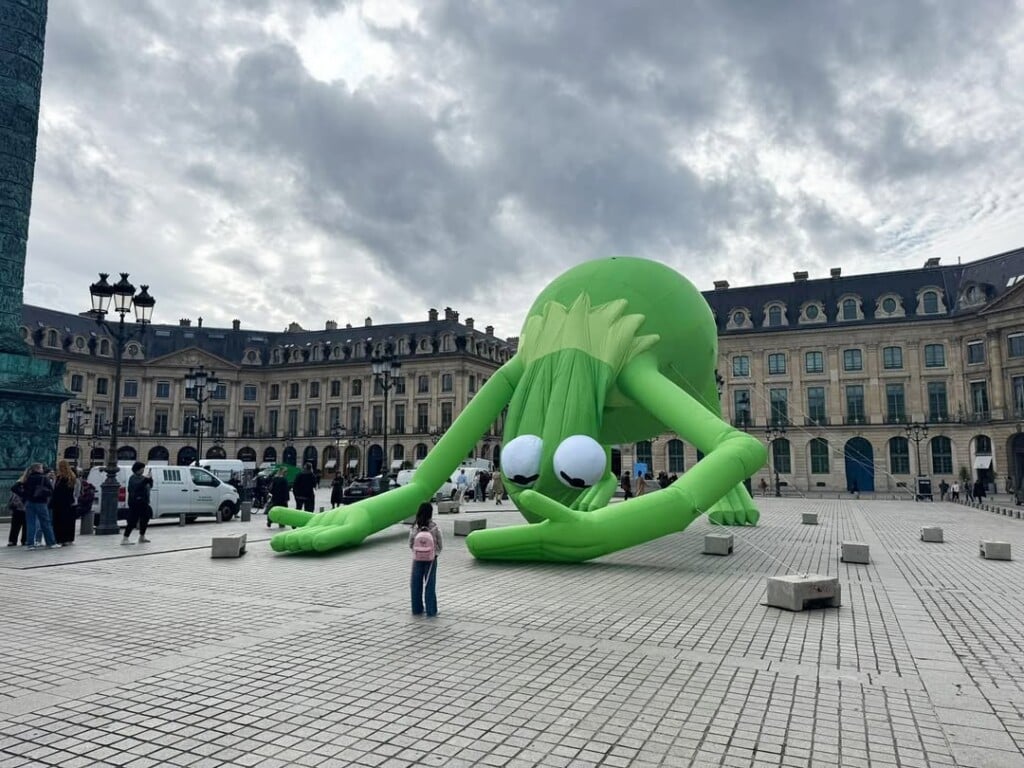
On the occasion of Art Basel, at Place Vendôme, amid the façades and logos of the maisons that line the Parisian square, something unexpected moves in the sky: a huge inflatable Kermit the Frog, suspended like a dream that can’t decide whether to laugh or collapse. The most famous frog in American pop culture becomes, in the hands of Alex Da Corte, a hollowed-out icon—the ironic, melancholy symbol of a childhood that keeps inflating and deflating under the public’s gaze.

Part of Art Basel Paris’s public program, the installation is titled Kermit the Frog, Even—a subtle nod to Duchamp and his The Bride Stripped Bare by Her Bachelors, Even. Here, however, the bride is replaced by a gigantic helium balloon, lightness turned into melancholy, purity into spectacle. Da Corte drew on a real episode from 1991, when Kermit’s balloon during the Thanksgiving Parade in New York got snagged and began to deflate, its limp head swaying between sky and asphalt. It’s in that imperfect image that the artist finds his truth: a character trapped between life and ruin, between myth and vulnerability.
View this post on Instagram
Beneath the sculpture at Place Vendôme, a small crowd of performers dressed as Kermit smile and wave at passersby. It’s a silent parade, a collective ritual blending irony and unease. From afar it looks like a party, but up close everything appears fragile, almost surreal. It’s as if the artist wanted to remind us that a smile isn’t enough to keep our myths aloft—that entertainment is only an elegant form of melancholy.
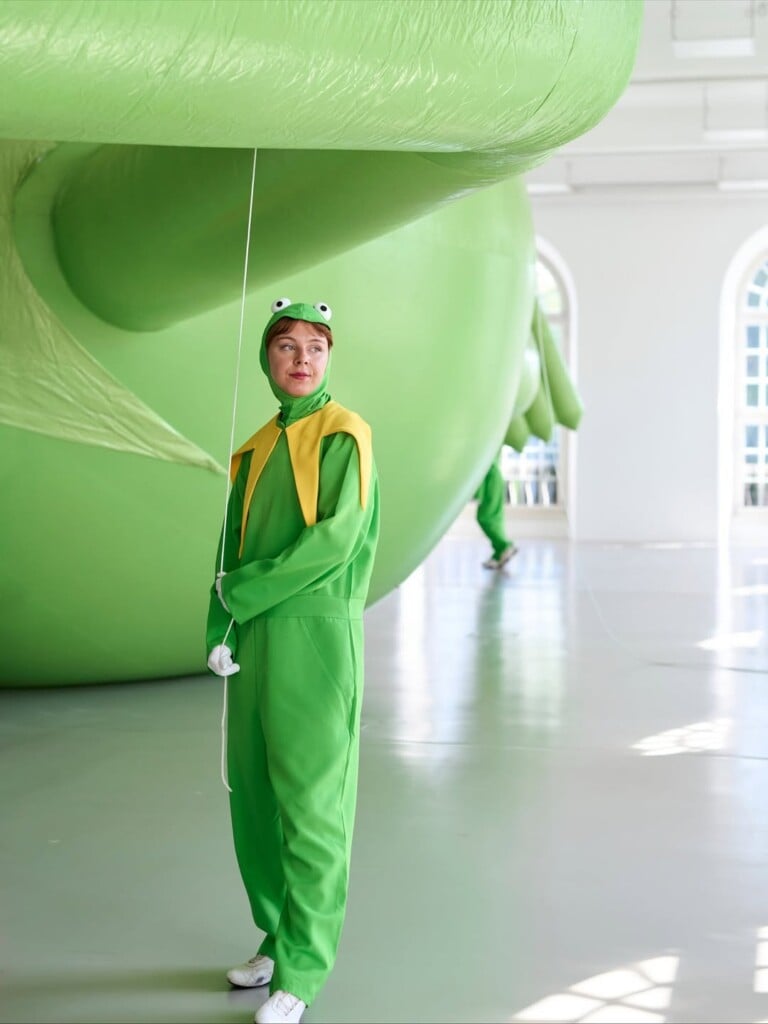

Alex Da Corte—an American-Venezuelan artist known for his pop and psychedelic aesthetic, made of saturated colors and television references—uses Kermit as a universal alter ego: the symbol of those who try to stay afloat, who strive to appear “right” even when the air starts to run out. In a place like Place Vendôme, where everything shines and nothing gives way, his deflated frog becomes an act of poetic resistance.

The work is a visual and cultural short circuit. Kermit’s childlike green reflects in the Cartier and Van Cleef windows, the synthetic fabric against the neoclassical architecture. The absurd enters the luxury scene and exposes its theatricality. It’s an image that speaks of collapse, but also of lightness—the kind that remains when everything else deflates.
In the end, perhaps this is exactly what Da Corte suggests: there is nothing more human than a balloon losing air, an icon bending under the weight of the wind, a hero allowing us to watch as he can no longer fly.