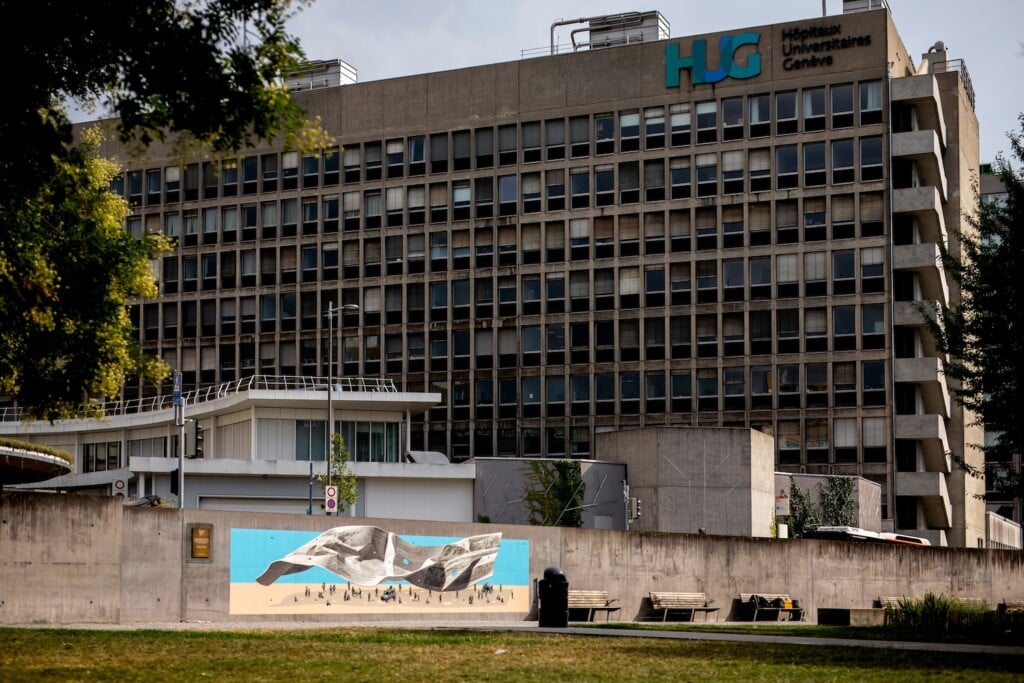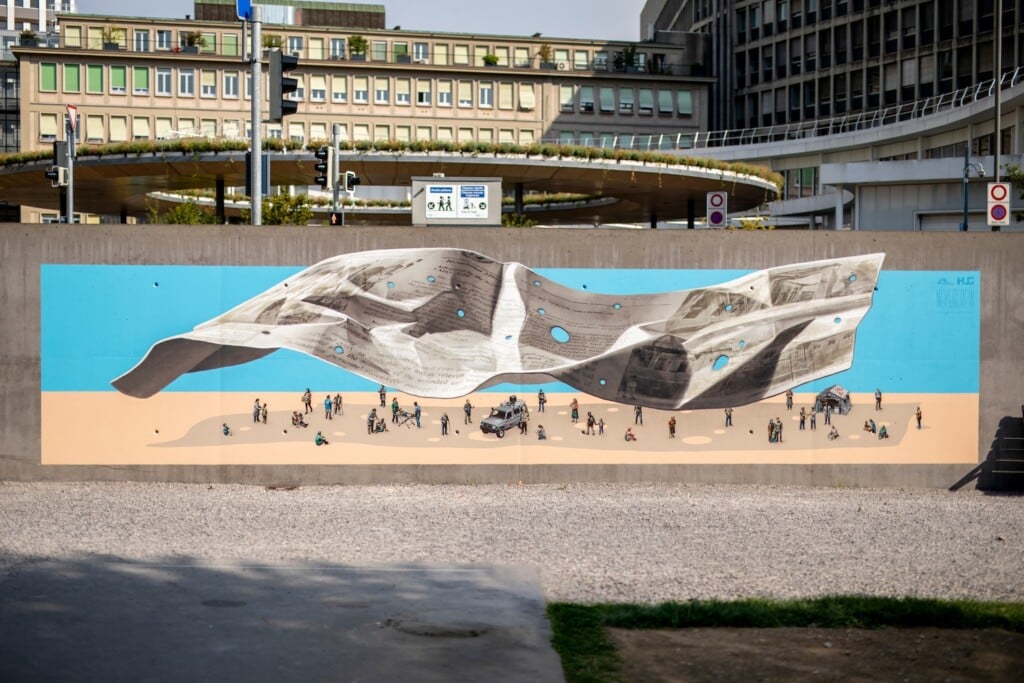
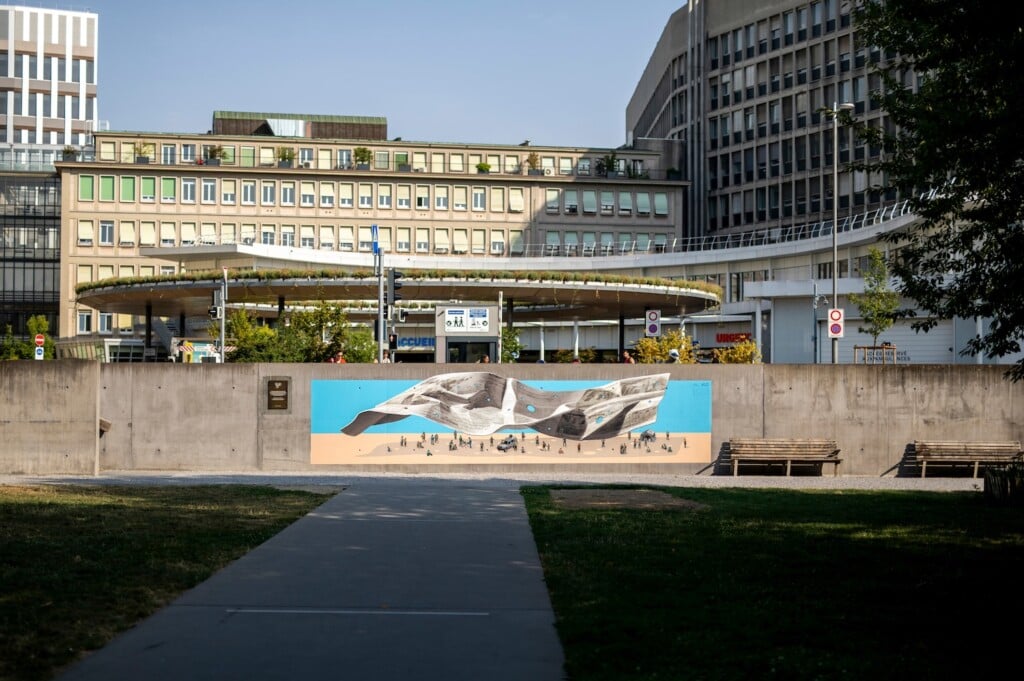
In front of the Geneva University Hospitals, a large crumpled sheet of paper seems to float above a group of people. It is punctured, torn, and burned in places. It should protect them, but it cannot fully do so. This very contradiction lies at the heart of “Paper-thin”, the new mural created by Swiss duo NEVERCREW, made up of Christian Rebecchi and Pablo Togni, for Médecins Sans Frontières and Hôpitaux Universitaires de Genève.
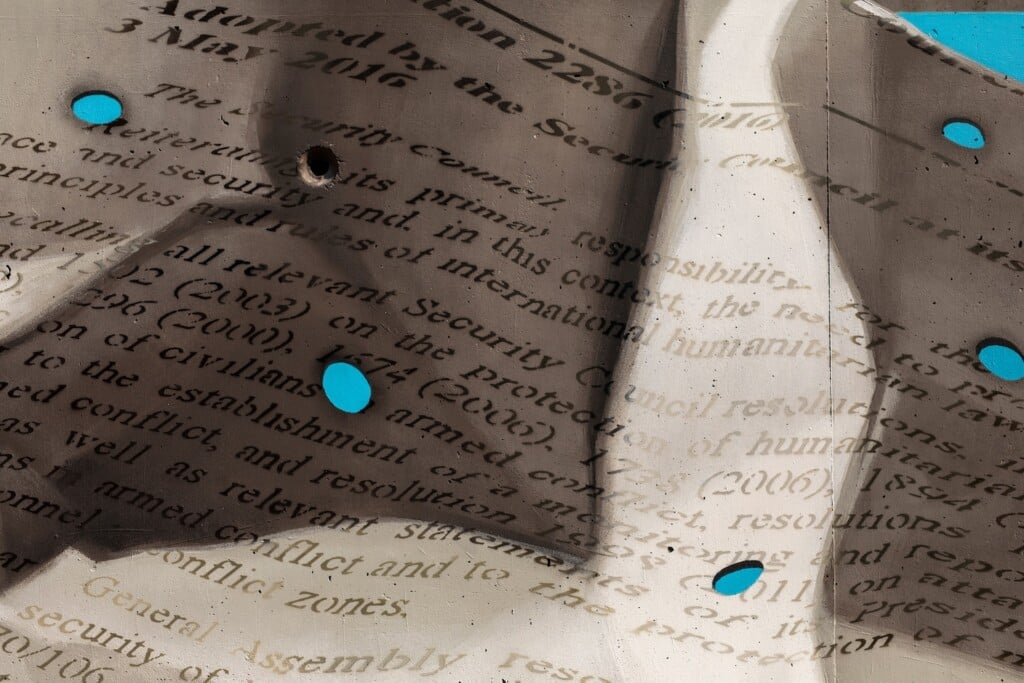
Presented on the occasion of World Humanitarian Day, the work occupies Parc des Chaumettes, directly in front of the HUG, and marks ten years since the adoption of United Nations Security Council Resolution 2286, which condemns attacks against patients, medical and humanitarian personnel, hospitals, and medical transport during armed conflicts.
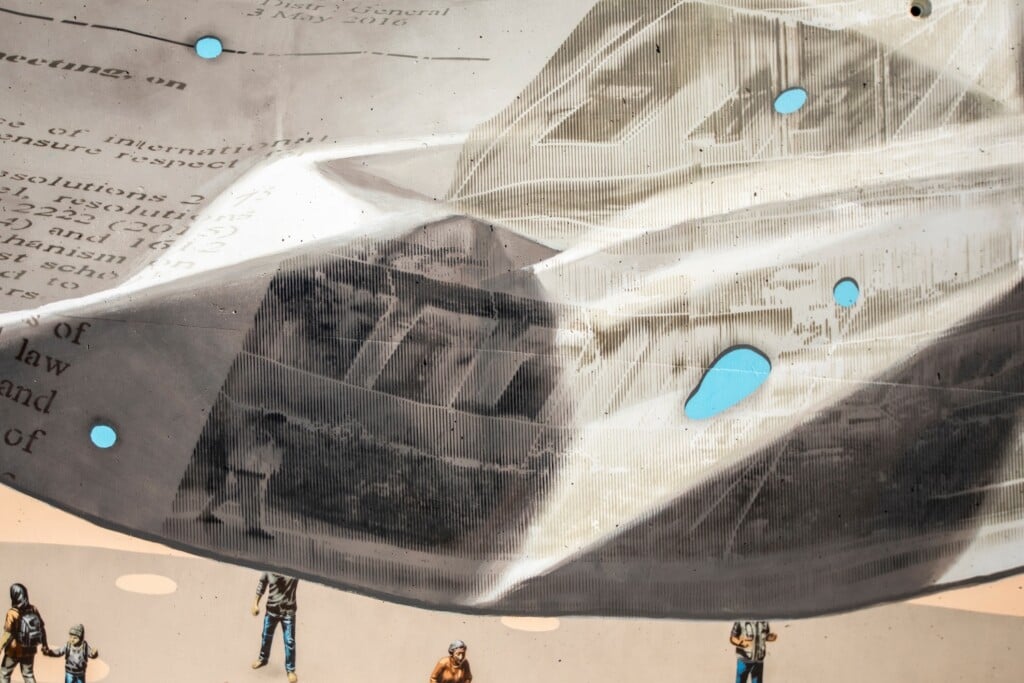
It is from this document that NEVERCREW draws inspiration for the work, transforming it into something physical. The sheet depicted in the mural is at once a resolution, a document, and a roof. A seemingly simple form of protection, made fragile by the violence running through it. Holes and tears interrupt the surface of the paper, revealing glimpses of what lies beneath. The message is immediate: what should guarantee safety is not solid enough to do so. The distance between what is written on paper and what happens in reality thus becomes the very image of the work.
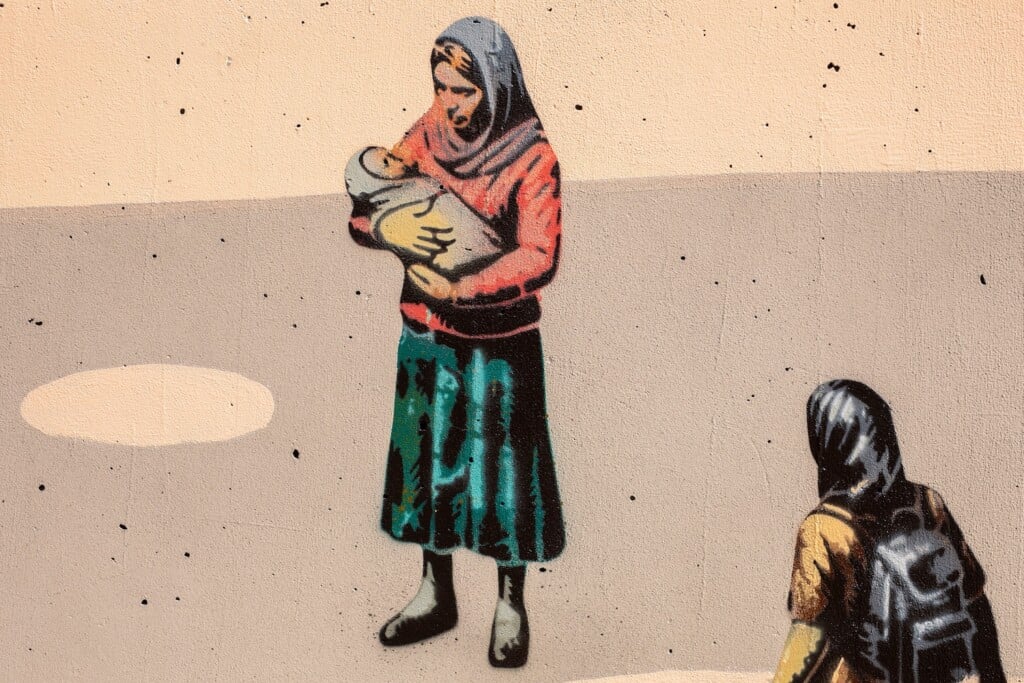
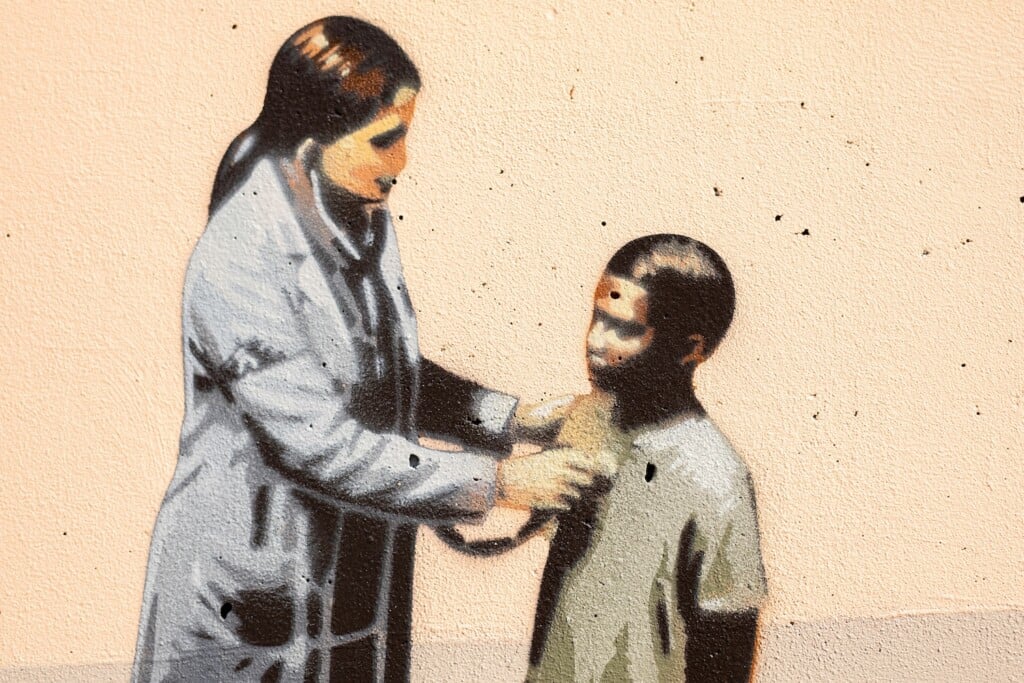
Under this fragile shelter are people giving and receiving care. The sheet that should protect them is therefore as vulnerable as they are, turning the metaphor into a concrete scene. In a context of war, hospitals, ambulances, and healthcare workers can also become targets, despite the international laws and conventions intended to protect them.
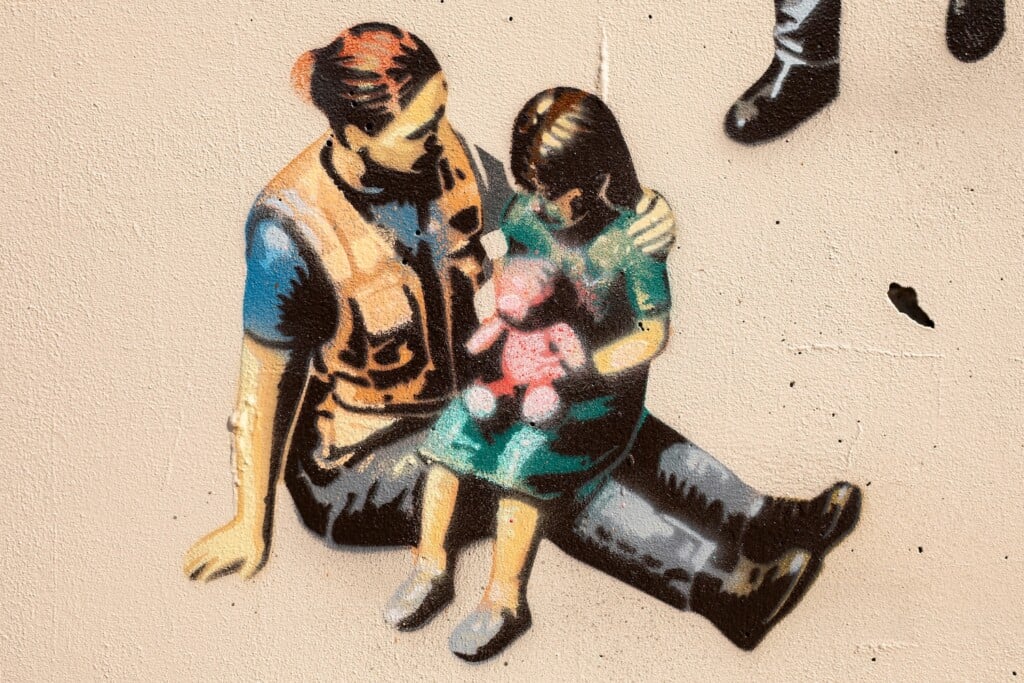
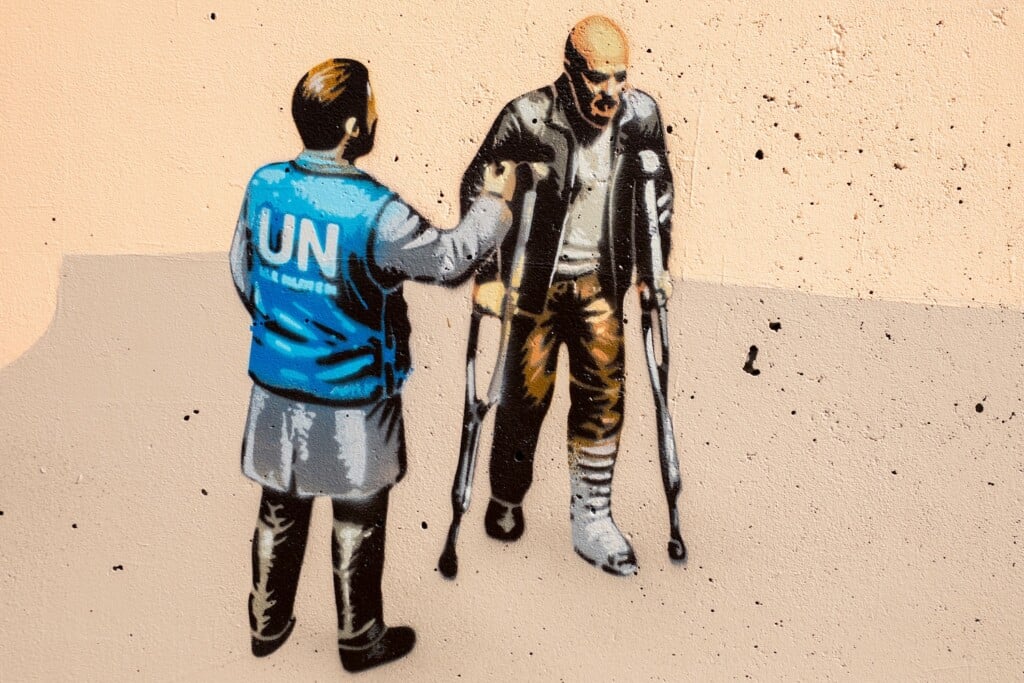
The mural also contains visual references to two places that have become symbols of violence against humanitarian aid: the Canal Hotel in Baghdad, the United Nations headquarters that was attacked in 2003, and the MSF trauma centre in Kunduz, Afghanistan, which was bombed in 2015. Two events separated by time but connected by the same inability to consider spaces of care truly safe from violence.
The decision to create the work directly in front of a hospital therefore takes on an additional meaning. The HUG represents a space of care and safety, while the mural brings into that same setting the memory of healthcare facilities that, in other parts of the world, have lost that sense of security. Geneva thus becomes a meeting point between a condition of protection and its denial.
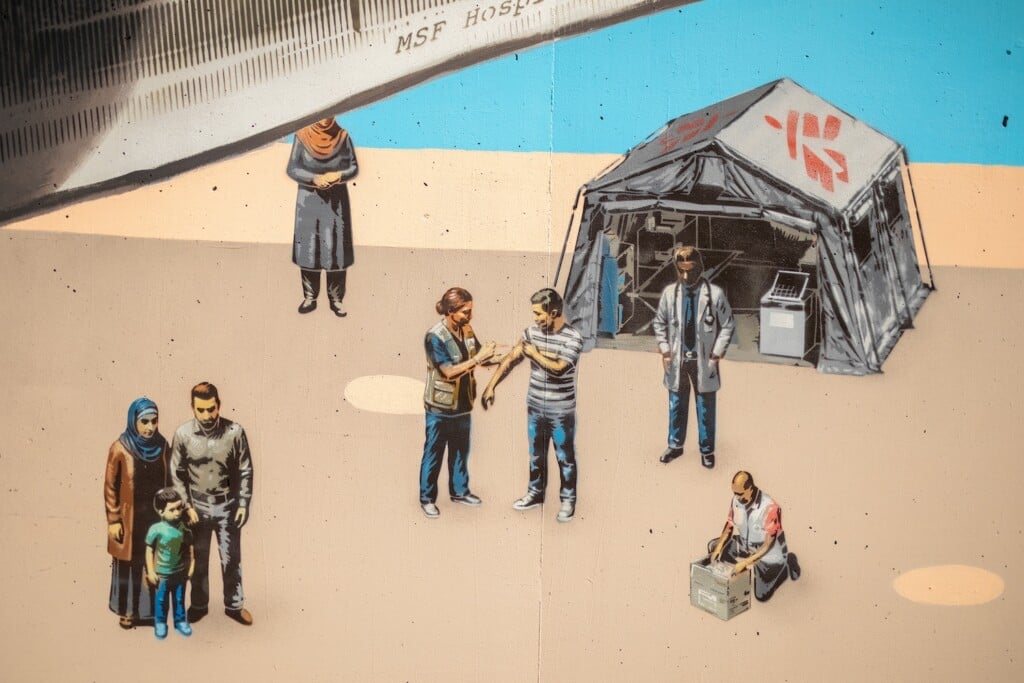
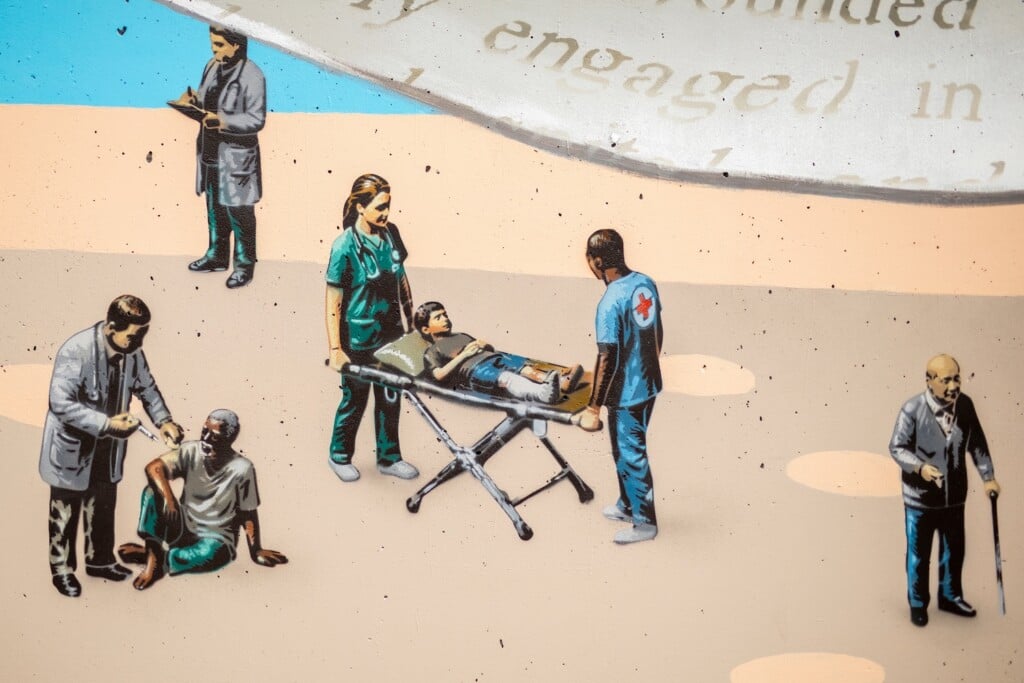
For NEVERCREW, the sheet is therefore more than a simple visual element; it is an image of collective responsibility. “It represents a roof that evokes protection, but the holes show us that this protection is vulnerable,” the artists explain. Its damaged state makes visible the gap between the commitments that have been made and their actual implementation.
It is a tension that often returns in the duo’s work, which is accustomed to constructing images in which seemingly familiar elements are taken out of context and charged with new meanings. Here, however, the public scale of the mural makes its message impossible to separate from the place where it is presented.
Paper-thin does not attempt to depict war, but rather what happens when even the last spaces that should remain outside it become vulnerable. Paper, fragile by definition, becomes a symbol of a form of protection that exists—quite literally—on paper, but that, without concrete action, risks remaining nothing more than a principle.