At the end of August 2025, at the Venice Film Festival, Guillermo del Toro’s Frankenstein received a fifteen-minute standing ovation. The Mexican director, visibly moved, finally saw a project come to life that had haunted him since adolescence. But the true genesis of this film – as of all his cinema – did not begin on a set or in front of a screen. It began in a notebook.
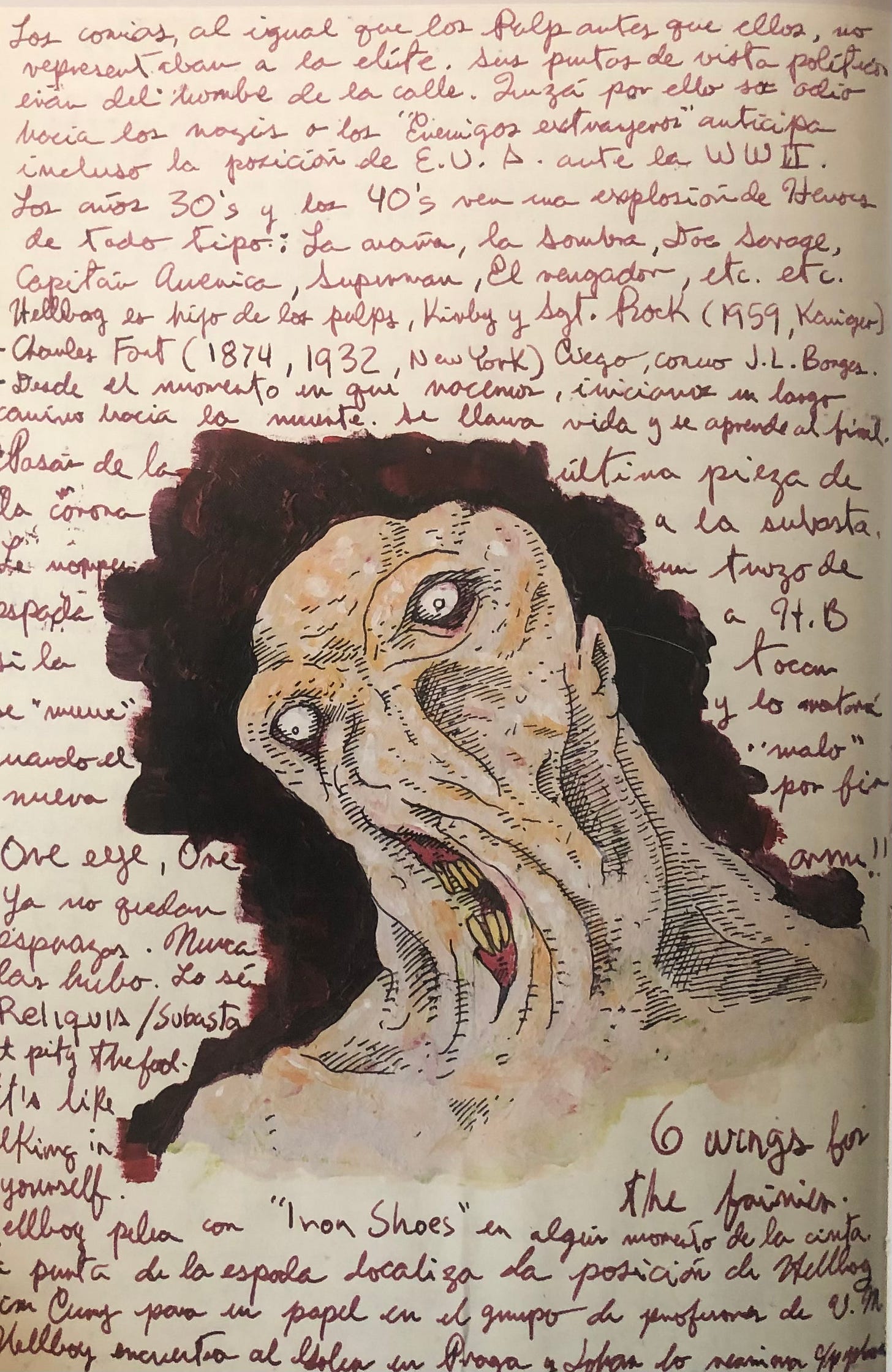
For twenty years, del Toro has filled notebooks with sketches and notes, which he once nearly lost during a trip. Those notebooks—identical to the one carried by little Ofelia in Pan’s Labyrinth—are the real beating heart of his work: private archives where monsters are born first as graphite marks, then as flesh, latex, and pixels. It is here, among frantic sketches and feverish annotations, that the passage from the invisible to the visible, from dream to frame, takes place.
The director who draws (or the artist who directs?)
Born in Guadalajara in 1964, Guillermo del Toro has established himself as one of the most visionary filmmakers of contemporary fantasy cinema. From the gothic sci-fi of Blade II to the monstrous melodrama of The Shape of Water, from the kaiju spectacle of Pacific Rim to the melancholic stop-motion of his Pinocchio, del Toro has crossed multiple genres without ever losing his unmistakable signature: that of a storyteller for whom the fantastic is not escapism, but a political and emotional tool. His monsters are never merely creatures of nightmares — they are metaphors for diversity, marginalization, and the violence of power.
But there is an aspect of his creative practice that often remains on the margins of critical discussion: del Toro is not only a director. He is a compulsive draftsman and archivist, a collector of images. Before being a filmmaker, he is a visual artist who chooses cinema as the final medium — but always begins on paper.
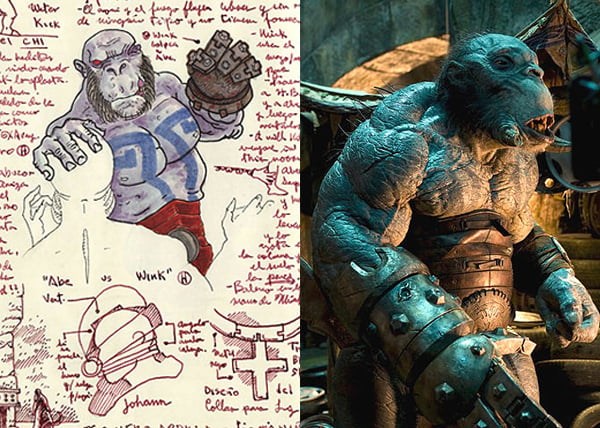
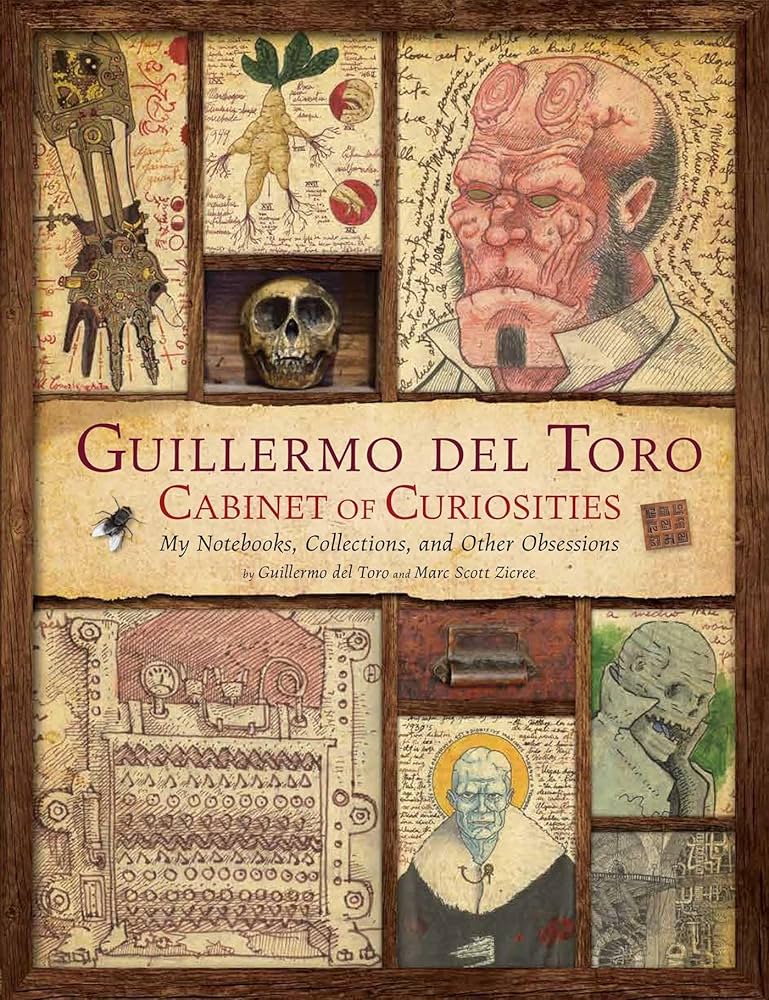
Guillermo Del Toro: Cabinet of Curiosities
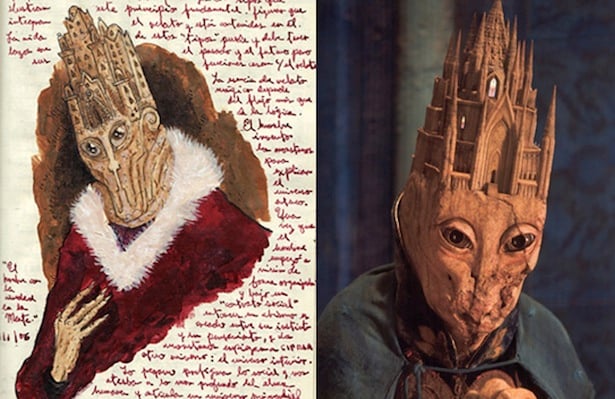
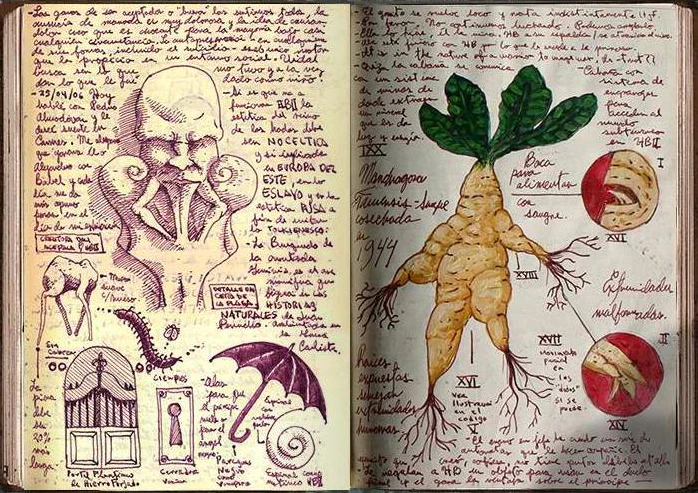
In 2013, del Toro published Guillermo del Toro’s Cabinet of Curiosities: My Notebooks, Collections, and Other Obsessions, a volume that gathers decades of drawings, notes, and photographs from his personal collection. It’s not just a promotional artbook: it’s an autonomous work, an artist’s book that documents the director’s creative process through hundreds of pages of preparatory sketches. The title is no coincidence: Cabinet of Curiosities is also the name of the horror anthology series del Toro curated for Netflix in 2022, where each episode functions as a “room” in his imaginary collection — dark stories seemingly extracted from the margins of his notebooks.
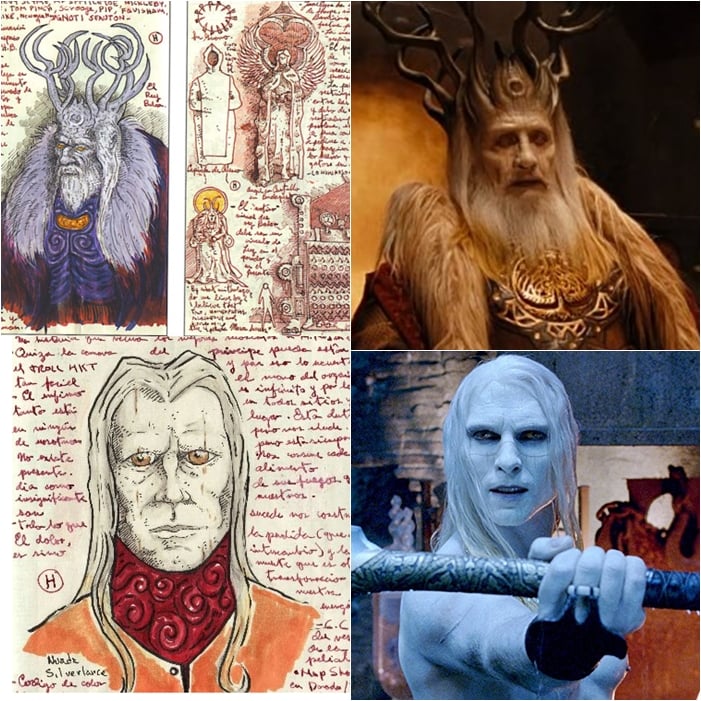
For del Toro, the notebooks act as “incubators of ideas,” private laboratories where anatomy, architecture, and mythology fuse into hybrid creatures. Leafing through those pages, one encounters the first studies for the Faun — old, wooden, ambiguous — alongside variations of the Pale Man’s design, the monster with eyes on his palms who in Pan’s Labyrinth evokes Goya’s Saturn. There are also sketches for the Kaiju of Pacific Rim, the mechanical gears of Hellboy, the haunting silhouettes of The Devil’s Backbone.
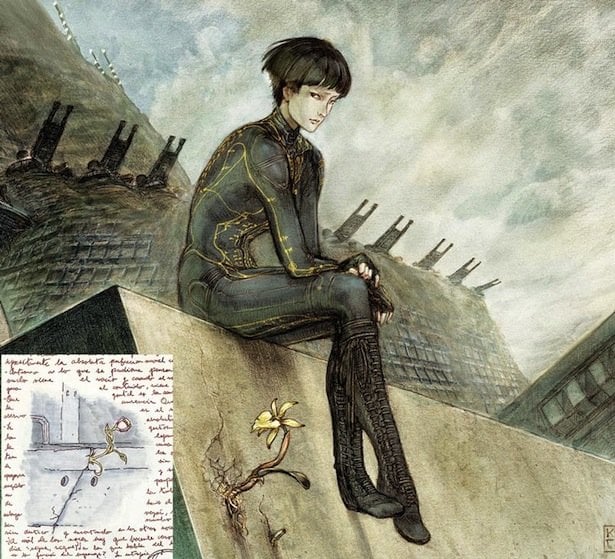
But the notebooks don’t just contain monsters. There are emotional maps, narrative diagrams, literary quotes, reflections on the creative process. Del Toro writes obsessively: the color of light in a scene, the texture of artificial skin, the rhythm of a sequence. The notebooks thus become a place of overlap between artistic practice and theoretical thought, between drawing and dramaturgy.
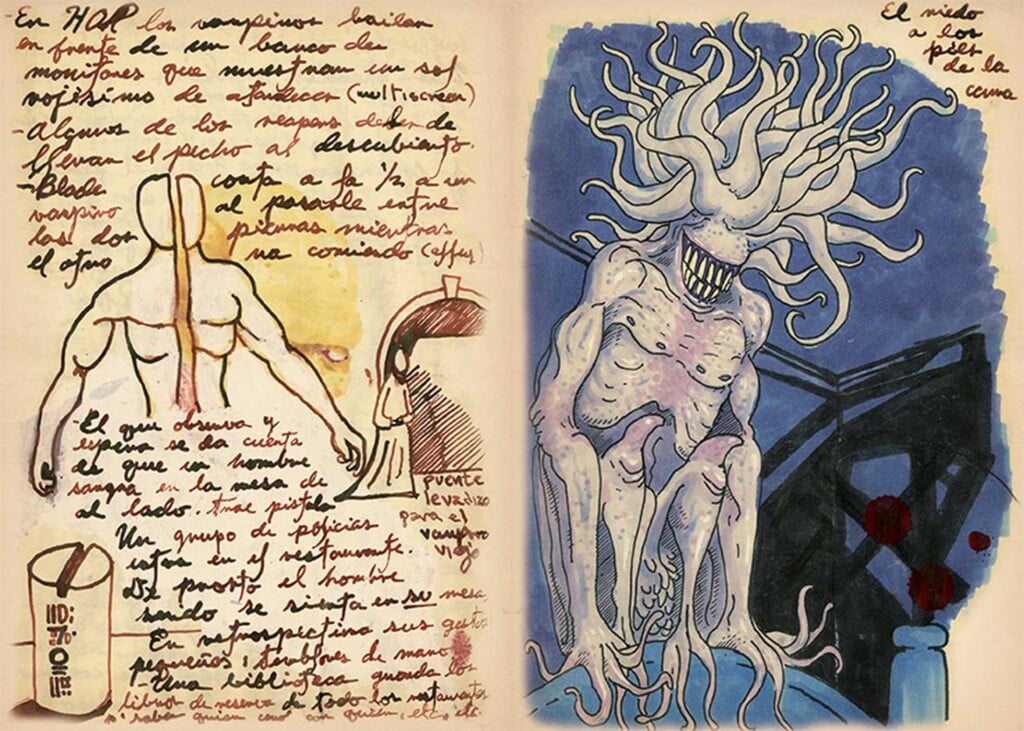
From line to creature: the anatomy of the impossible
What distinguishes Guillermo del Toro’s drawings from mere concept art is his almost obsessive attention to anatomy. His creatures are not abstract fantasies: they have plausible skeletons, functional muscles, an internal logic. The Faun is not just “a mythological being,” but a body that bears the marks of time — cracked bark, asymmetrical horns, weary eyes. The Pale Man is not a dream apparition, but an organism that moves with terrible clumsiness, as if its anatomy were a mistake of nature.
This obsession with the physical credibility of fantastic creatures stems from del Toro’s background in special effects. Before becoming a director, he spent years working with prosthetic makeup and latex, learning how to build tangible monsters. In his notebooks, this technical expertise translates into drawings that are not just visual suggestions but real blueprints: every creature is studied from multiple angles, with notes on materials, joints, and stitching points.
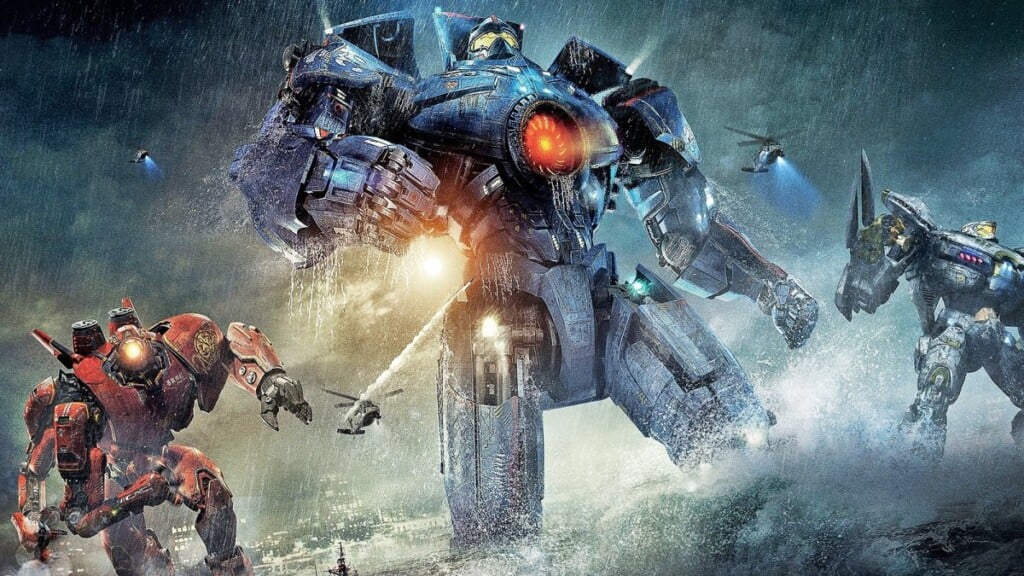
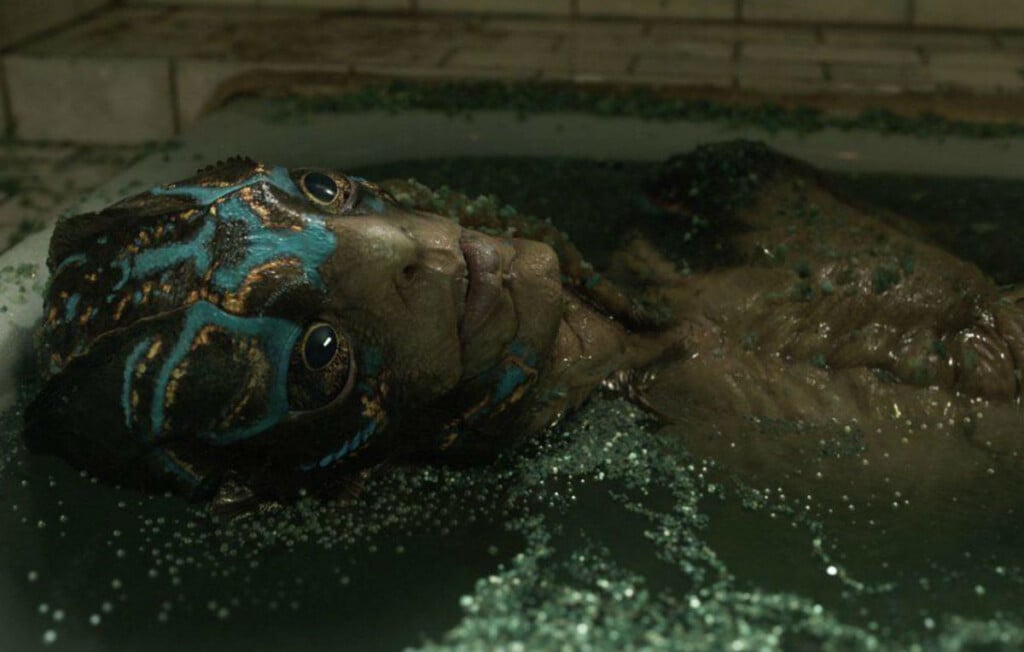
The result is a cinema in which the fantastic always retains a tactile, material dimension. Even when he resorts to CGI — as in Pacific Rim or The Shape of Water — del Toro insists on building physical models, scale prototypes, mechanical heads. Drawing is the first step in a production chain that rejects the immateriality of pure digital: the creatures must exist, even if only in fragments, even if only as sculptures.
Frankenstein: the film that becomes autobiography for del Toro
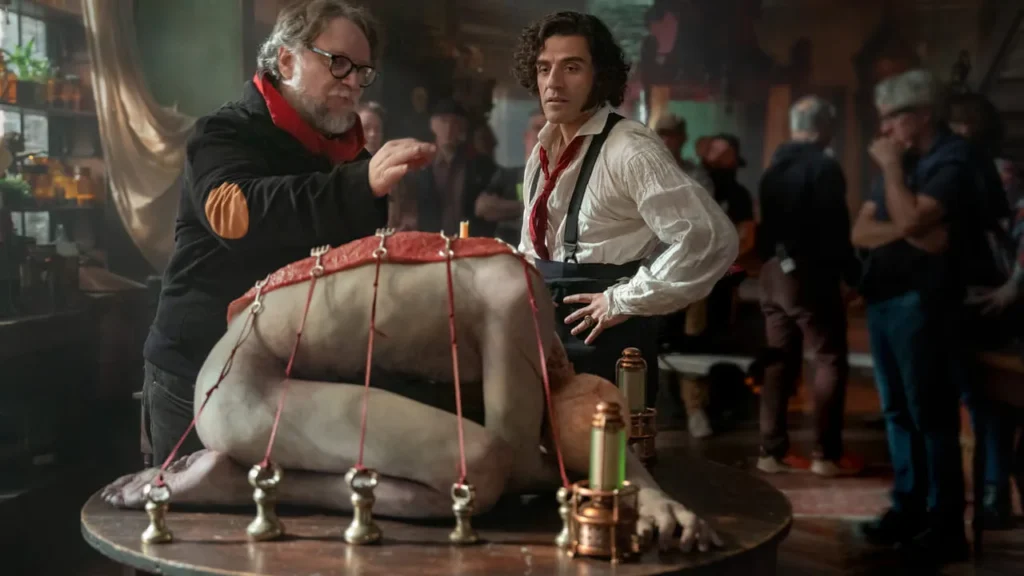
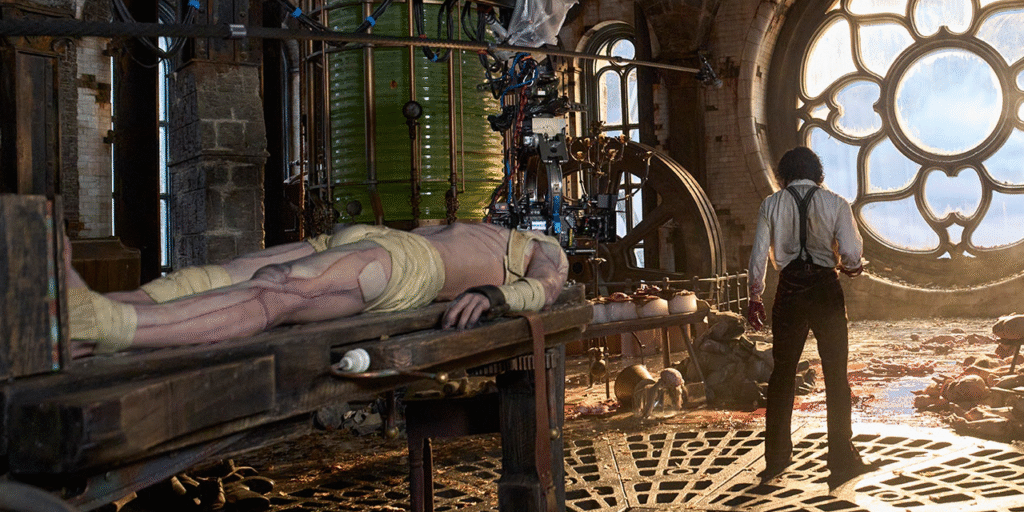
Del Toro has said that he has been chasing Frankenstein’s creature since childhood. His first encounter dates back to when he was seven years old: struck by the 1931 version directed by James Whale, starring Boris Karloff with the flat forehead and bolts in his neck. A few years later, at just eleven, he read Mary Shelley’s novel for the first time: a thunderbolt that would become a lifelong obsession. His adaptation therefore arrives after decades of gestation in his notebooks—pages upon pages of sketches of the creature waiting for the right moment to come to life.
But what does it mean, for a filmmaker obsessed with the physical construction of monsters, to engage with the myth of the assembled body—the creature stitched together from pieces of death? In a sense, Frankenstein is a meta-cinematic reflection on del Toro’s own process: Victor Frankenstein assembling a body from fragments of corpses is the gothic counterpart of the director who draws, sculpts, and animates his creatures from fragments of imagery stolen from other works, other artists, other eras. Frankenstein’s creature, like del Toro’s monsters, is not an organic being but a collage, a constructed work of art.
And just like Shelley’s creature, the monsters in del Toro’s notebooks also ask to be recognized not as horrors, but as subjects: bearers of pain, loneliness, and desire. Drawing thus becomes an act of empathy, a way to give formal dignity to what society expels, censors, or hides.
Del Toro has often emphasized that his film is not meant to be a faithful adaptation, but a personal mirror. Just as Mary Shelley poured her fears and experiences into her novel, the director says he sought the same sincerity: to make Frankenstein not a gothic classic to revere, but a territory in which to recognize himself.
The lost (and found) notebook
There’s an anecdote worth remembering. During a trip, del Toro once left one of his notebooks on the back seat of a taxi. If it hadn’t been for the driver who returned it to him, Pan’s Labyrinth might never have existed.
The episode says something essential about del Toro’s relationship with his notebooks: they are not replaceable tools or replicable digital archives. They are unique objects, personal fetishes, relics of a creative process that remains fundamentally analog, physical, incarnate. For del Toro, losing a notebook would mean losing a part of his visual memory, his artistic identity.
In an era when film pre-production is increasingly digitalized — mood boards on Pinterest, concept art in Photoshop, 3D models — del Toro continues to draw by hand, on paper. It’s an act of resistance, or perhaps simply of coherence: monsters are born from matter, not from code. And they are born in the shadows, in private, before being exposed to the blinding light of cinema.
Read also: Off Screen – David Lynch, the director who paints the invisible