How many times have we heard someone say that a TV show has changed the history of television? We took it upon ourselves to compile a list of shows that, in our opinion, have truly changed the rules of the small screen. (We don’t want to rank them, so we decided to opt for the ever-popular chronological order).
Star Trek
You don’t need to have seen it – some of you might be too young – but surely everyone has heard at least once in their life about Spock, Jim Kirk, and the famous starship Enterprise. Star Trek completely changed the representation of the future, the universe, and space travel. Its influence is still palpable today, so much so that audiences are eagerly awaiting the new series Star Trek: Starfleet Academy, currently in production. Of course, we are talking about the one referred to by trekkers as “TOS,” or The Original Series, which aired in the USA from 1966 to 1969.
Non serve averla vista – alcuni di voi potrebbero essere troppo giovani -, ma sicuramente tutti hanno sentito almeno una volta nella vita sentir parlare di Spock, Jim Kirk e della famosa astronave Enterprise. Star Trek ha cambiato completamente la rappresentazione del futuro, dell’universo e dei viaggi spaziali. La sua influenza è palpabile ancora oggi, tant’è che il pubblico è in attesa della nuova serie Star Trek: Starfleet Academy, in produzione. Ovviamente noi stiamo parlando di quella chiamata dai trekker “TOS”, ovvero The Original Series, andata in onda negli USA dal 1966 al 1969.
Unforgettable and legendary is the kiss between Captain Kirk and Commander Uhura in the tenth episode of the third season, Plato’s Stepchildren, which went down in history as the first “interracial” kiss in the history of television.
M*A*S*H
It’s 1972, the end of the Vietnam War is finally in sight, Nixon wins the election, the United States is filled with peace marches and demonstrations, and CBS decides to air a TV series set in South Korea during the Korean War. The question naturally arises: how did MAS*H become one of the most-watched TV series? Thanks to a perfect balance of drama and comedy. Indeed, the challenge of bringing a war to TV was not easy to tackle, but what better way than to add a touch of humor to a dramatic situation? Probably, the success of MAS*H also lies in the fact that it managed to depict the war better than the newspapers of the time, which did so in an unrealistic and patriotic manner. The hype created by this series followed it all the way to its final episode, which remains to this day the one with the highest share ever, reaching 60.2%.
Dallas
Today, cliffhangers—those devices that involve a sudden interruption right after a plot twist—are commonplace, but if we had to trace back to who first understood the potential of inserting a cliffhanger at the end of an episode, or even better, at the end of a season, it would be David Jacobs, the creator of Dallas. Airing from 1978 to 1991, more than many other series, Dallas managed to keep millions of viewers on the edge of their seats. The third season finale, with the attempted murder of J.R., became a true piece of history. “Who shot J.R.?” became one of the most spoken phrases during the American summer of 1980. The attempted murder made the front pages of American newspapers as if it were a real news event, and even then-President Jimmy Carter stated that he would have had no trouble financing his presidential campaign if only he had known who shot J.R. The episode revealing the culprit, titled Who Done It, was the most-watched episode of the entire series.
The Simpson
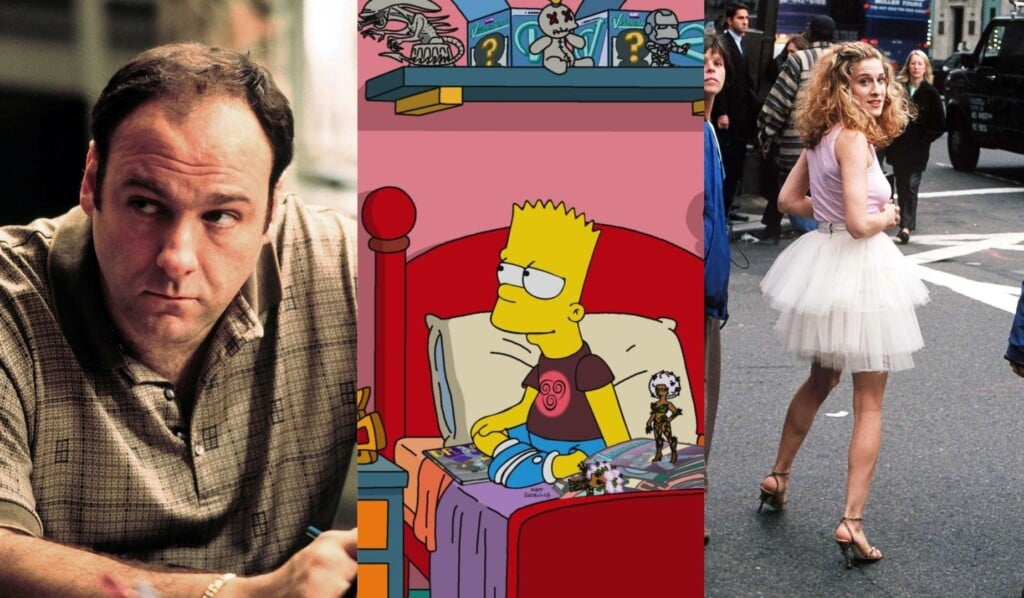
Born as a 60-second advertising interlude, the first official episode of The Simpsons aired on December 17, 1989, and since then, it has never skipped a season, celebrating 35 years today (not bad!). The winning idea that has allowed the family from Springfield to endure all these years is that what they depict is exactly what we might see on the news: all the contradictions, flaws, and shortcomings of society. By narrating, in a humorous and sometimes crazy way, what surrounds us every day, it’s no surprise that over the years, the creators of The Simpsons have accurately predicted more than a few events, from Trump becoming President to a pandemic. Homer, Marge, Bart, Lisa, and little Maggie are the protagonists of the most successful animated series in television history; it’s obvious that they don’t want to grow up.
Seinfeld
What made Seinfeld so iconic is encapsulated in the tagline with which the series was presented to NBC: “The idea of doing a show about nothing.” Indeed, today it is considered the ultimate “show about nothing,” and if those who haven’t seen it think it’s a silly concept, they should stop and think about their own days, the dialogues, and the actions they take daily. The characters who don’t evolve, who don’t take a stand, become the symbol of a society adrift.
Twin Peaks
It is the series that can be considered an auteur TV show more than any other. For the first time, cinema and television merge into one, thanks to the figure of David Lynch. After five films, the American director decided in 1990 to embark on his first television production, but he did so without abandoning his cinematic style, characterized by a particular attention to atmospheres, the use of sound, and the composition of shots. Seeing this style on the small screen, serving a story that mixes mystery, thriller, crime, and the supernatural, demonstrated for the first time how television could compete with cinema.
Friends
In this case, more than on the history of television, the impact of Friends was on the audience’s real lives. Just think of how the haircut “The Rachel” from Jennifer Aniston’s character became a must-have, requested in beauty salons worldwide. Additionally, many phrases used by the characters became commonplace in the USA and the UK and are still part of the language of millions of people today.
Sex & the City
If women today feel more confident and free to talk about sex, credit is also due to Sex and the City. The series created by Darren Star , presenting for the first time four independent women who were far removed from the representations seen on television up to that point. They became symbols not only of sexual freedom but also of women’s overall emancipation. What unites Carrie, Miranda, Charlotte, and Samantha is that each of them – in her own way and time – chooses her own path in life. This aspect made them role models for many young women who populated big cities at the end of the 1990s but felt that no one truly represented them.
I Soprano
The first season of The Sopranos, which aired in 1999, marked not only the end of a century but also the end of a way of conceiving and thinking about TV series. The Sopranos is truly the first major contemporary TV series, described by The New York Times as “the most important work of pop culture of the last quarter-century.” Creator David Chase, with his hyper-characterized characters whom we come to know better than our friends, and whose moves and reactions we understand, forever changed the rules of serial writing.
ER
When discussing the Medical Drama genre, we cannot overlook ER. Unlike other series mentioned here, ER stands out with its minimal use of plot twists, focusing instead on episodes that feature a multitude of intertwined narratives. Right from the start, the winning idea was structuring each episode as a day inside the busy General Medicine department of Chicago’s famous County General Hospital. ER raised the bar for accuracy in developing specific medical themes.
The Wire
Beloved and praised for its realism and meticulous portrayal of an urban setting, The Wire succeeded in forever changing the crime drama genre. The narrative of investigations had never been so detailed, covering every phase from beginning to end. Unlike other series that saw immediate success, The Wire took some time to gain traction, but eventually demonstrated how daring with longer formats, using unknown faces, and addressing the society it targets can sometimes pay off.
Lost
There’s a before and after Lost, that’s a fact. Previously, narrative lines (both horizontal and vertical) typically started at point A and moved towards point B. However, the series created by J.J. Abrams mixes up the rules of the game in the most complicated way possible. Throughout the entire series, each episode, and the individual characters’ stories no longer follow a chronological sequence. Flashbacks, flashforwards, but also flashpresents and flash sideways: you can find any imaginable temporal leap in Lost.
The Office
It’s the type of subtle and sometimes edgy humor (where we see the hand of Ricky Gervais in both the UK and US versions) that makes The Office a landmark in television history. A key element was also the insight to combine this humor with the mockumentary technique, involving handheld camera shots, “dirty” frames, and mock interviews that make us feel close to the characters despite the brevity of the episodes.
Breaking Bad
One word: antihero. All the characters who have transformed from good to bad, yet we continued to understand and root for them, owe their existence to Walter White. The story of the Albuquerque professor who, upon discovering he had lung cancer, decides to produce the purest methamphetamine possible to secure a future for his wife and son, has become legendary. It led critics and audiences alike to proclaim Breaking Bad as the greatest TV series of all time. Indeed, everything about it is perfect: the character development, the narrative arc, the plot twists, the settings, and the pacing. But the linchpin is the protagonist himself, because it could very well be any of us, showing how anyone in a desperate situation might be willing to do anything.
Game of Thrones
There are many reasons why Game of Thrones could be on this list, but the one we’ve chosen is simple: money. The revolution brought by what was for years HBO’s flagship series lies in its production budgets, which for the first time demonstrated that TV shows could have cinematic budgets (and earnings as well). In fact, each episode of the final season cost $15 million, to put it into perspective, the exact same budget as Paola Cortellesi’s film C’era ancora domani.
Stranger Things
Some might raise an eyebrow at seeing Stranger Things on this list, and we can understand why, but we’re not here to discuss its plot or other aspects. The reason we’ve included it is because, besides being a turning point for Netflix and its first major hit series on the streaming platform, it represents a pivotal moment in how TV shows are consumed. In fact, while we used to wait week by week to find out what would happen to our favorite characters, Stranger Things introduced us to the experience of binge-watching an entire season in a single evening.
Leggi anche: Le serie tv più lunghe e belle di sempre