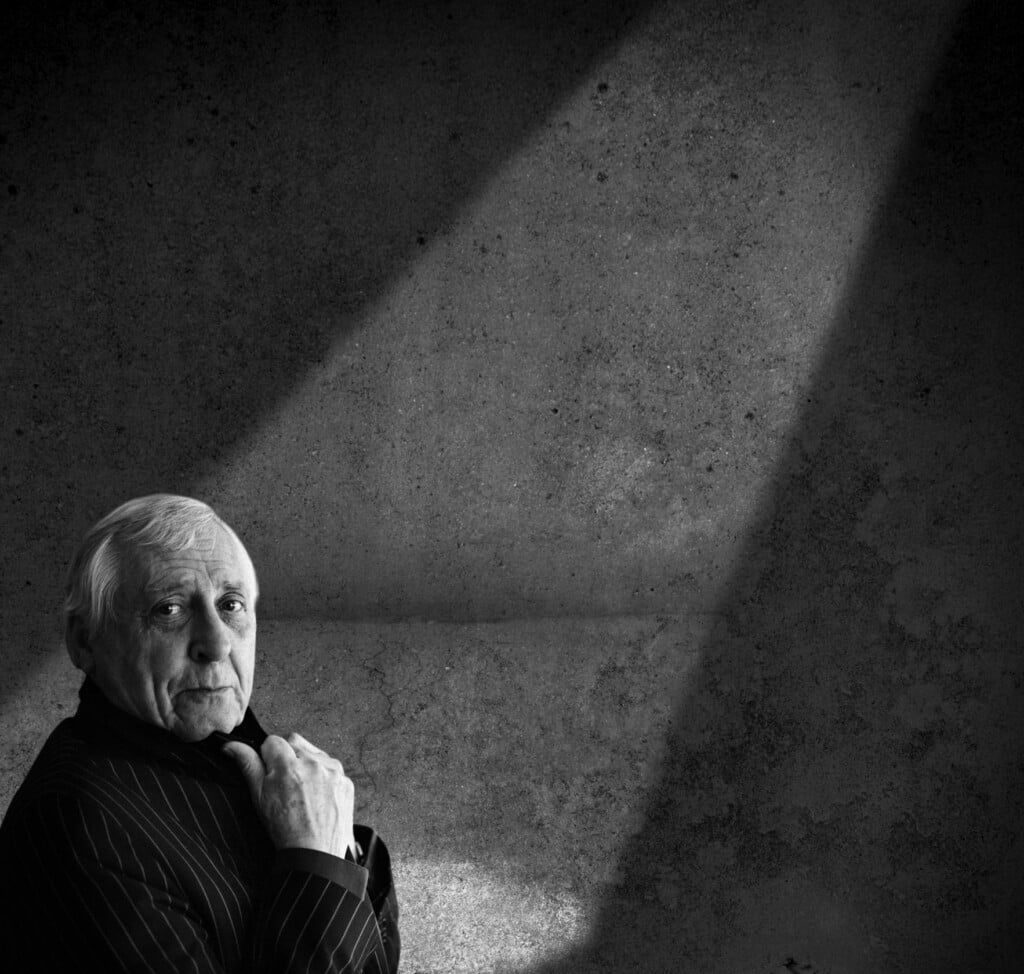
Off Screen is the column that looks beyond the screen.
It tells the stories of directors who don’t limit themselves to cinema, but bring their vision into painting, installations, and hybrid visual languages. Because some films continue even after the reel ends.
Peter Greenaway has never believed in boundaries. Neither between painting and cinema, nor between the museum and the movie theater. His entire body of work is a constant effort to unite what convention has long kept separate: the still image and the moving one, narrative and installation, surface and depth. For him, cinema is just one of many expressive possibilities within a broader, more complex, more total visual language.
“I consider myself a painter first, then a filmmaker”, he has often stated. And this declaration is key to truly understanding his work. Born in Wales in 1942, Peter Greenaway studied at the Walthamstow College of Art in London during the 1960s. He explored mural art, worked with collages, triptychs, and drawings, and approached painting not as an end in itself but as a method — an analytical, compositional, and systematic tool. It was during these formative years that his vision began to take shape. When he made Death of Sentiment, his first short film, in 1962, the path was already clear: he would not tell stories, he would construct images.

And that’s precisely how his films stand out: as living paintings, where the lighting evokes Caravaggio, the volumes are Renaissance-like, the composition echoes classical architecture, and the symbolism draws from Vermeer, Magritte, and Piero della Francesca. The viewer doesn’t follow a narrative, they are immersed in a figurative construction.
Films such as The Draughtsman’s Contract (1982) or The Belly of an Architect (1987) are constructed as layered canvases. The former, inspired by 18th-century English painting, is a perfect perspective architecture, a play on symmetry and visual power. The second, on the other hand, is a true homage to Piranesi and Boullée, in which architectural obsession is transformed into filmic language. With Drowning by Numbers (1988), Greenaway explores a numerical, symbolist, mathematical aesthetic in which every shot is a visual calculation. While The Cook, the Thief, His Wife & Her Lover (1989) exaggerates pictorial theatricality to the point of verging on Francis Bacon, creating a baroque, visceral, sensual palette. Everything is studied, everything is composition.


PETER GREENAWAY: CINEMA AS A STARTING POINT
Cinema, for Greenaway, is only a point of departure. Starting in the late 1990s, the author feels the need to break free from the cinematic “ritual”. He looks for new spaces, new formats, new ways of declining his art. And it is here that one of his most ambitious projects begins: Classic Paintings Revisited.
The project officially began in 2006 with Rembrandt’s Nightwatching, a film-installation entirely dedicated to the masterpiece The Night Watch. More than narrating the painting, Greenaway enters inside the work , analyzes its historical context, hidden plots, and iconographic secrets. The viewer is invited to look as never before.

The following year, in 2008, Greenaway produced a once-in-a-lifetime event: a visual reinterpretation of Leonardo da Vinci’s The Last Supper, projected for a single day directly onto the original fresco in Santa Maria delle Grazie in Milan. Lights, sounds, words envelop the refectory hall, transforming it into a living body. The painting is illuminated by beams of light that highlight its compositional structure, while an immersive soundtrack accompanies the experience. In collaboration with Adam Lowe, Greenaway also makes a high-fidelity replica of the work, reproducing even its material imperfections. It is not a restoration, but a new reading.

In 2009 it was the turn of Paolo Veronese’s The Marriage at Cana, installed in the Cini Foundation on the Island of San Giorgio in Venice. The work, one of the most complex and monumental in art history, is broken down into perspective grids, narrative lines, directions of the gaze. Greenaway returns it to its original space – the wall of the Palladian refectory – and reactivates its content: sacredness and worldliness, baroque excess and profane theatricality. The movements of the figures, heads turning, hands pointing, are emphasized by light projections and accompanied by soundscapes that reconstruct the joyful chaos of the scene.


Classic Paintings Revisited: a project in progress
These three installations are part of the larger Classic Paintings Revisited project still in progress, a veritable visual canon of the Western world. Peter Greenaway selects nine seminal works – from Rembrandt to Veronese, Leonardo to Velázquez – to narrate, through technology and performance, the permanence and transformation of great art.
In every project-whether film, painting, installation or performance-Greenaway never tries to explain art, but to show its power. His is a work that does not illustrate, but evokes, that does not tell, but constructs visual and spatial experiences. An author who sensed before many that the future of art is in contamination. In fusion. In disobedience to genres.
More than fifty years after his debut, Greenaway is today an indispensable figure for understanding the transformation of the image in our time. A total artist, at once classical and postmodern, theoretical and sensory, radical and rigorous. Where cinema ends, his art begins. And perhaps, it never really ended.
Read also: The T-Shirts that made cinema history