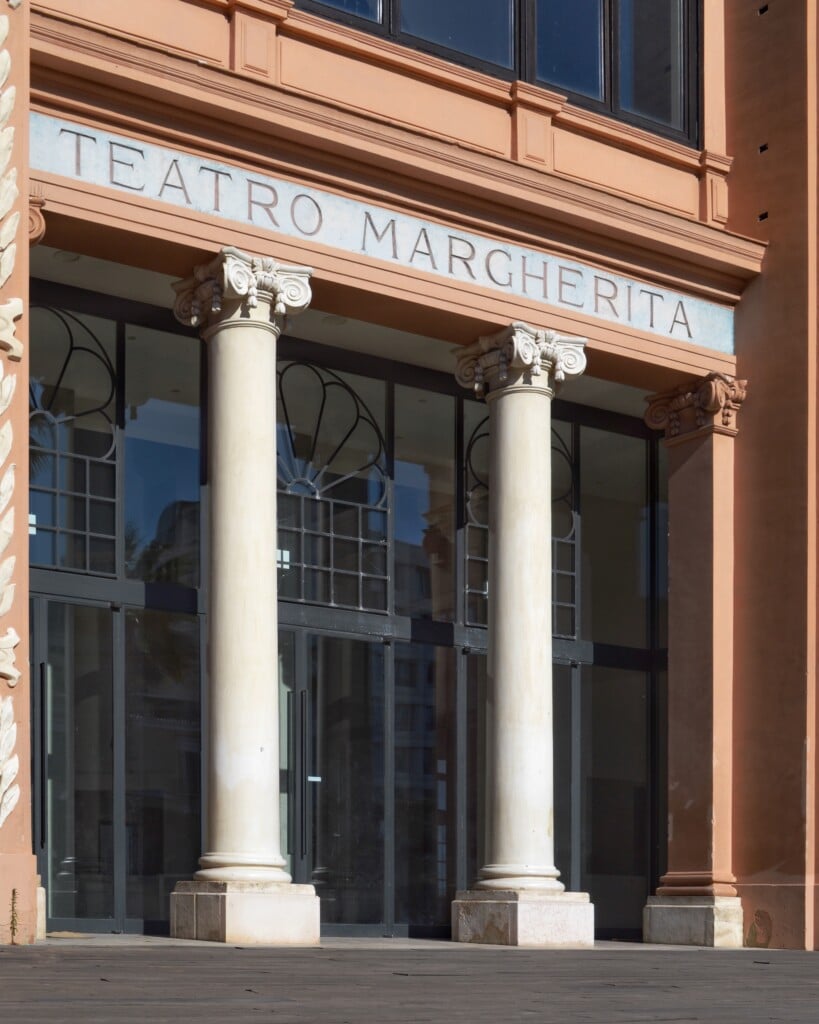
Strolling along Bari’s old harbour, level with the Molo San Nicola, the coastline suddenly breaks for a monumental structure that at first glance seems to defy conventional building logic. The Teatro Margherita doesn’t just look out at the sea from its position — it rises literally out of the water, the only theatre in Europe built entirely on stilts.
The story behind this building rests on an extraordinary piece of early-twentieth-century Italian bureaucratic-legal maneuvering.

While preparations were underway for another major theatre, the city of Bari signed a binding agreement with the family that owned the Petruzzelli, banning the construction of any further theatres on city land. The measure was meant to protect the investment that had just been made and to avoid awkward competition between venues. The point wasn’t so much shielding the investor from some vague risk or speculation as simply securing the business in every sense.
Rather than challenge the rule head-on, the people of Bari came up with a clever workaround that let them respect the letter of the law while sidestepping it entirely: since they couldn’t build a theatre on land, the new building would be built on water instead, linked to the shore by a jetty.


The first attempt was a wooden structure, a kind of floating theatre on an artificial island. It was named Eden Margherita, and it burned down not long after. Then, in 1912, the Società Anonima Pubblici Divertimenti Orfeo began work on the new building, with architect Francesco De Giglio and engineer Luigi Santarella completing it within a few years (1912–1914). Only later, once the seafront was filled in, did the Margherita lose its look of a structure suspended over water.
On the construction side, this theatre is a landmark piece in the history of twentieth-century architecture and engineering.
The building is in fact one of the first and boldest works built with what’s commonly known as the “solaio a margherita” — a floor system that takes its name directly from this very theatre. The technique was devised and applied here to enormous success, later becoming a benchmark in engineering and construction of the era. It’s a cast-in-place floor made of reinforced concrete and hollow terracotta blocks, notably light, economical and strong — well suited to the wide spans called for by the theatre’s unusual design.

What’s more, using reinforced concrete for the structure was, for the time, a cutting-edge method of construction, and one of the earliest and most daring applications of the Hennebique system in southern Italy. In practice, it eliminated the risk of instability posed by the marine environment: the reinforced-concrete pillars that appear to rise straight out of the sea carry the building’s weight while leaving room for the movement of the water — waves and currents pass freely beneath the theatre. Here, the engineering had to account for more than just the strength and stability of the supports; it also had to solve for resistance to corrosion and the constant pressure of the currents.

On the purely aesthetic side, the whole building is closely tied to Art Nouveau, though expressed in the monumental register typical of large-scale spaces. The pink main façade centres on a grand round-arched portal opening onto a single large glass window, flanked by two symmetrical towers topped with ribbed domes carrying eclectic detailing and large windows that let light and the sea’s reflections pour into the interior, merging with it.
Over the course of the twentieth century, the Teatro Margherita went through a long series of changes in function that closely tracked the city’s own ups and downs. Initially a refined variety theatre, the building soon became one of Bari’s social and cultural hubs, hosting opera and comedy alike, as well as political meetings and regional art shows. The hall was later modified for film screenings, and the interior adapted to the demands of mass entertainment.


During World War II, following the Allied occupation of the city, the theatre was requisitioned by Anglo-American forces and turned into the Garrison Theatre, an entertainment club for troops stationed on the Mediterranean front. Returned to the city after the war and converted permanently into a cinema, the building fell into gradual decline, closing for good in 1980.
Its complicated position on state-owned maritime land, combined with high structural maintenance costs, led to a long period of neglect.
The building has since undergone major restoration and repurposing, and today it’s back in use as a flexible exhibition hub for visual art and photography shows of international scope, suspended between land and sea.


Article and photos by Roberta Ruggieri